Germany Enters Winter with Sub-Target Gas Storage, Testing Europe's Energy Resilience Amid Geopolitical Pressures
Germany missed its November 1 gas storage target at ~61%, with officials assuring security but industry warning of risks; this amplifies Europe's LNG dependence and price exposure amid cold weather and geopolitics, pointing to needed policy evolution for long-term resilience.
Germany's natural gas storage facilities stood at approximately 61.2% full as of early November 2026, falling short of the blended national target of around 70% set for November 1 under rules requiring 80% at most sites and 45% at six designated facilities.[1][2] Official data from Gas Infrastructure Europe (GIE) via AGSI+ and the Bundesnetzagentur confirm levels well below the 15-year seasonal average of roughly 91% and the EU aggregate near 75%.[3]
The Federal Network Agency and Economy Ministry maintain that supply remains secure for the winter, citing diversified imports from Norway, LNG terminals, and European neighbors, alongside additional measures such as directing state-owned SEFE to inject extra volumes.[4][5] However, the storage operators' association INES described the shortfall as a "serious warning," noting reduced safety margins that heighten risks during prolonged cold snaps or import disruptions.[2]
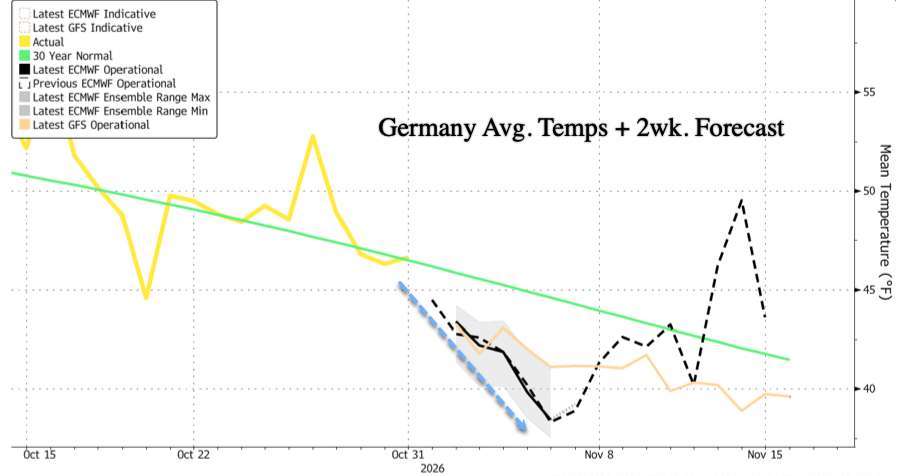
European benchmark TTF prices have traded above €100/MWh, reflecting winter supply concerns and broader market tightness linked to geopolitical factors including disruptions in the Middle East.[6] This pricing environment underscores Europe's ongoing dependence on imported natural gas, with Germany as the continent's largest economy facing amplified exposure due to its industrial base and heating demand. Storage shortfalls could accelerate withdrawals, intensify competition for spot LNG cargoes against Asian buyers, and drive further price volatility—potentially straining manufacturing competitiveness and household costs.
Deeper connections emerge in policy debates: industry groups advocate supplementing the existing national gas reserve with supplier obligations to ensure adequate withdrawal capacity through winter's end, as current import pipelines and LNG may cover only about half of peak cold-day demand.[7] The situation also highlights structural shifts post-2022 crisis, where reliance on flexible but costly LNG has replaced more stable pipeline flows, leaving thinner buffers. While authorities downplay immediate risks, the combination of low inventories, early cold weather, and elevated prices signals the urgency of bolstering energy security through accelerated renewables, efficiency gains, and storage reforms to mitigate economic vulnerabilities across Europe.
[Energy Analyst]: Sub-target storage will likely amplify TTF price spikes and import competition during cold periods, pressuring policymakers to implement supplier obligations or expanded reserves to safeguard industrial output and affordability.
Sources (6)
- [1]Germany Misses Gas Storage Target as Cold Snap Sets In(https://www.bloomberg.com/news/articles/2026-11-01/germany-misses-gas-storage-target-as-cold-snap-sets-in)
- [2]Ministry insists gas supply is secure as Germany misses storage target(https://dpa-international.com/economics/urn:newsml:dpa.com:20090101:261101-930-927407/)
- [3]Germany Enters Heating Season With Gas Storage 61.2% Full(https://www.tokenpost.com/news/regulation/46248)
- [4]Aktuelle Lage Gasversorgung - Bundesnetzagentur(http://www.bundesnetzagentur.de/DE/Gasversorgung/aktuelle_gasversorgung/_svg/Gasspeicher_Fuellstand/Speicherfuellstand.html)
- [5]Germany Gas Storage Levels Today(https://energyriskiq.com/gas-storage-levels-germany)
- [6]Changing conditions in the natural gas market call for action to prepare for winter - FNB Gas(https://fnb-gas.de/en/news/changing-conditions-in-the-natural-gas-market-call-for-action-to-prepare-for-winter/)