Second Screwworm Detection in Texas Reveals Deepening Vulnerabilities in Beef Supply Chain and Food Inflation Pressures
Confirmation of a second New World screwworm case in Texas, amid a 75-year low in U.S. cattle herds and record beef prices, underscores direct links between livestock disease, supply chain disruptions, food inflation, and household economic security.
The U.S. Department of Agriculture has confirmed a second case of New World screwworm (NWS) in a one-month-old calf in Zavala County, Texas, located just 5.6 miles from the initial detection earlier this week. This parasitic fly, eradicated from the United States in the 1960s through a successful sterile insect technique program, has larvae that burrow into living flesh of warm-blooded animals, causing severe tissue damage, economic losses, and potential production disruptions in livestock. Both cases remain within an established movement control zone where enhanced surveillance and sterile insect releases are underway, with nearby tests so far returning negative.
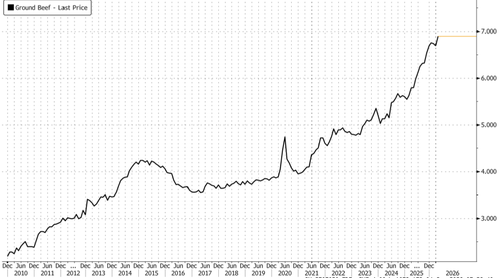
While officials emphasize containment for now, the detections arrive at a precarious moment for the U.S. cattle industry. The national cattle herd stands at its lowest level since 1951, with roughly 86 million head, the result of prolonged drought, high feed costs, and delayed rebuilding cycles. This historic low has already driven beef prices to record highs, squeezing meatpackers and elevating costs throughout the supply chain. A potential broader outbreak in Texas—which accounts for 14% of the U.S. cattle herd, 15% of feeder cattle, and 22% of cattle on feed—could exacerbate these pressures, leading to further herd reductions, elevated veterinary and biosecurity costs, and tighter interstate cattle movements.
Analyses suggest that unchecked spread would intensify the multi-year cattle downcycle, reduce packer profitability, and prompt consumer demand shifts toward cheaper proteins like chicken, particularly ahead of peak summer grilling season. These dynamics reveal a concrete biological-economic vulnerability rarely emphasized in standard policy discussions: livestock pests do not exist in isolation but cascade directly into household food budgets. With beef already contributing significantly to food inflation, additional supply shocks from NWS could translate into sustained higher grocery prices, reduced food security for lower-income families, and greater reliance on imported beef from regions like South America currently free of the parasite.
The USDA, working alongside Texas officials, stresses that the U.S. food supply remains safe, as screwworms do not infest processed meat and rigorous inspections prevent contaminated products from reaching consumers. However, the episode highlights systemic risks in concentrated agricultural systems where a single pathogen can amplify existing fragilities—from historic herd liquidation to climate-induced vulnerabilities—ultimately landing as higher costs at the dinner table. Heightened biosecurity surveillance and movement controls represent the base-case response, yet the incident serves as a reminder that seemingly fringe biological threats can become meaningful drivers of macroeconomic pressures on everyday Americans.
LIMINAL: Even limited screwworm detections will compound existing cattle shortages and biosecurity costs, driving beef prices higher and directly increasing household food expenses while exposing overlooked connections between biological threats and inflationary pressures.
Sources (5)
- [1]USDA Confirms Presence of New World Screwworm in the United States(https://www.aphis.usda.gov/news/agency-announcements/usda-confirms-presence-new-world-screwworm-united-states)
- [2]New World screwworm detected in 2nd cow in Texas, USDA confirms(https://abcnews.com/US/usda-confirms-detection-new-world-screwworm-texas/story?id=133576447)
- [3]Why the U.S. cattle herd is at a 75-year low — and what it means for beef prices(https://www.npr.org/2026/05/29/nx-s1-5719511/beef-cattle-herd-food-prices)
- [4]USDA confirms second screwworm case in Texas(https://www.yahoo.com/news/science/articles/second-case-screwworm-parasite-confirmed-235509833.html)
- [5]How Flesh-Eating Screwworms in Cattle Could Raise U.S. Beef Prices(https://www.agriculture.com/partners-how-flesh-eating-screwworms-in-cattle-could-raise-u-s-beef-prices-11990736)