MANPADS Persistence Exposes Rotary-Wing Survivability Crisis: Air Force IRCM Upgrade Request Reveals Systemic EW Modernization Failure
The Air Force's push to integrate CIRCM or DAIRCM on HH-60W helicopters reveals chronic gaps in rotary-wing defenses against proliferating MANPADS, underscoring broader delays in EW modernization and the unsuitability of current CSAR platforms for peer conflict.
The U.S. Air Force's recent Sources Sought notice for integration of advanced infrared countermeasures on the HH-60W Jolly Green II is far more than a routine procurement request. It is a stark admission that even the service's premier combat search-and-rescue platform remains critically exposed to one of the most proliferated and effective threats in modern warfare: man-portable air-defense systems (MANPADS). While the Defense News report accurately captures the notice's language warning that the absence of an Advanced Infrared Countermeasures (AIRCM) system 'significantly increases the risk of infrared-guided missile engagement,' it understates the deeper institutional and doctrinal failures this request illuminates.
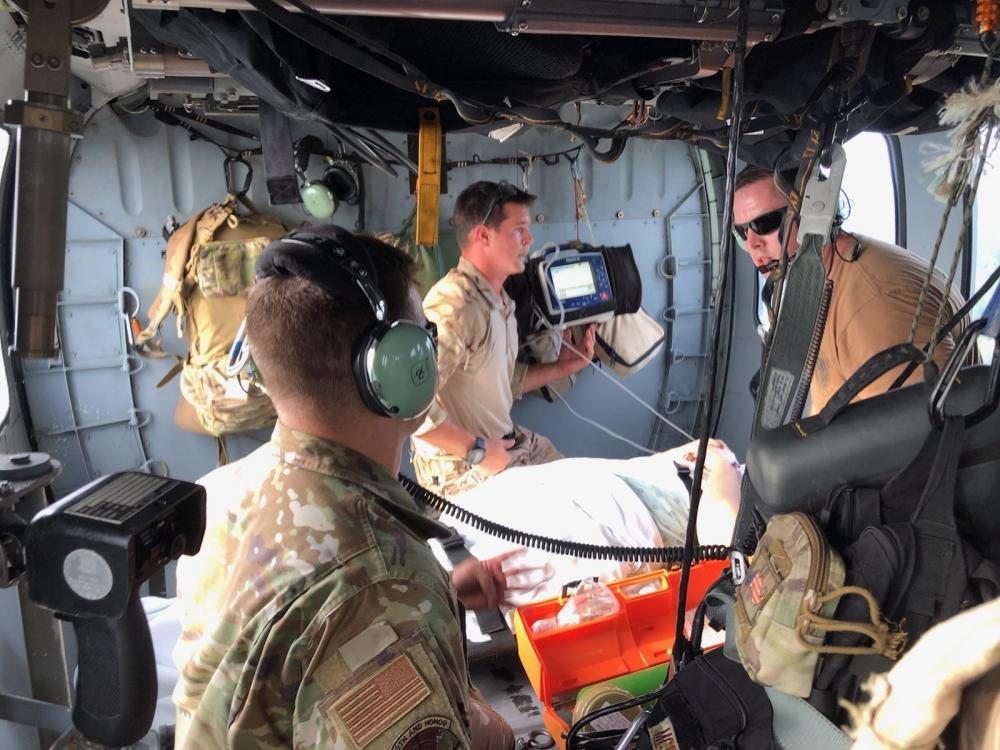
Recent operational history makes the gap impossible to ignore. During the high-profile recovery of two downed F-15E pilots over Iran, an HH-60W sustained multiple small-arms hits, wounding crew members. That the aircraft survived at all likely owed more to Iranian forces' limited access to advanced MANPADS variants than to the platform's organic defenses. The HH-60W currently relies on basic chaff/flare dispensers and warning receivers—technologies that have proven increasingly ineffective against dual-band infrared seekers and sophisticated counter-countermeasure algorithms now fielded by Russia, China, and their proxies.
This vulnerability is not new. What the original coverage missed is the direct lineage to repeated combat lessons stretching from the Soviet experience in Afghanistan through U.S. operations in Iraq, where MANPADS and rocket-propelled grenades accounted for the majority of rotary-wing losses. A 2023 GAO assessment (GAO-23-105389) on aircraft survivability equipment highlighted that legacy DIRCM systems fielded in the early 2000s were never properly scaled to the rotary-wing fleet due to cost, weight, and integration challenges. The HH-60W program, which saw its procurement objective slashed from 113 to 75 aircraft precisely because Pentagon planners doubted its ability to survive against sophisticated adversaries, represents a continuation of this pattern rather than a break from it.
The two systems now sought for integration—Northrop Grumman's Common Infrared Countermeasures (CIRCM) using quantum cascade laser technology and Leonardo's Distributed Aperture Infrared Countermeasure (DAIRCM)—have existed in various stages of maturity for years. CIRCM achieved limited production decisions as far back as 2019 for special operations aircraft. Their absence from the HH-60W, which reached initial operational capability in 2022, points to broader systemic delays in electronic warfare modernization. These delays mirror problems seen across the joint force: the Navy's Next Generation Jammer program has faced repeated cost growth and schedule slips; Army efforts to equip UH-60 and AH-64 fleets with advanced EW suites have been hampered by fragmented requirements and funding instability. The Air Force's struggle to retrofit its newest CSAR platform is symptomatic of a Pentagon that continues to prioritize exquisite fifth-generation fighter capabilities while its support and rescue assets lag dangerously behind.
The operational implications extend beyond rescue missions. In any Taiwan contingency or high-intensity conflict against Russian forces in Europe, combat search-and-rescue in contested airspace would likely prove nearly impossible without comprehensive suppression of enemy air defenses (SEAD) and dedicated EW escort—an asset mix that does not currently exist in sufficient numbers. By highlighting the need for government-furnished CIRCM or DAIRCM integration without degrading the HH-60W's complex mission systems, the notice implicitly acknowledges that current avionics architecture was designed with permissive environments in mind. This represents a procurement philosophy failure identified in multiple RAND studies on rotorcraft survivability since 2015.
The reduction in planned HH-60W inventory itself was an early warning sign ignored by much of the defense press. Rather than treating the cut as an indicator of deeper survivability shortfalls against peer competitors, coverage largely framed it as a simple budget decision. What connects these dots is the uncomfortable reality that MANPADS proliferation—estimated at over 700,000 systems globally with advanced variants reaching non-state actors through Iranian and Russian channels—has outpaced Western countermeasures development and integration cycles.
Until the Pentagon treats rotary-wing EW as a core survivability requirement rather than a bolt-on capability, even its most sophisticated rescue platforms will remain liabilities in the very environments where their crews are most needed. The HH-60W upgrade effort, while necessary, arrives years late and risks becoming another underfunded retrofit program unless tied to a comprehensive Department-wide acceleration of directed infrared countermeasures fielding.
SENTINEL: Expect accelerated but fragmented integration timelines for CIRCM on HH-60W fleets through 2028, yet persistent gaps will constrain CSAR viability in any high-intensity Pacific or European scenario until a dedicated EW escort package is funded and fielded.
Sources (3)
- [1]US Air Force wants better infrared jammers for its combat rescue helicopters(https://www.defensenews.com/air-warfare/2026/04/20/us-air-force-wants-better-infrared-jammers-for-its-combat-rescue-helicopters/)
- [2]GAO-23-105389: DOD Aircraft Survivability Equipment(https://www.gao.gov/products/gao-23-105389)
- [3]RAND RR-A1880-1: Enhancing Rotorcraft Survivability in Contested Environments(https://www.rand.org/pubs/research_reports/RRA1880-1.html)