Strait of Hormuz Shutdown: Iran's Control Expansion Threatens Global Oil Supply and Economic Stability
Iran’s expanded control over the Strait of Hormuz has halted commercial shipping, clustering hundreds of vessels near Dubai and threatening 20% of global oil supply. This crisis risks driving oil prices above $100/barrel, fueling inflation, while U.S. efforts to secure passage falter amid heightened tensions and historical parallels to the Tanker War.
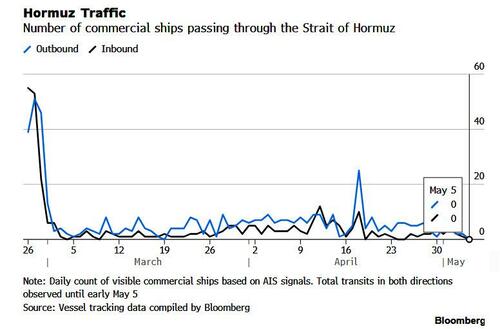
The Strait of Hormuz, a critical artery for global oil trade, has become a geopolitical flashpoint as Iran expands its control over the waterway, effectively halting commercial shipping traffic. According to recent satellite imagery and maritime tracking data, no new commercial crossings were recorded on Tuesday following violent clashes, including missile strikes on the UAE and attacks on vessels. This development, coupled with Iran’s Islamic Revolutionary Guard Corps (IRGC) unveiling a map of an expanded control zone around Hormuz, signals a deepening crisis that could disrupt up to 20% of the world’s oil supply, a figure underscored by the U.S. Energy Information Administration (EIA) in its 2022 report on global chokepoints.
Beyond the immediate halt in traffic reported by Bloomberg, the broader implications of Iran’s actions reveal a pattern of strategic escalation. The clustering of over 360 ships near Dubai, just outside Iran’s newly claimed zone, indicates a deliberate avoidance of confrontation but also a bottleneck that could exacerbate supply chain delays. This is not merely a regional standoff; it mirrors historical tensions, such as the 1980s Tanker War, where Iran and Iraq targeted oil vessels in the Gulf, leading to significant price volatility. The current situation, however, is complicated by modern factors like AIS (Automatic Identification System) spoofing, which obscures real-time tracking and raises the risk of miscalculation or unintended escalation.
What the original coverage misses is the deeper economic ripple effect. A sustained closure of Hormuz could drive Brent crude prices above $100 per barrel, as warned by the International Energy Agency (IEA) in its 2023 risk assessment, directly impacting inflation rates in oil-dependent economies like the EU and India. This is particularly concerning given the fragility of global markets post-COVID-19 recovery, where energy price shocks could undermine central banks’ efforts to stabilize inflation. Additionally, the original report underplays the strategic intent behind Iran’s ‘dark posture’ at Kharg Island and rerouting of oil via Indonesia’s Lombok Strait, a move that suggests Tehran is preparing for prolonged sanctions evasion and potential naval blockades by the U.S. and its allies.
The U.S. response, under 'Project Freedom,' appears misaligned with the ground reality. While two U.S. destroyers have entered the Gulf and escorted select vessels, the lack of broader commercial confidence in safe passage—evidenced by zero transits on Tuesday—highlights a failure to deter Iran’s influence or reassure markets. This echoes past missteps, such as the limited effectiveness of Operation Earnest Will during the Tanker War, where U.S. naval escorts could not fully prevent attacks. Iran’s warning against U.S. forces approaching Hormuz further complicates the calculus, raising the specter of direct military confrontation at a time when diplomatic channels remain strained post-2022 JCPOA collapse.
Synthesizing multiple sources, including the EIA’s analysis of Hormuz as a chokepoint and the IEA’s warnings on price volatility, alongside real-time maritime data from Windward, it’s clear that this crisis extends beyond a localized shipping halt. Iran’s actions are a calculated bid to leverage its geographic advantage, potentially as a response to tightened sanctions or as a signal to regional rivals like Saudi Arabia and the UAE. The clustering near Dubai also suggests a possible shift in trade patterns, with the UAE positioning itself as a temporary safe haven, though this raises questions about long-term sustainability given limited anchorage capacity and rising tensions after the Fujairah attack.
Ultimately, the Hormuz shutdown is a microcosm of broader geopolitical risks, where energy security, economic stability, and military posturing collide. The international community must weigh the costs of inaction against the risks of escalation, as a prolonged closure could reshape global energy markets and test the resilience of an already fragile world economy.
MERIDIAN: A prolonged Hormuz closure could push oil prices past $100/barrel within months, straining global economies already battling inflation. Diplomatic de-escalation or alternative shipping routes may be critical to avert a broader energy crisis.
Sources (3)
- [1]Hormuz 'Deserted' As Iran Expands Area Of Control; Hundreds Of Ships Cluster Near Dubai(https://www.zerohedge.com/energy/hormuz-deserted-iran-expands-area-control-ships-cluster-dubai)
- [2]World Oil Transit Chokepoints - U.S. Energy Information Administration (EIA)(https://www.eia.gov/international/analysis/special-topics/World_Oil_Transit_Chokepoints)
- [3]International Energy Agency (IEA) Oil Market Report 2023(https://www.iea.org/reports/oil-market-report)