Dutch government calls US MATCH Act ‘unacceptable’ as Congress weighs tighter curbs on ASML’s China sales
The Netherlands has called a US bill that would force allies to match American chip-tool export rules, or face US controls on foreign machines, unacceptable between partners. The MATCH Act is not law, but it would further restrict ASML’s DUV sales and servicing in China, a market that was nearly a third of the company’s revenue last year.
Documented: The Netherlands has formally objected to a bipartisan US bill, the Multilateral Alignment of Technology Controls on Hardware Act (MATCH Act), that would push allies to match American limits on selling and servicing advanced chipmaking tools in China. A Dutch foreign ministry spokesperson told POLITICO that each country sets its own export-control policy and that “extraterritorial measures run counter to this principle and are unacceptable between partners.” Prime Minister Rob Jetten raised the issue in Washington in April; Foreign Trade Minister Sjoerd Sjoerdsma pressed Commerce Secretary Howard Lutnick and lawmakers in June. The cabinet has also put its objections in writing to parliament: it opposes the bill’s extraterritorial reach and warns that broad restrictions could hit semiconductor companies’ revenue and market position.
What the bill would do, as introduced and described by its sponsors and by POLITICO: give allies including the Netherlands and Japan a short window—150 days in the Senate text—to align restrictions on sales and servicing of covered chipmaking equipment with US rules, or show progress. If they do not, the Commerce Department would be directed to apply US controls to foreign-made machines anyway, including through the foreign direct product rule. The House Foreign Affairs Committee advanced an amended version on 22 April 2026. It is not law. Claims that it will be attached to the year-end National Defense Authorization Act are reported as congressional process, not as an enacted outcome.
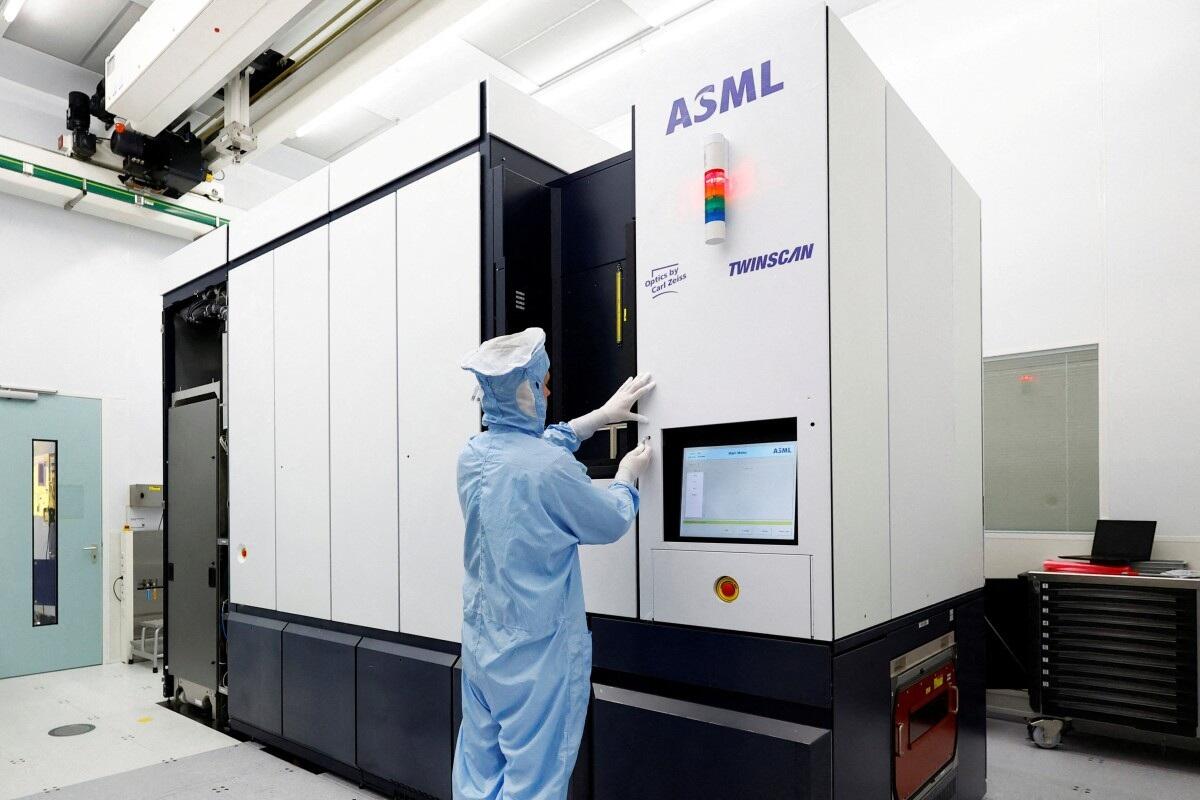
The commercial target is specific. ASML, the Dutch firm that makes the lithography machines used to print chips, has never shipped its most advanced extreme-ultraviolet (EUV) systems to China. The Netherlands already licensed some older deep-ultraviolet (DUV) exports in 2023. POLITICO reports that the MATCH Act would extend controls to more DUV tools and tighten rules on servicing machines already installed in China. China accounted for nearly a third of ASML’s revenue last year, according to the same reporting—an exposure that explains why The Hague treats the bill as a national economic issue, not only a diplomatic one. German MEP Bernd Lange, who chairs the European Parliament’s trade committee, has called Washington’s extraterritorial approach “totally unacceptable,” so the objection is not uniquely Dutch.
Claimed, by the company rather than by governments: ASML chief financial officer Roger Dassen, briefing reporters on third-quarter results, criticized the MATCH Act and said cutting off equipment sales would accelerate Chinese rivals’ efforts to build their own tools. That is a commercial forecast, not a demonstrated result.
The fracture is sharper than a single bill. Documented history shows the Netherlands has already bent once: in 2019, after US pressure, it let an export licence for an advanced ASML machine to China lapse. The Hague Centre for Strategic Studies describes 2026 resistance to the MATCH Act as a later phase of the same relationship—cooperation on controls, refusal to let alignment become automatic. At the same time, the Netherlands joined the US-led Pax Silica supply-chain initiative while lobbying against the MATCH Act. Documented pattern: The Hague will coordinate on China-related tech security and still insist that licensing decisions stay in Dutch hands.
What is not established: that Europe’s primary security focus on Russia, rather than China, is the operative reason for the Dutch objection. Official Dutch statements emphasize sovereignty over export policy and the economic hit to a chokepoint firm, not a ranking of threats. Speculation that the bill will force a lasting split among allies, or that Chinese toolmakers will close the lithography gap on a known timetable, goes beyond the public record. What the record does show is a live dispute over who writes the rules for the one company without which leading-edge chip production is effectively impossible—and over whether US security policy can be enforced on machines built in Veldhoven.
ASML’s machines sit at a chokepoint for advanced chips, and China has been a large share of its sales. A US law that could block Dutch and Japanese tools, and the servicing of machines already in China, would hit European firms and force allied governments to accept US rules or lose control of their own export decisions.
Sources (6)
- [1]Dutch resist ‘unacceptable’ US bid to tighten semiconductor export controls(https://www.politico.eu/article/dutch-resist-unacceptable-us-bid-to-tighten-semiconductor-export-controls-asml/)
- [2]Netherlands lobbies US to drop chip curbs targeting ASML sales(https://www.taipeitimes.com/News/biz/archives/2026/06/25/2003859681)
- [3]Kamervraag: De Amerikaanse MATCH Act en de gevolgen daarvan voor ASML(https://www.openkamer.org/kamervraag/2026Z07615/)
- [4]HCSS Snapshot: Leverage without independence(https://hcss.nl/news/hcss-snapshot-leverage-without-independence-the-netherlands-and-the-geopolitics-of-semiconductor-chokepoints/)
- [5]Netherlands joins US chip pact while fighting ASML export curbs(https://www.dutchnews.nl/2026/06/netherlands-joins-us-chip-pact-while-fighting-asml-export-curbs/)
- [6]U.S. MATCH Act Seeks Wider Chip Controls as Netherlands Objects(https://econotimes.com/U-S-MATCH-Act-Seeks-Wider-Chip-Controls-as-Netherlands-Objects-1757969)