U.S. Fertility Shift: Women Over 40 Surpass Teens in Births Amid Delayed Adulthood
CDC-validated reversal in U.S. birth timing underscores education, economics, and housing as primary drivers of later parenthood, with lasting implications for demographics and policy.
For the first time in U.S. history, births to women age 40 and older have edged out those to teenagers, according to 2023 CDC data showing 4.1% of births to older mothers versus 4.0% to teens. This milestone reflects a decades-long reversal: the share of births to women 40+ has more than tripled since 1990, while teen births have plummeted over 70%. Provisional and final data through 2024-2025 indicate the trend persists, with fertility rates for women 40-44 rising sharply even as overall births decline.
CDC reports confirm the average age of first-time mothers reached a record 27.5 years in 2023, up from 26.6 in 2016 and far higher than the 21-year average in 1972. This delay ties directly to extended education and career-building: women with bachelor's degrees or higher have median first-birth ages around 31, compared to 20 for those without high school completion. High housing costs and urban living further postpone family formation, with metropolitan areas showing the highest maternal ages.
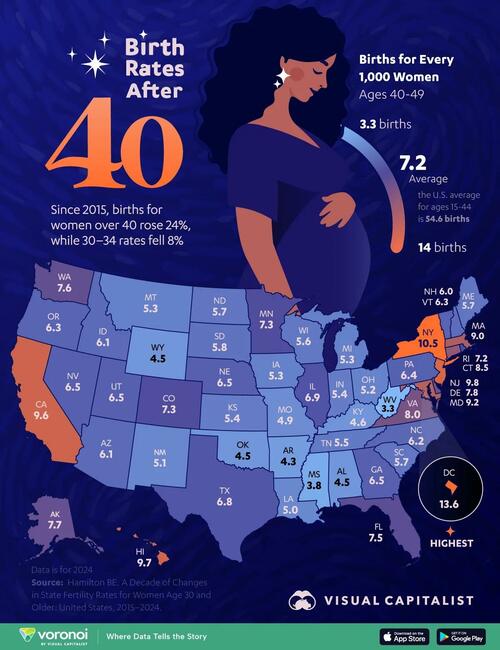
State-level patterns reveal concentrations in high-education, high-cost regions like the District of Columbia (highest rates), New York, New Jersey, and California, while Southern states lag but still show double-digit growth since 2015. Broader economic pressures—student debt, delayed homeownership, and dual-career norms—amplify the shift, producing a visible cohort of older parents with greater resources but raising questions about workforce, housing, and eldercare timelines.
These changes signal a structural reconfiguration of American family formation, where milestones once compressed into the early 20s now span into the 30s and beyond, driven by credentialism and economic realities rather than isolated cultural preferences.
[Demographer]: This timing reversal will accelerate demands for family-support policies in high-cost metros while reshaping labor markets and eldercare systems as the median parental age climbs steadily.
Sources (5)
- [1]CDC: More babies now born to women over 40 than teens(https://www.wane.com/news/local-news/more-babies-now-born-to-women-over-40-than-teens-cdc-says/)
- [2]Trends in Mean Age of Mothers in the United States, 2016 to 2023(https://www.cdc.gov/nchs/data/nvsr/nvsr74/nvsr74-09.pdf)
- [3]More women over 40 are having children than ever before(https://www.investigatetv.com/2026/02/25/more-women-over-40-are-having-children-than-ever-before/)
- [4]Women Over 40 Are Now Having More Babies Than U.S. Teenagers(https://www.visualcapitalist.com/women-over-40-are-now-having-more-babies-than-u-s-teenagers/)
- [5]More Babies Born to Moms 40+ Than Teens For First Time(https://www.thebump.com/news/more-births-to-women-over-40-than-teens)