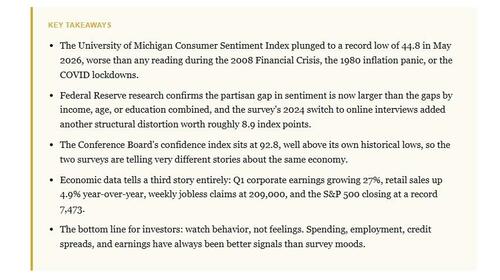
University of Michigan Consumer Sentiment Index at 44.8 Diverges from 2.7% GDP Growth and 4.3% Unemployment
The Michigan index records its lowest reading since 1952 while output, earnings, and claims data remain expansionary. The split traces directly to partisan reallocation at the 2025 inauguration rather than to aggregate transaction flows. Official statistics and survey responses therefore measure different margins of the same economy.
The index has remained below 70 since 2022, a range previously observed only during the 2008 crisis and 1980 inflation peak. Retail sales rose 0.5% in April and stand 4.9% above year-ago levels, while S&P 500 earnings beat estimates by 20.7% with an 84% positive surprise rate. The Atlanta Fed GDPNow model tracked 4.3% annualized growth for Q2 as of May 21. These aggregates have moved in alignment with one another but not with the sentiment series.
The divergence widened after the January 2025 administration transition. Republican responses rose from 67 to 93 within two months while Democratic responses fell from 78 to 56, reproducing the same X-pattern observed in January 2021. Independent responses remained stable. The survey therefore registers administration changes more than changes in reported spending or employment.
Labor-market and expenditure data continue to track each other without recessionary signals. The prior therefore rests with the five coincident indicators rather than the single survey. The gap measures how respondents weight political outcomes against their own transaction records.
Sustained GDP growth above 2% with unemployment below 5% will test whether the index reverts toward historical norms or remains anchored by partisan response patterns through the next two quarters.
BLS: Unemployment rate will remain below 4.5% through December 2025 unless initial claims exceed 250,000 for four consecutive weeks.
Sources (3)
- [1]University of Michigan Surveys of Consumers(https://data.sca.isr.umich.edu/)
- [2]Bureau of Economic Analysis GDP Release(https://www.bea.gov/data/gdp/gross-domestic-product)
- [3]Bureau of Labor Statistics Employment Situation(https://www.bls.gov/news.release/empsit.nr0.htm)