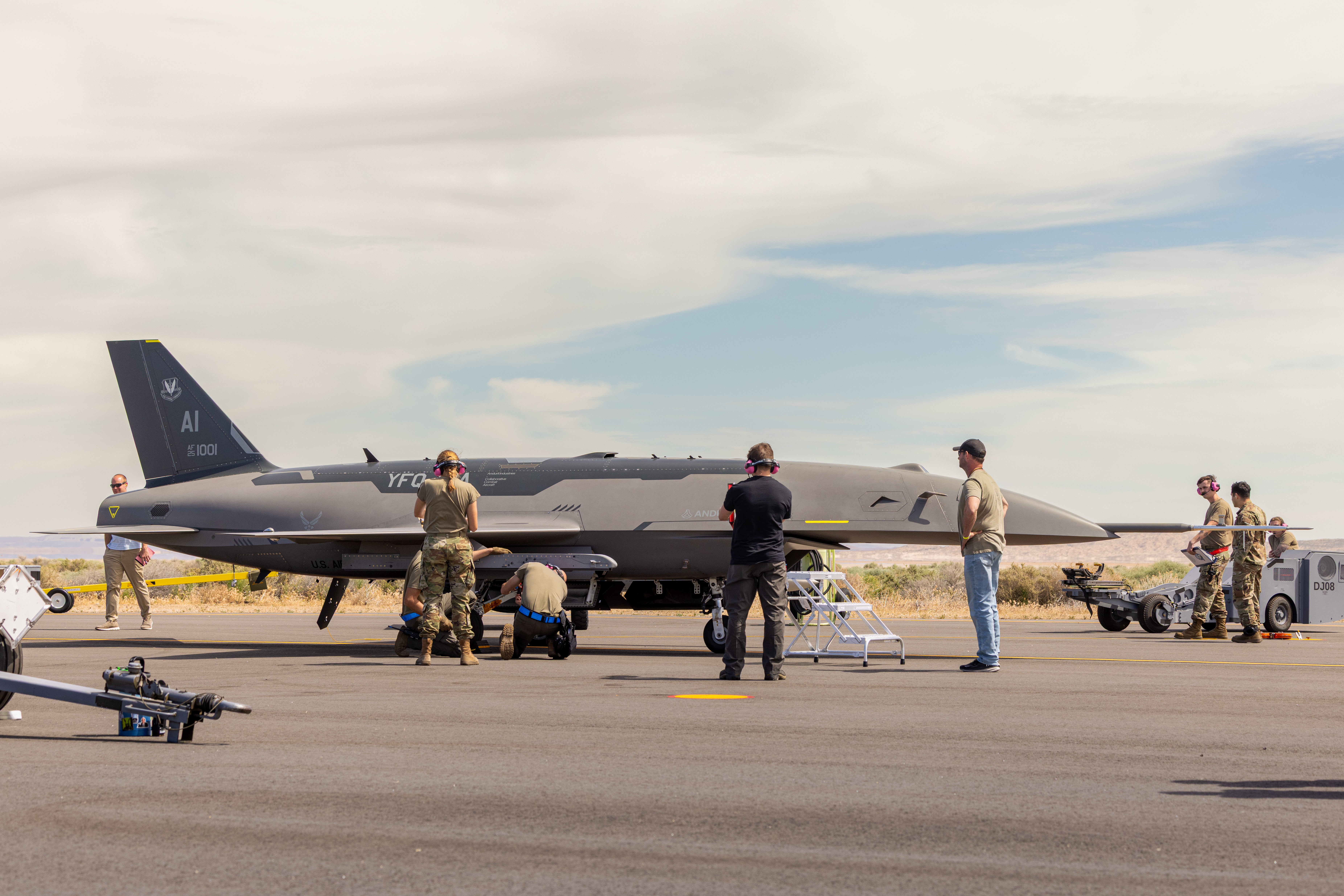
Anduril's Autonomous Drone Milestone: The Unspoken Threshold to AI Lethality
Anduril's YFQ-44A test advances lethal AI autonomy in U.S. airpower but masks profound ethical accountability gaps, escalation risks with China, and the normalization of machines in kill decisions—issues largely ignored in operational-focused coverage.
The U.S. Air Force's recent hands-on testing of Anduril's YFQ-44A at Edwards Air Force Base marks far more than a successful demonstration of the Collaborative Combat Aircraft (CCA) program. While the Defense News coverage focuses on operational details—ruggedized laptops replacing fixed control stations, small crews performing rapid turns after minimal training, and the shift away from traditional stick-and-throttle piloting—it fundamentally understates the strategic and ethical inflection point now being crossed. This was not merely an experiment in maintainability or acquisition reform under the new Warfighting Acquisition System. It represents a concrete step toward normalizing semiautonomous systems capable of independent lethal decision-making in contested airspace.
The original reporting misses critical context. By framing the test as an efficiency success and operator-centric feedback loop, it glosses over the expanding autonomy envelope. Anduril's own October 2025 release and subsequent statements indicate the YFQ-44A is designed for strike missions, target prosecution, and loyal wingman operations alongside F-35s and next-generation fighters. 'Semiautonomous' here increasingly means AI handling dynamic routing, threat prioritization, and weapons employment with human oversight that is supervisory rather than direct. This mirrors patterns seen in DARPA's ACE program and the earlier Skyborg efforts, yet mainstream coverage rarely connects these dots.
Synthesizing the Defense News dispatch with the Center for a New American Security's 2025 report on 'Attritable Autonomous Systems' and a concurrent RAND Corporation assessment of CCA integration challenges reveals a clearer picture. CNAS highlights how such platforms lower the cost of massed aerial attrition warfare, enabling swarms that could overwhelm Chinese air defenses in a Taiwan contingency. RAND, however, flags persistent vulnerabilities in AI perception systems and the brittle nature of autonomous identification in complex electromagnetic environments—issues barely acknowledged in triumphalist Pentagon releases. The Air Force's goal of acquiring at least 1,000 CCAs is not simply force multiplication; it signals a doctrinal shift toward expendable, AI-enabled fleets that change the risk calculus for commanders.
What remains dangerously underexamined is the ethical and strategic blowback. Lethal autonomous weapons systems (LAWS) erode the human accountability chain that has, however imperfectly, governed use-of-force decisions since 1945. If an AI-driven YFQ-44A misidentifies a civilian signal or escalates based on flawed pattern recognition, responsibility diffuses across programmers, commanders, and policymakers. This development fits a broader global pattern: China's progress with its own loyal wingman programs (notably the GJ-11 Sharp Sword derivatives) and Russia's Lancet drone evolution demonstrate that strategic competitors are not waiting for international norms. Discussions at the UN Convention on Certain Conventional Weapons have stalled for years, with the United States resisting meaningful restraints.
The limited mainstream scrutiny is itself a strategic failure. Defense industry reporting tends to celebrate rapid prototyping and 'operator-driven experimentation' while ignoring second-order effects: lowered thresholds for conflict due to reduced pilot risk, arms-race dynamics that incentivize preemptive AI deployment, and the potential for flash escalations when autonomous systems interact unpredictably across adversarial networks. The test at Edwards, executed with just days of maintainer training, proves the technology is maturing faster than the doctrine, law, or public discourse needed to govern it.
This is not Luddite resistance to innovation. It is recognition that the quiet normalization of AI in lethal loops—celebrated here as acquisition agility—fundamentally transforms warfare. Without rigorous public examination of kill-chain delegation, escalation safeguards, and verification protocols, the United States risks locking itself and its adversaries into a destabilizing new equilibrium where speed and autonomy trump human judgment. The YFQ-44A's successful sorties should serve as a wake-up call, not just another procurement milestone.
SENTINEL: Anduril's test accelerates deployment of AI-enabled lethal wingmen by 2028, but the absence of robust human oversight protocols risks rapid escalation spirals with China, where autonomous swarms could trigger unintended conflict before decision-makers intervene.
Sources (3)
- [1]Air Force unit executes test of Anduril’s semiautonomous combat drone(https://www.defensenews.com/industry/techwatch/2026/04/17/air-force-unit-executes-test-of-andurils-semiautonomous-combat-drone/)
- [2]Attritable Autonomous Systems and the Future of Air Power(https://www.cnas.org/publications/reports/attritable-autonomous-systems)
- [3]Collaborative Combat Aircraft: Risks and Integration Challenges(https://www.rand.org/pubs/research_reports/RRA1890-1.html)