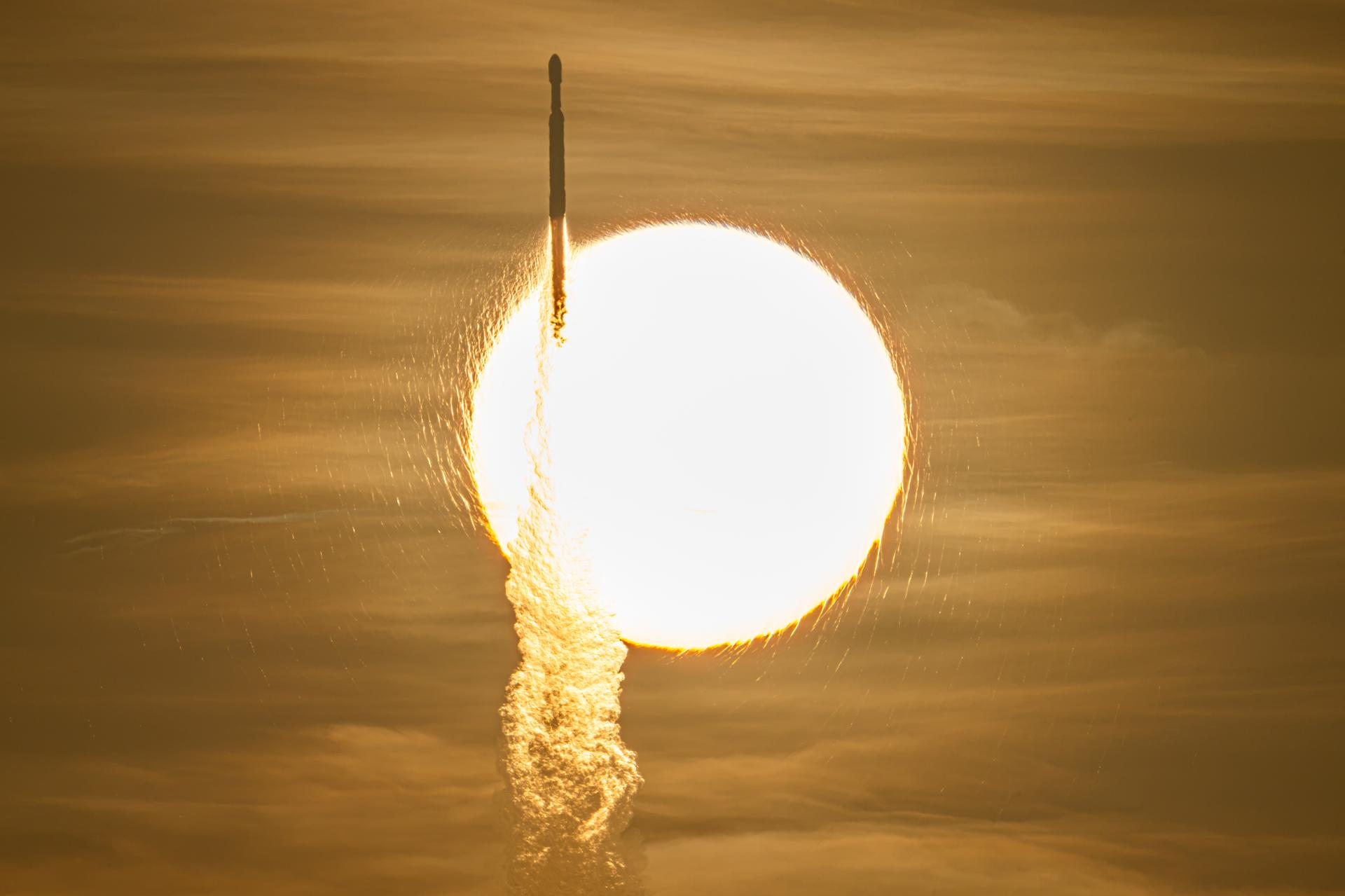
Roman Space Telescope Launches on Falcon Heavy, Begins L2 Commissioning for Dark Energy Surveys
The Roman launch marks the start of a wide-field infrared survey mission optimized for dark energy and exoplanet demographics. Its 300-megapixel camera and stable optics enable rapid mapping that complements existing facilities. Commissioning and early science operations will determine whether the observatory meets its 1 percent dark energy precision target within the first two years.
The observatory separated from the rocket 31 minutes after liftoff, with solar arrays and sun shade deployed within 83 minutes. Ground teams at Goddard confirmed initial telemetry via the Near Space Network before handover to the Deep Space Network for the million-mile journey. The 2.4-meter telescope carries a coronagraph technology demonstrator and the primary infrared camera designed for 0.28 square degree fields, enabling surveys 1000 times faster than Hubble.
Roman's core program targets weak lensing and baryon acoustic oscillations across 2000 square degrees to constrain dark energy equation-of-state parameters to 1 percent precision, while its microlensing survey will detect thousands of exoplanets down to Earth mass. This dual focus directly addresses the 2020 decadal survey priority for a wide-field infrared mission. The design also mitigates systematic errors in supernova cosmology by providing simultaneous multi-band photometry and grism spectroscopy.
Unlike earlier coverage that emphasized schedule and budget success, the mission's real leverage lies in its stable pointing and large-format detectors that reduce cosmic variance in large-scale structure measurements. Integration with Euclid and Rubin data will allow cross-calibration of photometric redshifts, tightening constraints on modified gravity models. The coronagraph's first-light Jupiter analogs will validate wavefront control needed for the Habitable Worlds Observatory.
Over the next 18 months, the team will complete instrument checkout, wavefront sensing, and the first reference survey fields before beginning the High-Latitude Wide Area Survey in 2027. Early data releases are planned at six and twelve months post-launch to enable community pipeline validation.
Roman team: First wide-field reference images released within 9 months; survey speed exceeds 1000 deg^{2}/month by month 18 post-launch.
Sources (2)
- [1]Primary Source(https://www.nasa.gov/news-release/nasas-dark-universe-seeking-nancy-grace-roman-space-telescope-launches/)
- [2]Supporting Source(https://www.stsci.edu/roman)