Aschenbrenner’s Situational Awareness tells investors it lost 65% in the third quarter after a summer near-collapse
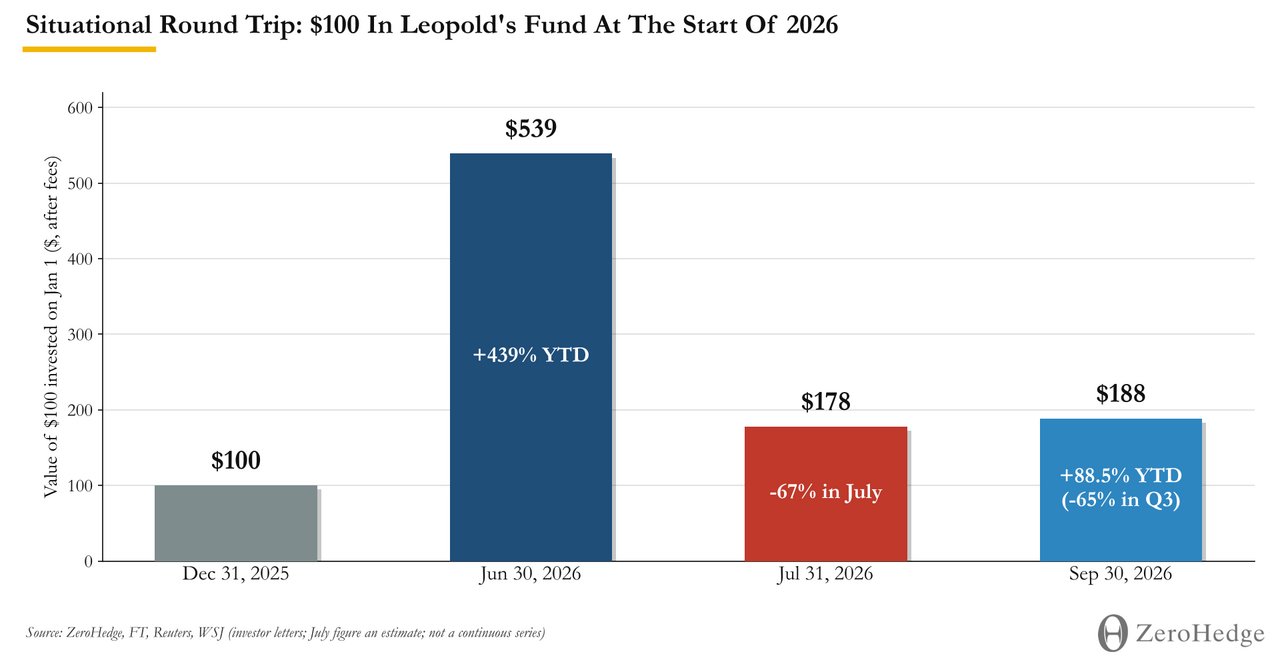
Situational Awareness reported a 65% third-quarter loss after fees while remaining up 88.5% for 2026 through September, a figure that mostly reflects a 67% July drawdown and a forced sale of its public book to Citadel after levered AI bets nearly impaired the fund.
Documented: Leopold Aschenbrenner’s Situational Awareness hedge fund told investors it lost 65% after fees in the third quarter of 2026, according to an investor letter seen by The Wall Street Journal and reported by Bloomberg and Reuters. The same letter said the fund was still up 88.5% after fees for the year through September, and that current opportunities “are the highest potential return we have seen in the lifetime of the fund.” Reuters said it could not immediately verify the letter and that the firm did not immediately comment.
Documented, and the part that makes the year-to-date figure misleading: the third-quarter loss is largely the summer unwind already on the record. In a July 31 letter reviewed by Reuters and first described by the Journal, the fund said its portfolio fell 67% in July after steep losses on AI stocks, that it had come “closer to permanent capital impairment than is acceptable,” and that “we let you down this month.” Even after that month it was still up about 80% for 2026, because earlier gains had been so large. A letter earlier in July, reported by the Financial Times and cited by MarketWatch, put the first-half gain at 439%. A stylized path from those reported figures—roughly quintupling by the end of June, then losing about two-thirds in July—lands near the later year-to-date numbers. That arithmetic is a reconstruction from published letters, not a figure the fund itself published as a single series.
Documented mechanism: this was not a quiet mark-to-market dip. In late July the fund sold the bulk of its public stock portfolio to Ken Griffin’s Citadel after margin pressure from lenders, and Aschenbrenner told investors leverage had been removed and shorts closed. Bloomberg, summarizing the Journal, described highly levered bets on AI-linked firms that nearly led to the fund’s implosion, and reported his new line: “Volatility, yes; existential risk, even if we are totally wrong, never.” The Journal also reported that he expects to restart shorting and may use borrowed money again, at lower levels than before. After Anthropic’s IPO, the letter put the book at about 70% publicly traded stocks and 30% private positions, with the firm “highly bullish” on Anthropic at the offering price while allowing it might rebalance away from that stake.
Claimed, not independently demonstrated: that today’s setup is the highest-return opportunity in the fund’s life, and that the lesson has been fully absorbed into a more resilient book. Those are the manager’s statements in a letter seen by one newspaper. The fund did not, in the reporting available, publish a full audited bridge from the July letter’s “up 80%” to September’s “up 88.5%,” so August and September performance is inferred rather than stated.
Speculated, and not established by the letters: that the AI trade as a whole has been exposed as a bubble, or that later price moves in names the fund once held prove the thesis false. What is documented is narrower and sharper. A fund built on a public AGI-infrastructure thesis, run by a former OpenAI researcher with no prior professional investing record, used leverage to turn a crowded theme into one of the fastest asset ramps in recent hedge-fund history—and then had to hand the public book to a larger firm to survive a few weeks of adverse prices. The year-to-date gain that remains is real on the fund’s own accounting as reported. It is also the residue of a round trip in which most of the spectacular first-half result was given back in a forced deleveraging. Investors who arrived after the 439% print, including any who added capital around the late-July invitation to new money, did not own that earlier gain. They owned the drawdown and the tax and liquidity consequences of a sale made under margin pressure.
The disconnect is not between “AI is fake” and “AI is real.” It is between a narrative of inevitable compounding and a balance sheet that could not sit through a correction. The letter’s contrition—“how merciless the market is”—and its simultaneous buy signal sit in the same document. Both can be true as statements of intent. Only the loss, the Citadel sale, and the removal of leverage are facts about what the market already did.
Limited partners in one of the most visible AI-themed hedge funds absorbed a near-wipeout of a spectacular first-half gain when leverage turned a stock selloff into a forced sale to Citadel. The episode shows how quickly borrowed exposure to the AI supply chain can impair capital even when the manager’s year-to-date number still looks strong.
Sources (6)
- [1]Aschenbrenner’s Situational Awareness Tells Investors It Lost 65% in Third Quarter(https://www.wsj.com/finance/investing/aschenbrenners-situational-awareness-tells-investors-it-lost-65-in-third-quarter-de8e9797)
- [2]Situational Awareness Lost 65% in Wild Third Quarter, Report Says(https://www.bloomberg.com/news/articles/2026-11-26/situational-awareness-ai-65-hedge-fund-third-quarter-wsj-says)
- [3]Situational Awareness lost 65% after fees in third quarter, WSJ reports(https://www.reuters.com/legal/transactional/situational-awareness-lost-65-after-fees-third-quarter-wsj-reports-2026-11-26/)
- [4]Situational Awareness' portfolio sinks 67% in July on AI stock rout, letter shows(https://www.reuters.com/business/finance/situational-awareness-portfolio-sinks-67-july-ai-stock-rout-letter-shows-2026-07-31/)
- [5]Situational Awareness Down 67% in July in AI Stock Rout(https://www.wsj.com/finance/investing/situational-awareness-down-67-in-july-in-ai-stock-rout-cd19901f)
- [6]Implosion of Situational Awareness has Wall Street betting the bottom is in for the AI trade(https://www.morningstar.com/news/marketwatch/20260730208/implosion-of-situational-awareness-has-wall-street-betting-the-bottom-is-in-for-the-ai-trade)