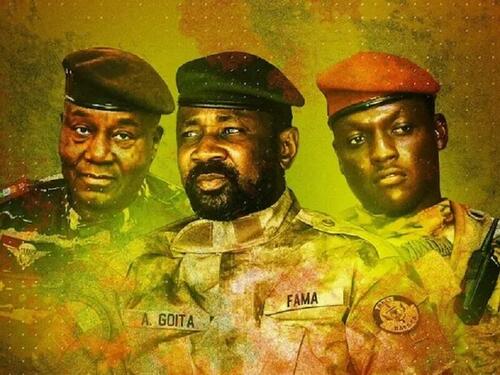
US-Nigeria ISIS Strike Signals Western Counteroffensive Against Anti-Western Sahel Alliance
US-Nigeria joint strikes on ISIS in the Lake Chad Basin, the second in six months, underscore a strategic push to counter the Russia-aligned AES (Mali-Burkina Faso-Niger) amid Mali's escalating crises, revealing underreported realignments in West African power structures where Nigeria emerges as a pivotal Western security partner.
The recent joint US-Nigerian operation that eliminated ISIS second-in-command Abu-Bilal al-Minuki in Nigeria's Lake Chad Basin is not merely another counterterrorism success. It represents a deliberate geopolitical signal amid rapidly shifting African alliances. Confirmed by President Trump and Nigerian President Bola Tinubu, this mission—conducted in an area linked to ISWAP and Boko Haram activities—marks the second major US strike in Nigeria in under six months, following coordinated Christmas 2025 airstrikes on ISIS targets in the northwest that killed multiple militants. These deepening security ties with Nigeria, a significant regional power and BRICS partner, come as the Alliance of Sahel States (AES)—Mali, Burkina Faso, and Niger—struggles with cascading jihadist offensives. Recent coordinated militant attacks in Mali in April 2026 displaced government and Russian-backed forces from key northeastern territories, killing the defense minister and exposing the limits of the juntas' pivot away from France toward Russia and other non-Western partners. Mainstream reporting on the ISIS strike has focused on tactical outcomes, yet the deeper unreported connections are clear: the AES's anti-Western posture, formed after successive coups and ECOWAS exits, has created a vacuum that groups like JNIM and ISIS are exploiting across porous borders. Nigeria's recent intimations of possible intervention in Mali, whether unilateral or with US intelligence and drone support from bases in Ghana or Cote d'Ivoire, could prove decisive. Transit challenges exist, but Niger—viewed as the AES's weakest link due to its border vulnerabilities—may face increasing pressure to break ranks. This episode highlights an overlooked dynamic: Western powers are leveraging established partners like Nigeria to contain the Sahelian bloc's expansion without direct confrontation, potentially fracturing the anti-French, Russia-aligned axis through a combination of counterterrorism cooperation and selective military signaling. As terrorist safe havens threaten to link across the region, these operations suggest behind-the-scenes diplomatic maneuvering to peel AES members back toward pragmatic security alignments with the West.
LIMINAL: US deepening of Nigeria ties will likely escalate to limited intervention support in Mali by late 2026, fracturing AES unity as Niger faces border pressures and considers realignment away from Russian influence.
Sources (5)
- [1]Senior IS leader killed in joint operation, US and Nigeria say(https://www.bbc.co.uk/news/articles/cy72p2kpd03o)
- [2]US and Nigerian forces 'eliminate' IS group senior leader in joint mission(https://www.france24.com/en/africa/20260516-us-and-nigerian-forces-eliminate-is-group-senior-leader-in-joint-mission)
- [3]The Dynamics Behind Trump's Decision to Bomb ISIS in Nigeria(https://www.cfr.org/articles/dynamics-behind-trumps-decision-bomb-isis-nigeria)
- [4]Militant Advances in Mali Threaten West Africa, Nigeria Warns(https://www.bloomberg.com/news/articles/2026-05-07/militant-advances-in-mali-threaten-west-africa-nigeria-warns)
- [5]Top Islamic State leader killed in Nigeria strike, Trump says(https://www.washingtonpost.com/world/2026/05/16/senior-isis-commander-killed-by-us-nigerian-forces-trump-says/)