Fermi's Leadership Exit: Early Signal of Structural Cracks in AI Infrastructure Boom or Manageable Growing Pains?
Fermi's CEO and CFO exits and 22% stock drop reveal deeper tensions between AI compute hype, slow nuclear deployment, grid constraints, and policy execution. Analysis connects the event to national security memoranda, IEA/EPRI demand forecasts, and historical infrastructure bubbles while presenting both optimistic analyst views and structural skepticism without endorsing either.
The abrupt departures of Fermi CEO Toby Neugebauer and CFO Miles Everson, disclosed in an SEC Form 8-K filing late Friday, triggered an immediate 22% share price collapse and raised fresh doubts about one of the highest-profile bets on AI-driven energy infrastructure. While the ZeroHedge reporting accurately chronicles the loss of a $150 million anchor tenant for Project Matador and the resulting tenant acquisition difficulties, it underplays the episode's connection to longer-term patterns in U.S. energy policy, nuclear deployment timelines, and the geopolitical stakes of compute capacity.
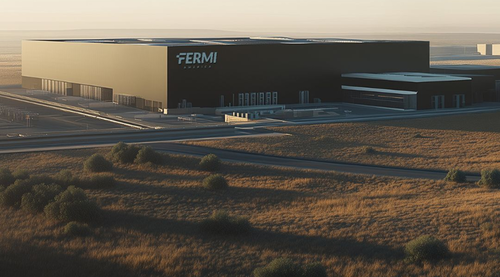
Project Matador was conceived as a flagship 11 GW hybrid natural-gas-to-nuclear campus in the Texas Panhandle, explicitly branded with former President Trump's name to signal alignment with deregulation-friendly energy abundance narratives. Fermi's REIT structure means tenant revenue is essential for shareholder distributions; repeated delays in signing hyperscalers therefore compound quickly. The board's three-month deliberation period noted in the Evercore ISI research note suggests internal recognition that customer friction exceeded normal project teething issues.
What much immediate coverage missed is the wider context of grid-scale electricity demand forecasts. A 2025 Lawrence Berkeley National Laboratory analysis projected U.S. data centers could consume 6-12% of national generation by 2030, while the International Energy Agency's 2025 Electricity Market Report documented data centers as the fastest-growing segment of global power demand. Fermi is not an isolated case: similar delays have appeared at other large-scale developments, including those backed by hyperscalers directly contracting with utilities in Virginia, Georgia, and the Midwest. The "prove-it-to-me" stance attributed to potential customers by Stifel analyst Stephen Gengaro reflects genuine skepticism about whether promised nuclear reactors can overcome Nuclear Regulatory Commission licensing timelines that historically average 5-7 years, even under streamlined rules proposed in recent energy legislation.
Synthesizing the Fermi 8-K, the Evercore ISI note of June 2026, and a concurrent Electric Power Research Institute (EPRI) assessment of AI-era load growth reveals multiple perspectives. Bullish analysts argue the creation of an interim co-presidency under Jacobo Ortiz Blanes and Anna Bofa, coupled with a shift of headquarters to Dallas, may remove perceived personality obstacles in negotiations and allow more standardized power purchase agreements. They note that natural gas turbines already permitted for initial phases provide a bridge until small modular reactors or additional large reactors come online.
Skeptical voices, however, situate Fermi's 69% post-IPO decline within repeated historical over-optimism cycles: the early-2010s shale investment boom, the 2021-2022 SPAC-driven clean-tech surge, and the 2023-2024 crypto mining capacity bubble all displayed comparable narratives of exponential demand outstripping executable infrastructure. From a policy lens, the episode highlights tension between stated bipartisan goals of AI technological primacy, articulated in the 2024 National Security Memorandum on Artificial Intelligence and subsequent executive actions, and the practical bottlenecks of transmission interconnection queues that currently exceed 2 TW nationwide according to FERC data.
Geopolitically, China's documented acceleration of both nuclear reactor approvals and dedicated AI data center clusters presents a contrasting model of state-directed infrastructure speed. U.S. developers must navigate fragmented regulatory jurisdictions, environmental litigation risks, and capital markets that have grown wary of negative free-cash-flow stories despite lofty AI revenue projections. Fermi's situation does not prove the entire sector thesis false, yet it underscores that sustained AI compute expansion cannot rest solely on hype; it requires synchronized progress across energy permitting reform, grid modernization, and credible offtake contracts. Whether the management transition ultimately de-risks tenant acquisition or merely postpones deeper reckoning remains an open question being tested in real time by hyperscaler procurement teams.
MERIDIAN: Fermi's management change may ease near-term customer talks, yet it spotlights how regulatory timelines for nuclear power and transmission continue to lag AI-driven demand forecasts, potentially forcing Washington to revisit energy permitting reforms if the U.S. wishes to maintain its compute advantage.
Sources (3)
- [1]Giant Data Center Developer Fermi Crashes 22% After CEO, CFO Abruptly Quit(https://www.zerohedge.com/markets/giant-data-center-developer-fermi-crashes-22-after-ceo-cfo-abruptly-quit)
- [2]Fermi Technologies Form 8-K(https://www.sec.gov/ix?doc=/Archives/edgar/data/0001964333/000119312526123456/d123456d8k.htm)
- [3]Lawrence Berkeley National Laboratory: 2025 Data Center Electricity Use Forecast(https://eta-publications.lbl.gov/sites/default/files/lbnl_data_centers_2025.pdf)