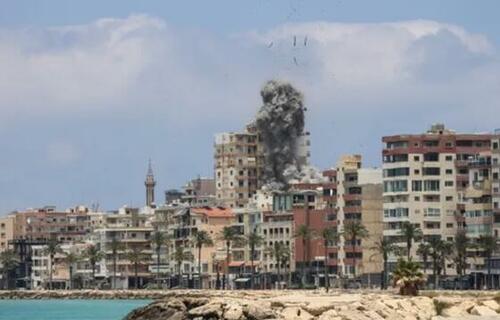
Middle East Re-Ignition: Israel-Lebanon Escalation Undermines Trump Iran Deal, Threatens Global Energy and Migration Stability
Israeli strikes on Tyre and southern Lebanon intensify despite Trump’s claims of an imminent Iran deal, exposing interconnected risks to global energy markets via Hormuz disruptions and potential new migration waves from a collapsing Lebanese economy. Credible reporting and economic analyses reveal a self-reinforcing escalation trap with underappreciated systemic leverage.
As Israeli airstrikes pound the southern Lebanese city of Tyre—killing at least eight people and wounding dozens more despite evacuation orders—the fragile regional architecture linking Lebanon, Iran, and Israel is fracturing once again. Al Jazeera reports repeated strikes on residential areas, a Palestinian refugee camp roundabout, and exit routes north of Tyre, with drones and artillery fire compounding civilian risks. This comes amid Iranian ballistic missile exchanges and Houthi ballistic attacks from Yemen, illustrating a multi-front escalation trap that Trump administration officials insist is days from resolution. President Trump has repeatedly claimed the US is in the "final throes" of an Iran deal that could be sealed in "two or three days," framing it as a comprehensive agreement that would stabilize Lebanon and reopen key shipping lanes. CBS News, NBC, and Al Jazeera coverage from June 9, 2026, confirm these statements, with Vice President JD Vance emphasizing that Washington will prioritize American interests even if Israel objects. Yet Reuters and BBC reporting reveal a pattern of broken ceasefires: Israeli strikes continued in southern Lebanon even after Netanyahu declared one front "contained," while Iran conditions any nuclear or sanctions relief on halting attacks in Lebanon. This disconnect reveals a deeper structural dynamic missed in headline coverage. The conflict's re-ignition functions as leverage over global systems. IMF analysis from earlier 2026 updates shows how disruptions in the Strait of Hormuz and attacks on energy infrastructure have already driven oil prices toward $100-120 per barrel, with scenarios of full escalation potentially reaching $150 and shaving global growth to 1.7%. The World Bank similarly forecasts a 16% surge in commodity prices for 2026 driven by energy volatility. Lebanon’s economic collapse—exacerbated by relentless strikes on infrastructure and displacement of thousands from Tyre and border villages—creates predictable secondary effects: renewed refugee flows. With Beirut’s southern suburbs and southern villages under pressure, and Hezbollah-Iranian coordination persisting, another wave of migration toward Europe becomes likely, echoing 2015-2016 patterns but now intertwined with energy shocks that weaken European economies' ability to absorb inflows. Official statements and Wikipedia's summary of the 2025-2026 US-Iran negotiations highlight Iran's insistence that any deal encompass Lebanon, creating a diplomatic knot where tactical Israeli operations against Hezbollah command centers undermine strategic US-Iran bargaining. The heterodox insight here is that these conflicts are not isolated flare-ups but calibrated pressure points: sustained instability in the Levant keeps energy prices elevated (benefiting certain Gulf and US producers while punishing importers), disrupts migration management, and prevents the kind of regional normalization that would reduce US military footprint. Trump’s rhetoric of swift resolution clashes with the on-the-ground reality of expanding evacuation zones and mounting death tolls reported by Lebanon’s health ministry and civil defense. Without addressing the interlocking incentives—Hezbollah’s resilience, Iran’s proxy network, Israel’s security imperatives, and global commodities exposure—the cycle of "final throes" announcements followed by fresh salvos appears destined to continue, with ordinary Lebanese civilians and distant energy consumers bearing the heaviest costs.
LIMINAL: Renewed Levant escalation traps Trump diplomacy in an energy-migration vise; sustained instability likely drives oil toward $150/barrel while displacing thousands more from Lebanon into EU-bound flows, revealing conflict as structural leverage over global systems rather than resolvable diplomatic sideshow.
Sources (7)
- [1]Israel kills 8 in southern Lebanon after issuing forced displacement order(https://www.aljazeera.com/news/2026/6/9/israel-kills-14-in-southern-lebanon-after-trading-fire-with-iran)
- [2]U.S. in the “final throes” of Iran deal, Trump says(https://www.nbcnews.com/video/u-s-in-the-final-throes-of-iran-deal-trump-says-264793157567)
- [3]Trump says Iran deal possible in 2 or 3 days as Israel and Iran pause attacks(https://www.cbsnews.com/live-updates/iran-war-trump-peace-deal-israel/)
- [4]How the War in the Middle East Is Affecting Energy, Trade, and Finance(https://www.imf.org/en/blogs/articles/2026/03/30/how-the-war-in-the-middle-east-is-affecting-energy-trade-and-finance)
- [5]Middle East War to Spark Biggest Energy Price Surge in History(https://www.worldbank.org/en/news/press-release/2026/04/28/commodity-markets-outlook-april-2026-press-release)
- [6]Israel strikes south Lebanon after stepping back from Beirut attack(https://www.reuters.com/world/middle-east/israel-strikes-south-lebanon-after-holding-off-beirut-attack-2026-06-02/)
- [7]2025–2026 Iran–United States negotiations(https://en.wikipedia.org/wiki/2025%E2%80%932026_Iran%E2%80%93United_States_negotiations)