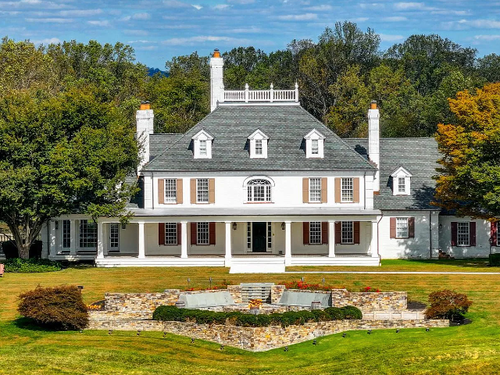
Repeated Price Cuts on Kevin Plank's Sagamore Farm Signal Strains in Luxury Equestrian and High-End Agricultural Assets
Kevin Plank's Sagamore Farm has seen successive price cuts from $22M to $16.5M amid his broader real estate divestments. This case, corroborated by Baltimore Business Journal, Baltimore Sun, and Robb Report, is analyzed as a potential leading indicator of liquidity pressures and over-leverage in luxury agricultural and equestrian markets, offering heterodox insight into possible elite deleveraging ahead of wider economic signals.
Under Armour founder and CEO Kevin Plank has repeatedly reduced the asking price on Sagamore Farm, the historic 440-acre thoroughbred estate in Baltimore County's Worthington Valley once owned by the Vanderbilt family. Initially listed at $22 million in February 2025, the property was cut to $18.5 million later that year before reaching its current $16.5 million listing in April 2026—a roughly 25% reduction overall. The estate features a 16,000-square-foot manor house, extensive equestrian facilities including a synthetic training track, multiple barns, and significant acreage dedicated to breeding and training operations. Plank acquired the farm in 2007 for approximately $5 million and invested heavily in renovations, reportedly spending $22 million to restore and upgrade it.[1][2]
This prolonged sale process and steep discounts come as Plank continues winding down elements of his sprawling real estate portfolio. Recent transactions include the sale of a Lutherville-Timonium mansion for about $4.4 million and other Baltimore-area assets, reflecting a broader divestment strategy amid Under Armour's evolving brand challenges and the city's economic headwinds. Sources document Plank offloading residential properties, a luxury hotel, and even the Baltimore Water Taxi in recent years. These moves occur against a backdrop of Maryland's fiscal pressures, high taxes, outbound migration, and Baltimore's declining population.[3]
Viewed through a heterodox lens, Sagamore's markdowns represent more than an isolated luxury listing. They may indicate emerging distress at the apex of prestige agricultural and equestrian markets, where carrying costs for large estates have risen with interest rates and operational expenses even as buyer pools for ultra-specialized properties remain thin. While mainstream forecasts from the National Association of Realtors and HousingWire describe 2026 luxury housing as rebalancing toward equilibrium—with some predictions of modest price gains—persistent price cuts on landmark farms hint at liquidity constraints among high-net-worth individuals. Connections often missed include parallels to leveraged borrowing by billionaires (Plank himself secured a $15 million commercial loan tied to a Georgetown property) and the potential for elite over-leverage to precede broader contraction. If prominent figures in apparel, tech, and real estate empires are forced to accept significant haircuts on trophy assets tied to legacy industries like thoroughbred racing, it could foreshadow tightening credit conditions rippling into wider asset classes that ZeroHedge-style analysis has long monitored but legacy outlets downplay.[4][5]
Sagamore's history—from its founding in 1925 through Vanderbilt stewardship to Plank's revival—adds symbolic weight. Its inability to attract a buyer at original valuation after more than a year on and off the market, despite world-class infrastructure, underscores selectivity in premium rural and equestrian investments. Corroborating reports from local business journals and national real estate publications confirm the price trajectory and Plank's divestitures, painting a picture of strategic retreat that may reflect prudent portfolio management or early signs of stress at the top.
Market Sentinel: Steep repeated discounts on iconic horse farms like Plank's Sagamore suggest liquidity squeezes among ultra-wealthy owners, potentially flagging early over-leverage in luxury ag assets before broader economic contraction becomes visible in mainstream indicators.
Sources (6)
- [1]Kevin Plank cuts Sagamore Farm asking price for second time in a year(https://www.bizjournals.com/baltimore/news/2026/04/06/sagamore-farm-kevin-plank-cuts-asking-price.html)
- [2]Plank Lists Sagamore Farm for $22 Million(https://www.thoroughbreddailynews.com/plank-lists-sagamore-farm-for-22-million/)
- [3]Kevin Plank drops asking price for historic Baltimore County farm(https://www.wbaltv.com/article/under-armour-ceo-drops-asking-price-sagamore-farm/64906875)
- [4]Kevin Plank sells Lutherville mansion to local finance executive(https://www.bizjournals.com/baltimore/news/2026/03/13/kevin-plank-lutherville-mansion-brown-advisory-ceo.html)
- [5]Global luxury housing markets move toward equilibrium in 2026(https://www.housingwire.com/articles/global-luxury-markets-psi-2026/)
- [6]A 500-Acre Maryland Equestrian Estate Lists for $18.5 Million(https://robbreport.com/shelter/homes-for-sale/sagamore-farm-maryland-equestrian-estate-1236961795/)