Beijing's Defiance of U.S. Sanctions on Teapot Refineries Signals Deeper Geopolitical Fractures Ahead of Trump-Xi Summit
Beijing's instruction to Chinese 'teapot' refineries to ignore U.S. sanctions ahead of the Trump-Xi summit signals a bold challenge to Washington's global enforcement mechanisms. Beyond energy security, this move reflects China's broader push for economic autonomy and risks undermining international sanctions regimes, setting a contentious tone for upcoming U.S.-China talks.
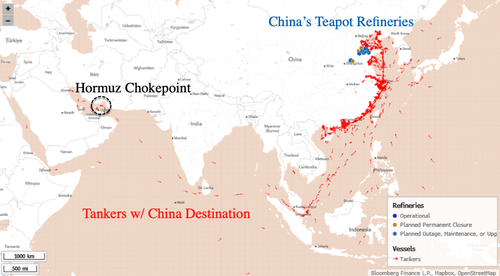
As President Donald Trump prepares for a pivotal mid-May summit with Chinese President Xi Jinping in Beijing, a new flashpoint has emerged in the already strained U.S.-China relationship. Beijing's directive to Chinese firms, particularly independent 'teapot' refineries in Shandong Province, to disregard U.S. sanctions over their trade in Iranian crude oil underscores a growing willingness to challenge Washington's global enforcement mechanisms. This move, announced by China's Commerce Ministry on Saturday, is not merely a reaction to the recent U.S. Treasury Department sanctions on five refineries, including Hengli Petrochemical's Dalian facility, but a broader signal of Beijing's intent to shield its domestic industries amid escalating geopolitical tensions and an ongoing energy crisis in Asia.
The original coverage of this story highlights the immediate context of the sanctions and Beijing's response as a protective measure against U.S. 'maximum pressure' tactics on Iranian oil flows. However, it misses the deeper strategic implications and historical patterns of behavior that frame this defiance. China's rejection of unilateral sanctions—deemed by the Commerce Ministry as lacking a basis in international law and authorization from the United Nations—echoes its long-standing position against U.S.-led extraterritorial measures, as seen in past disputes over Huawei and North Korean trade restrictions. This is not an isolated act of resistance but part of a consistent policy to assert sovereignty over economic decisions, especially in critical sectors like energy, where Asia's vulnerability to supply shocks via the Strait of Hormuz has been painfully exposed by the U.S.-Iran conflict.
What the initial reporting overlooks is how Beijing's stance could reshape global energy markets and sanctions enforcement. By openly instructing firms to ignore U.S. penalties, China risks not only direct confrontation with Washington but also the erosion of the international sanctions regime as a tool of policy. If other nations follow suit, citing China's precedent, the efficacy of U.S. financial levers—such as asset freezes and transaction bans—could be severely undermined. This is particularly significant given the timing: the Trump-Xi summit was already delayed once due to the Iran war, and energy security is a shared concern amid Asia's fuel shortages. Yet, Beijing's decision to prioritize domestic stability over compliance suggests a calculated gamble to test U.S. resolve while leveraging its role as a key fuel exporter to neighboring countries, a move noted in last week's reopening of export quotas.
Historical context further illuminates this maneuver. China's teapot refineries have long been a thorn in the side of international oil trade norms, often operating under less scrutiny than state-owned giants like Sinopec. A 2021 report by the U.S. Energy Information Administration (EIA) highlighted that these smaller, independent processors accounted for nearly 20% of China's crude oil imports, with a significant portion sourced from sanctioned states like Iran and Venezuela, often via opaque supply chains. Beijing's protection of these entities now mirrors its defense of strategic industries during the 2018-2020 trade war, when it retaliated against U.S. tariffs with export controls on rare earths. The pattern is clear: China views economic coercion as a direct challenge to its autonomy and responds by doubling down on self-reliance and defiance.
Moreover, the original coverage underplays the summit's broader stakes. Beyond energy, the Trump-Xi meeting will grapple with Taiwan, AI chip restrictions, and rare earth supply chains—issues where China's leverage is considerable. By taking a hardline stance on sanctions now, Beijing may be setting the tone for negotiations, signaling that it will not yield under pressure. This could complicate U.S. efforts to stabilize energy markets, especially as the Hormuz chokepoint remains a bottleneck. A 2023 International Energy Agency (IEA) report warned that prolonged disruptions in the Strait could spike global oil prices by 30%, a scenario neither leader can ignore. Yet, China's move to shield its refineries suggests it is willing to risk short-term economic friction for long-term strategic gains, potentially forcing Washington to recalibrate its approach at the summit.
In synthesizing these perspectives, it becomes evident that Beijing's directive is less about the teapot refineries themselves and more about challenging the rules-based order that underpins U.S. global influence. This action, while rooted in immediate energy needs, connects to a larger narrative of geopolitical realignment, where China seeks to redefine norms of international trade and sanctions enforcement. The Trump-Xi summit, already laden with contentious issues, now faces an additional layer of complexity: how to address this defiance without triggering a broader economic or diplomatic crisis.
MERIDIAN: Beijing's defiance of U.S. sanctions may embolden other nations to resist similar measures, potentially weakening global compliance with unilateral policies. This could force the U.S. to seek multilateral backing at the summit to maintain leverage.
Sources (3)
- [1]Ahead Of Trump-Xi Summit, Beijing Tells Chinese Firms To Ignore U.S. Sanctions On 'Teapot' Refineries(https://www.zerohedge.com/energy/ahead-trump-xi-summit-beijing-tells-chinese-firms-ignore-us-sanctions-teapot-refineries)
- [2]U.S. Energy Information Administration: China's Crude Oil Imports and Refining Sector(https://www.eia.gov/international/analysis/country/CHN)
- [3]International Energy Agency: World Energy Outlook 2023(https://www.iea.org/reports/world-energy-outlook-2023)