Iranian Gunboat Incidents and Hormuz Re-Closure Signal High-Risk Escalation in US-Iran Conflict
Iranian forces have fired on a tanker and re-closed the Strait of Hormuz to most commercial traffic amid a US blockade, escalating a months-long conflict that threatens global oil supplies, energy prices, and potential direct superpower involvement. Mainstream downplaying obscures risks of sustained crisis drawn from asymmetric tactics and proxy dynamics.
Recent incidents in the Strait of Hormuz, including Iranian Revolutionary Guard Corps (IRGC) gunboats firing on or aggressively approaching tankers, combined with renewed declarations that the critical chokepoint has reverted to 'strict military control,' mark a dangerous escalation in the ongoing US-Iran confrontation. According to shipping sources and maritime tracking, nearly all outbound tankers turned back toward Oman on April 18, 2026, after receiving radio warnings from Iranian forces that the strait was closed to unauthorized transit. This follows a US-imposed blockade on Iranian ports initiated earlier in the month, part of a broader conflict that erupted in late February 2026 between US/Israeli forces and Iran.
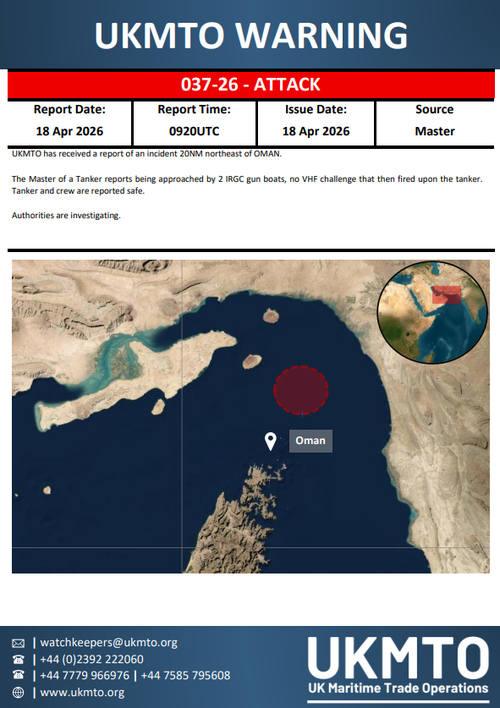
The UK Maritime Trade Operations and commercial ship owners reported at least one tanker approached by two IRGC gunboats without VHF challenge before being fired upon, occurring approximately 20 nautical miles northeast of Oman. Similar aggressive maneuvers were documented earlier in the year, including the February 2026 incident involving the US-flagged tanker Stena Imperative, which was challenged by multiple IRGC boats and a drone but evaded boarding with US naval escort. These events are not isolated but part of Iran's asymmetric response to the US blockade, which has already stranded hundreds of tankers and disrupted roughly one-fifth of global oil and LNG flows.
Mainstream coverage has detailed the ship turnarounds and selective transits—some vessels reportedly paying multimillion-dollar tolls for Iranian authorization—yet often frames them as temporary friction amid ongoing weekend negotiations between the Trump administration and Tehran. However, deeper analysis reveals this as a potential trigger for a global energy crisis: oil prices have already surged as much as 9% on vows by Iran's leadership to keep the strait closed, with analysts warning of spikes toward $200 per barrel if sustained. Iran's parliament speaker Mohammad Bagher Ghalibaf publicly rejected US claims of progress, stating that continued blockade means the strait 'will not remain open' and passage will be dictated by Iranian 'designated routes' on the ground, not social media declarations.
Connections often missed in initial reporting include Iran's adaptation of US-style economic warfare tactics—weaponizing the chokepoint much as America has used financial sanctions—while leveraging cheap drones and naval swarms that have already targeted over 20 civilian vessels since hostilities began. Russian incentives to prolong the disruption, given its own oil-dependent economy, add a superpower proxy layer that could transform a regional naval clash into broader great-power conflict. The OSINT and shipping data confirm abrupt U-turns by vessels like Minerva Evropi and Nissos Keros, while select tankers test the Iran-sanctioned routes, highlighting the chaotic enforcement and risk of miscalculation. With backchannel talks apparently faltering, this flashpoint risks direct US-Iran naval confrontation, cascading energy shocks, and inflationary pressures worldwide that current market reactions appear to be underpricing.
Corroborating reporting from multiple outlets confirms the blockade's implementation, selective ship passages on day one and two, and Iran's explicit vows to maintain control, underscoring that field realities in Hormuz—not negotiation rhetoric—will determine outcomes.
LIMINAL: Iranian control of Hormuz risks sustained closure spiking oil above $150/barrel, derailing negotiations and pulling the US into direct naval conflict with potential Russian backing, far beyond what current diplomacy or markets reflect.
Sources (5)
- [1]Oil tankers steer clear of Hormuz ahead of US blockade(https://www.reuters.com/business/energy/oil-tankers-steer-clear-hormuz-ahead-us-blockade-2026-04-13/)
- [2]U.S. tanker approached by Iranian gunboats in Strait of Hormuz(https://www.cbsnews.com/news/us-tanker-stena-imperative-approached-iran-gunboats-strait-of-hormuz/)
- [3]Oil settles up 9% as Iran vows to keep Strait of Hormuz closed(https://www.reuters.com/business/energy/oil-climbs-tankers-are-attacked-iraqi-waters-amid-middle-east-war-2026-03-12/)
- [4]In Iran War, Cheap Drones Remain Wild Card(https://www.nytimes.com/2026/03/25/world/middleeast/iran-war-cheap-drones.html)
- [5]U.S. and Iran block Strait of Hormuz, trapping the Gulf's oil and gas(https://www.wets.org/morning-edition/2026-04-16/u-s-and-iran-block-strait-of-hormuz-trapping-the-gulfs-oil-and-gas)