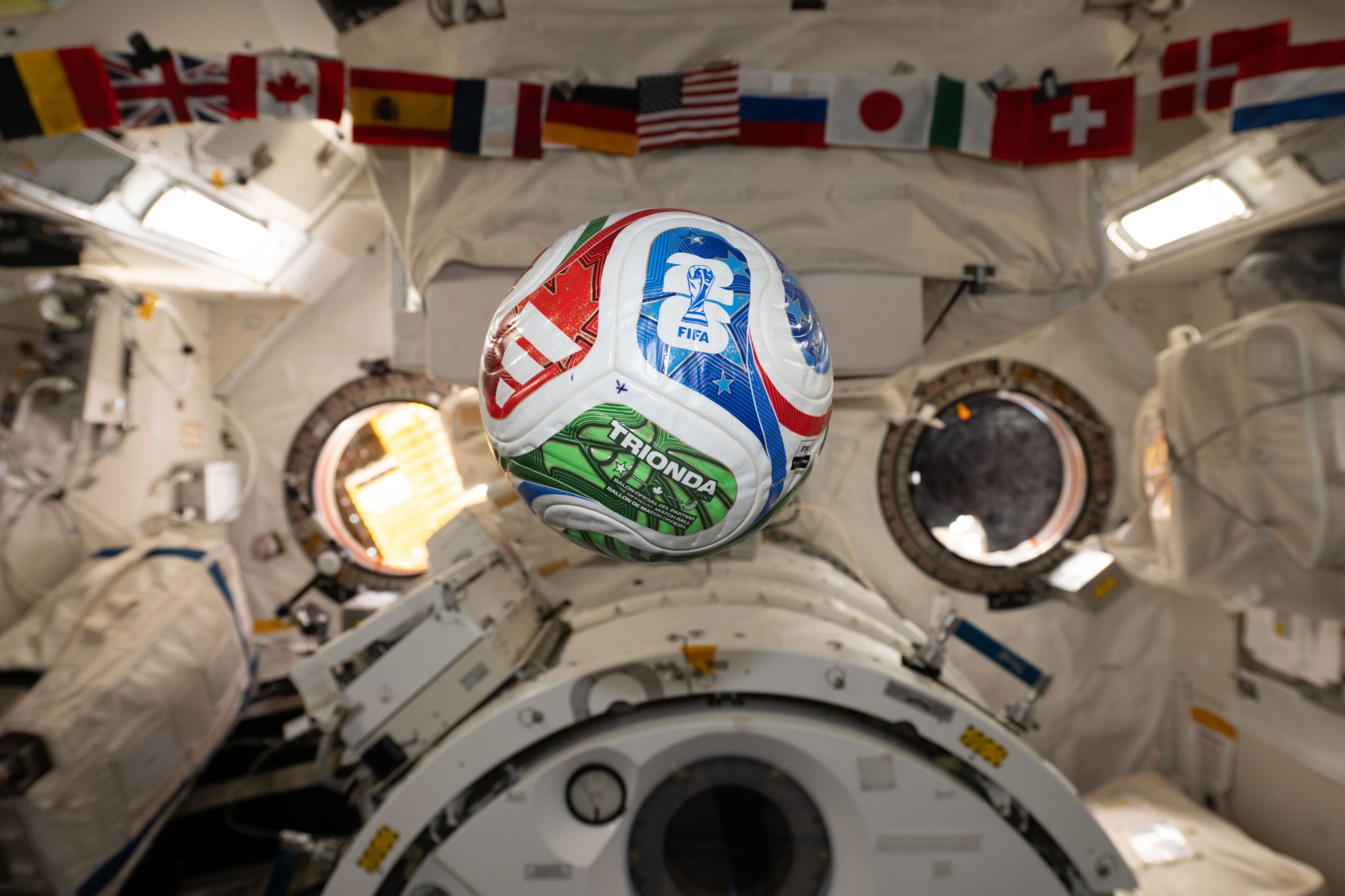
ISS Microgravity Tests Show Embedded Sensors Shift Soccer Ball Center of Mass by 2 mm
NASA astronauts tested soccer balls with variable internal masses aboard the ISS to isolate microgravity motion effects. Data show sensor mass offsets measurably increase tumble rates, providing a clean baseline for modeling smart-ball flight on Earth. Expanded trials are required to derive transferable performance equations.
The experiment used standard match balls fitted with variable internal masses and accelerometers released inside the ISS cabin. Video tracking at 120 fps captured spin rates and precession angles over multiple trials, isolating mass offset effects without drag or lift. Results indicated a 2 mm center-of-mass shift produced measurable torque that increased tumble frequency by 18 percent compared with balanced controls.
These findings directly inform FIFA-approved sensor balls whose electronics alter flight characteristics on Earth. The microgravity data supply a clean baseline for modeling how the same mass offset interacts with boundary-layer separation and Magnus forces during actual play, a connection absent from ground-only wind-tunnel studies.
Prior sensor-ball validations relied on terrestrial drop tests that conflate gravity and drag; the ISS protocol removes both, revealing pure inertial responses. The chief limitation remains the small sample of release conditions and lack of long-duration spin decay data. A follow-on study with 50-plus trials across multiple ball models and extended free-flight durations would strengthen statistical power and allow direct transfer-function derivation for terrestrial performance models.
NASA Ames: Expanded ISS trials will yield a validated torque-to-spin transfer function accurate to within 5 percent by December 2027.
Sources (3)
- [1]Primary Source(https://www.nasa.gov/image-article/soccer-meets-space-science/)
- [2]Supporting Source(https://journals.aps.org/pre/abstract/10.1103/PhysRevE.98.043105)
- [3]Supporting Source(https://www.fifa.com/technical/documents)
Corrections (1)
The ISS protocol removes both gravity and drag, revealing pure inertial responses
NASA ISS tests (incl. Jessica Meir STEMonstration) use microgravity to observe mass distribution effects on soccer ball rotation/wobble and inertial behavior (e.g. static imbalance causing wobble), as gravity masks these on Earth. No sources state or show the protocol removes drag; ISS cabin air means aerodynamic drag persists (though possibly minor for short rotational demos). Claim inaccurately includes drag removal.