The Global Fertility Divide: A Long-Term Pattern Reshaping Migration, Economies, and Geopolitics
UN-backed data reveals a stark fertility split driving migration, labor shifts, and geopolitical realignments, with high-fertility Africa contrasting low-fertility aging societies worldwide.
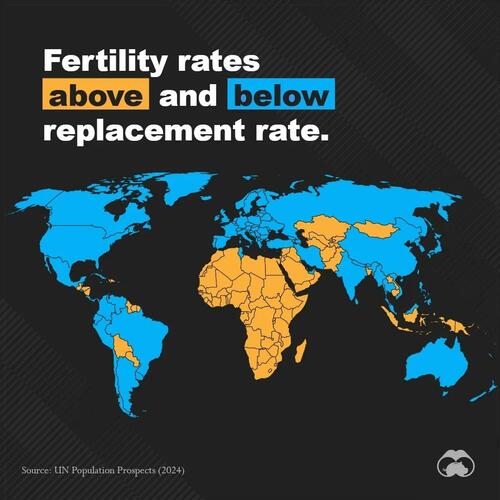
The world is increasingly split between countries with fertility rates below the 2.1 replacement level—facing aging populations, shrinking workforces, and economic pressures—and those maintaining higher rates, primarily in sub-Saharan Africa and parts of the Middle East and South Asia. This divergence, rooted in UN World Population Prospects 2024 data projecting 2025 rates, extends far beyond statistics. It drives migration patterns, strains labor markets in low-fertility nations, and alters global power balances over decades.
UN reports confirm that more than half of countries now sit below replacement fertility, with two-thirds of the global population in such places. Sub-Saharan Africa accounts for the bulk of high-fertility outliers (e.g., Chad at 5.94, Somalia at 5.91), while Europe, East Asia, and much of the Americas trend well below. Visual Capitalist visualizations, drawing directly from the same UN revision, map this split vividly, highlighting exceptions like Israel (2.75) amid broader declines.
Economically, low-fertility regions confront pension shortfalls and labor shortages. Immigration emerges as a key mitigator, as noted in IMF analysis where net migration has sustained population growth in the global North since 1990, accounting for 80% of Europe's increase in recent decades. Yet this creates feedback loops: high-fertility areas export youth, while destination countries grapple with integration and cultural shifts.
Geopolitically, the pattern suggests a redefinition of global divides. High-fertility zones in Africa and parts of the Muslim world may sustain population growth and influence, while former high-growth regions like India and Latin America converge toward low fertility. DNI assessments project migration drivers—economic disparities, youth bulges, and aging in developed states—intensifying through 2040, potentially shifting dependencies and alliances. Stratfor and other analyses underscore how adaptation via policy (immigration, automation, family incentives) will differentiate nations, with irreversible demographic momentum favoring those managing transitions effectively.
This civilizational pattern receives sporadic coverage through headline stats but warrants sustained attention for its compounding effects on everything from urban planning to international relations.
[LIMINAL]: Persistent fertility divergence will intensify south-to-north migration pressures while forcing low-fertility economies to innovate on labor and family policies or face relative decline.
Sources (6)
- [1]World Fertility 2024(https://www.un.org/development/desa/pd/sites/www.un.org.development.desa.pd/files/undesa_pd_2025_wfr_2024_final.pdf)
- [2]World Population Prospects 2024: Summary of Results(https://population.un.org/wpp/assets/Files/WPP2024_Summary-of-Results.pdf)
- [3]The Fertility Rate of Every Country in the World(https://www.visualcapitalist.com/fertility-rate-of-world-populations/)
- [4]Adapting to Demographic Decline: Policy Tradeoffs and Global Divergences(https://worldview.stratfor.com/article/adapting-demographic-decline-policy-tradeoffs-and-global-divergences)
- [5]Can Immigration Solve the Demographic Dilemma?(https://www.imf.org/en/publications/fandd/issues/2020/03/can-immigration-solve-the-demographic-dilemma-peri)
- [6]The Future of Migration(https://www.dni.gov/index.php/gt2040-home/gt2040-deeper-looks/future-of-migration)