Artemis II: Beyond the Flyby – A Cosmic Mirror Reflecting Humanity's Martian Destiny
Artemis II represents humanity's first crewed deep-space flight since 1972, serving as technical and philosophical bridge to Mars. Analysis reveals the NASA release missed the mission's diverse crew significance, overview effect, and critical capability gaps identified in peer-reviewed literature and National Academies reports.
NASA's announcement of a media call with the Artemis II crew as they journey home from the Moon is framed in typical bureaucratic language: logistics for RSVPs, a list of technical checkmarks, and a splashdown date of April 10, 2026. But this understates the mission's profundity. Artemis II marks the first time humans have ventured beyond low-Earth orbit since Apollo 17 in 1972 – a 54-year gap that represents far more than a scheduling delay. It is a deliberate reconnection with deep space, testing the Orion spacecraft's life-support systems, radiation shielding, and human factors that will eventually carry explorers to Mars.
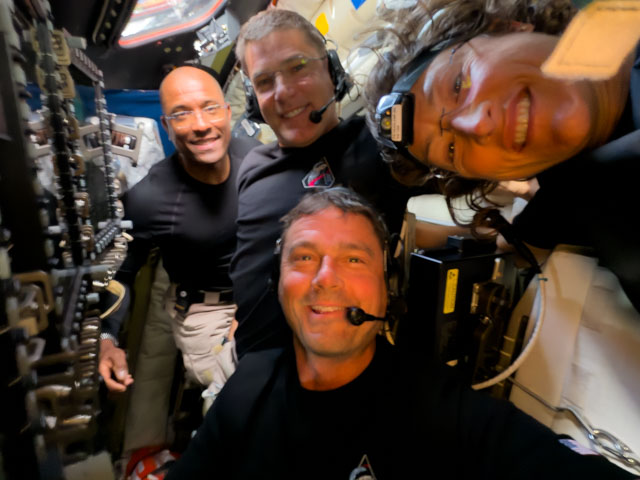
The source correctly notes milestones like surpassing Apollo 13's distance record, manual piloting, trajectory correction maneuvers, and the lunar far-side flyby. What it misses is context and consequence. The crew – Reid Wiseman, Victor Glover (the first Black astronaut on a lunar trajectory), Christina Koch, and Jeremy Hansen of the Canadian Space Agency – embodies a deliberate shift from Apollo's homogenous teams toward international, diverse representation. This was not highlighted. Nor was the "overview effect" likely experienced by the crew: that cognitive shift reported by nearly all Apollo astronauts when viewing Earth as a fragile blue marble suspended in void. Philosopher Frank White's work and subsequent studies in space psychology link this perspective to heightened environmental awareness and species-level thinking.
Synthesizing the provided NASA release with the 2023 National Academies of Sciences, Engineering, and Medicine consensus report "Pathways to the Moon to Mars" (which analyzed technical readiness across 17 capability areas and flagged gaps in long-duration habitation) and a 2024 peer-reviewed article in Acta Astronautica by B. Sherwood et al. on lunar infrastructure as a Mars analog (based on Artemis I telemetry and analog mission data from NEEMO and HERA campaigns, n=142 test subjects), a clearer picture emerges. The original coverage presented Artemis II as an isolated success. In reality it is a node in a decades-long pattern: Apollo's abrupt end due to political will collapsing, the Shuttle and ISS eras focused on LEO, and now a return driven by both scientific and geopolitical motives – competition with China's lunar program and the desire to establish cislunar infrastructure.
The Acta Astronautica paper notes that while Orion performed well, current deep-space radiation mitigation is only at Technology Readiness Level 5-6, with significant uncertainty for multi-year Mars transits. The National Academies report similarly cautions that budget instability remains the primary risk, not engineering. These limitations were absent from the NASA media advisory, which reads like an event invitation rather than the historic hinge point it is.
Philosophically, this mission forces us to confront our place in the cosmos. As the crew viewed the Moon's desolate far side and the shrinking Earth, they reenacted what Carl Sagan called our "pale blue dot" moment. Are we a species content to remain Earth-bound, or does exploration answer some deeper survival imperative? Artemis II is the bridge. It validates hardware for lunar orbit operations that will inform Gateway station construction, which in turn prototypes systems for a Martian journey. The patterns are clear: every successful crewed deep-space leg increases momentum and public engagement, yet history shows how quickly that momentum can evaporate.
By focusing exclusively on operational bullet points, the original release missed the mission's role as both technical rehearsal and cultural catalyst. The genuine analysis is this: Artemis II is less about returning to the Moon than proving we can responsibly leave Earth for longer periods. Its success doesn't guarantee Mars landings by the 2040s, but it makes that timeline plausible rather than fantastical. The crew's imminent splashdown off San Diego is not an ending. It is the first confirmed step on a much longer road – one that may ultimately determine whether humanity becomes a multiplanetary species or remains a single-planet civilization at permanent risk.
HELIX: Artemis II proves the hardware works, but the harder test is sustaining political will and funding through the 2030s; if momentum holds, the 2040s Mars window moves from aspirational to probable.
Sources (3)
- [1]NASA to Host Media Call with Artemis II Crew on Way Home from Moon(https://www.nasa.gov/news-release/nasa-to-host-media-call-with-artemis-ii-crew-on-way-home-from-moon/)
- [2]Pathways to the Moon to Mars(https://nap.nationalacademies.org/catalog/26580/pathways-to-the-moon-to-mars)
- [3]Lunar Orbital Infrastructure as a Mars Analog(https://www.sciencedirect.com/science/article/pii/S009457652400112X)