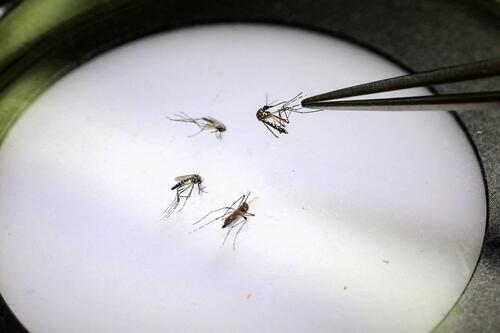
Alphabet's Debug Project Seeks EPA Approval for Releasing Millions of Wolbachia-Carrying Mosquitoes in California and Florida
Alphabet's Debug project has applied for EPA permission to release 32 million Wolbachia-infected male mosquitoes in CA and FL over two years to suppress disease-carrying Aedes aegypti populations. The bacteria-based, non-GM approach has shown success internationally and in prior U.S. trials; it reflects big tech's deepening role in biological pest control amid growing concerns over transparency and ecological precedent.
Google parent Alphabet, through its Verily Life Sciences spinout and the long-running Debug project, is seeking federal approval to release up to 32 million specially treated male mosquitoes across California and Florida. The Environmental Protection Agency is currently reviewing an Experimental Use Permit under the Federal Insecticide, Fungicide, and Rodenticide Act, with a Federal Register notice published in early May 2026 outlining plans for 16 million mosquitoes in Florida in the first year followed by 16 million in California in the second. Public comments are due by June 5 via docket EPA-HQ-OPP-2025-3951.
The program deploys male Aedes aegypti mosquitoes infected with the naturally occurring Wolbachia bacterium. When these males mate with wild females, the resulting eggs fail to hatch due to cytoplasmic incompatibility, gradually suppressing the local population of disease vectors. Only females bite and transmit pathogens; the released males do not. Debug emphasizes that the approach uses no chemicals, toxins, or genetic modification, building on similar sterile insect techniques used safely for decades against agricultural pests.
This latest request builds on Debug's prior field trials, including efforts in California's Central Valley that reportedly came close to local elimination at test sites, and international deployments. In Singapore, releases have achieved 80-90% suppression of Aedes aegypti and over 70% reduction in dengue cases. The project has recently deepened ties with the World Mosquito Program to combine Wolbachia methods with Debug's AI-powered robotics, automated rearing systems, and data-driven release platforms.
While framed as a sustainable alternative to increasingly ineffective pesticides and labor-intensive breeding-site removal, the initiative occurs against a backdrop of rising mosquito-borne threats. The CDC identifies mosquitoes as the deadliest animals on Earth, with diseases like dengue, Zika, chikungunya, West Nile, and malaria causing hundreds of thousands of deaths globally each year. The U.S. has seen occasional locally acquired malaria cases and steady West Nile impacts.
Deeper connections emerge when viewing Debug through Alphabet's broader portfolio. What began as a Google X moonshot has evolved into sophisticated bioengineering infrastructure blending entomology, machine vision for sex-sorting mosquitoes, sensor networks, and predictive analytics. This convergence of big tech and synthetic biology raises overlooked questions about data sovereignty over ecological interventions: the same company building health AI and surveillance tools is now engineering wild insect populations at scale. Past Oxitec genetically engineered mosquito trials in Florida and California (approved by EPA in 2022) faced significant community pushback over transparency and long-term ecological risks, highlighting patterns of public skepticism toward corporate-led open-air biological experiments.
Proponents argue the method is targeted, reversible, and addresses a gap where vaccines remain limited. Critics, including some lawmakers and environmental groups, question unintended consequences such as impacts on food webs, potential bacterial transfer, or evolutionary pressures on mosquito populations. Debug maintains that residents should notice no increase in biting, with population declines expected within weeks to months.
The episode exemplifies accelerating corporate involvement in public health infrastructure and ecosystem management. As climate shifts expand mosquito ranges, partnerships between tech firms, governments, and global health bodies like the World Mosquito Program could determine future vector control paradigms—yet they also invite scrutiny over accountability, independent monitoring, and whether such 'debugging' of nature represents genuine innovation or the privatization of living systems.
Liminal Analyst: Alphabet's scaling of biological insect control via AI and robotics normalizes corporate engineering of wild ecosystems, potentially creating dependencies on proprietary tech for public health while opening pathways for broader synthetic biology deployments with limited long-term oversight.
Sources (5)
- [1]Google wants to release up to 32 million 'good' mosquitoes in California and Florida(https://ktla.com/news/google-wants-to-release-up-to-32-million-good-mosquitoes-in-california-and-florida/)
- [2]Debugging: Google requests permission to release 32m mosquitoes(https://www.theguardian.com/technology/2026/jun/01/google-permission-release-mosquitoes-california-florida)
- [3]Google Debug asks to release millions of mosquitoes in Florida(https://www.palmbeachpost.com/story/news/environment/2026/05/29/google-debug-asks-release-millions-mosquitoes-florida/90218065007/)
- [4]Debug Project Official Site(https://debug.com/)
- [5]U.S. EPA Approves Oxitec Mosquito Pilot Projects in California and Florida(https://www.epa.gov/pesticides/following-review-available-data-and-public-comments-epa-expands-and-extends-testing)