Gravity from Space: NASA's GRACE-FO Data Exposes Florida's Aquifer Crisis as a Bellwether for Climate-Driven Extremes
NASA's GRACE-FO satellite gravity measurements reveal Florida's extreme 2026 groundwater drought, exposing long-term aquifer depletion trends linked to climate change that mainstream coverage underreports. Analysis integrates NASA data with peer-reviewed studies and USGS well monitoring, highlighting methodological strengths, resolution limits, population pressures, and saltwater intrusion risks missed in original reporting.
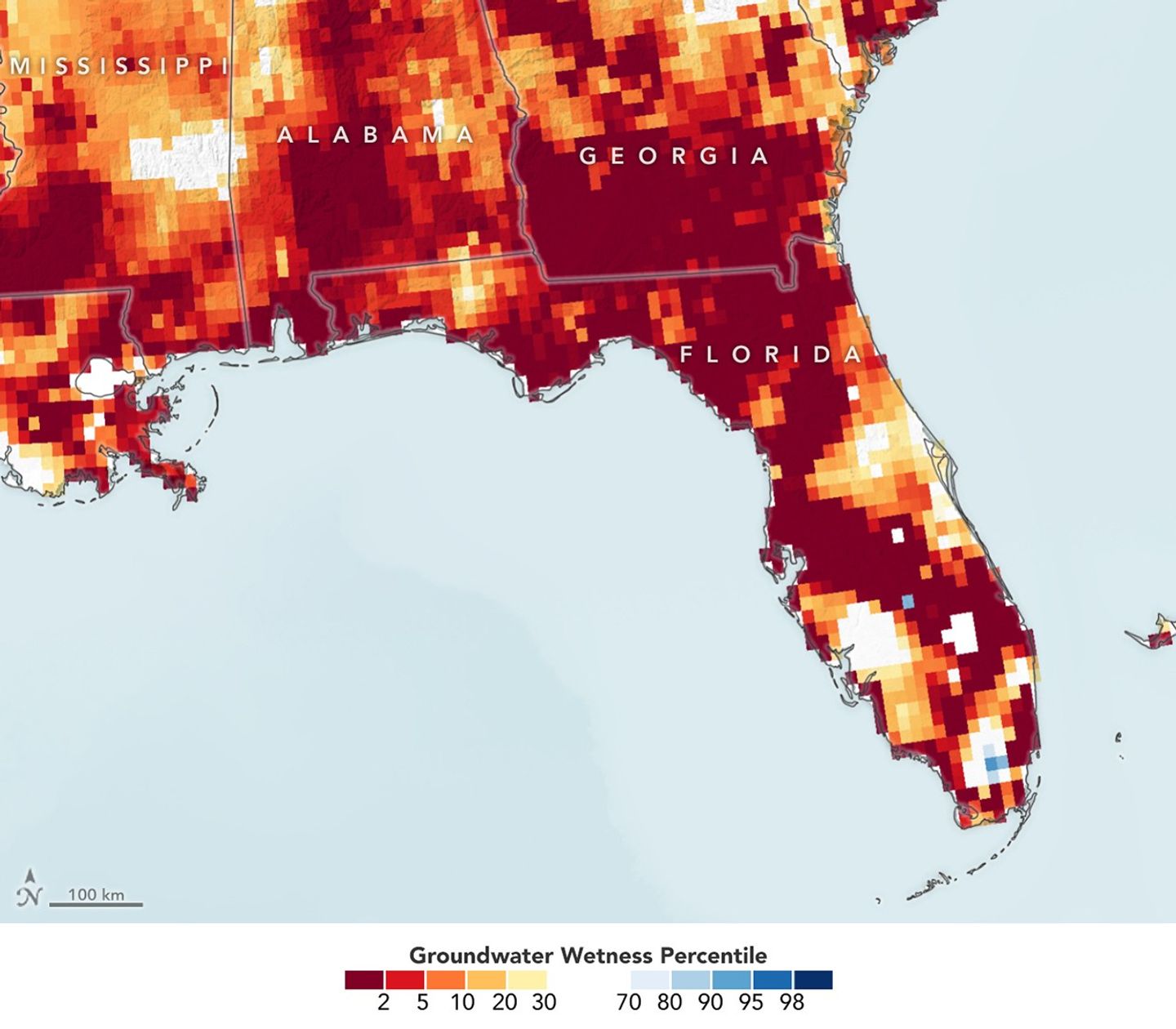
While Florida is renowned as one of the wettest U.S. states, the April 2026 NASA Earth Observatory release reveals a severe drought that has intensified since January, with nearly 80% of the state under extreme conditions according to the U.S. Drought Monitor. The twin GRACE-FO satellites, operated jointly by NASA and the German Research Centre for Geosciences, measure minute variations in Earth's gravity field caused by shifts in water mass. These measurements, which have a coarse spatial resolution of roughly 300 km and are merged with ground-based well data, are expressed as wetness percentiles relative to a 1948–2010 baseline. Blue areas indicate surplus; orange-to-red show significant deficits, with northern and central Florida aquifers particularly depleted.
This goes well beyond the original source's focus on surface impacts like watering restrictions, wildfire flare-ups, crop damage following February freezes (estimated at over $3 billion in losses), and the incoming rainstorm forecast. The NASA coverage notes this is the most widespread drought since 2012 yet stops short of rivaling the 2000–2001 event in duration or intensity. What it misses—and what mainstream environmental reporting consistently underplays—is how space-based Earth observation is exposing accelerating subsurface depletion patterns driven by anthropogenic climate change. GRACE-FO data illustrate that even humid subtropical regions are experiencing more volatile hydrological cycles, with faster soil moisture evaporation and delayed aquifer recharge.
Synthesizing the NASA observations with a 2022 peer-reviewed study in Environmental Research Letters (which analyzed 40+ years of Southeast U.S. hydroclimatic data from multiple reanalysis datasets and found a statistically significant increase in drought frequency and intensity post-1990 linked to rising temperatures) and a 2023 USGS report on the Floridan Aquifer System (drawing on 65 monitoring wells across Florida and Georgia), the trends are concerning. The USGS data, while not a randomized sample, show average aquifer levels during recent dry spells have declined 12–18% compared to mid-20th century norms, with recovery times lengthening. Limitations of GRACE-FO include its inability to resolve fine-scale local variations and sensitivity to non-water mass changes, yet when combined with in-situ measurements it provides an unmatched holistic view.
The original piece understates the human dimension: Florida's population has surged roughly 20% since the 2000–2001 drought, spiking municipal demand and heightening risks of saltwater intrusion into coastal aquifers—not mentioned in the NASA summary. This connects to broader patterns seen in California's prolonged droughts and Australia's Millennium Drought, where groundwater buffers fail under compound extremes. IPCC AR6 findings on the water cycle further contextualize this, indicating high-confidence shifts toward more intense precipitation whiplash events in subtropical zones. Coverage often fixates on immediate economic hits to citrus or wildfire acreage while ignoring how these satellite-derived insights demand proactive aquifer governance and reduced reliance on groundwater for agriculture.
Ultimately, the GRACE-FO perspective reveals that Florida's 2026 drought is not an isolated anomaly but part of an emerging regime where space-based monitoring becomes critical infrastructure for adaptation. Without integrating these orbital data into long-range planning, recovery will remain superficial while underground reserves continue their silent decline.
HELIX: NASA's GRACE-FO readings signal that Florida's aquifers are entering a new era of slower recharge under climate-amplified variability; even if rains arrive, long-term water security will require policy shifts informed by continuous satellite monitoring rather than reactive drought declarations.
Sources (3)
- [1]Drought Parches Florida(https://science.nasa.gov/earth/earth-observatory/drought-parches-florida/)
- [2]Increasing Drought in the Southeast U.S.(https://iopscience.iop.org/article/10.1088/1748-9326/ac3a2f)
- [3]USGS Floridan Aquifer System Assessment(https://www.usgs.gov/mission-areas/water-resources/science/floridan-aquifer-system)