Pentagon's Automaker Outreach Signals Structural Shift Toward Sustained War Economy
Beyond immediate headlines on converting auto lines to weapons production, analysis using DoD's National Defense Industrial Strategy and congressional reports reveals a structural policy pivot to war economy, highlighting technical hurdles, multi-perspective tensions, and connections to global rearmament missed in partisan coverage.
The ZeroHedge report accurately captures the Trump administration's early outreach to General Motors, Ford, GE Aerospace, and Oshkosh regarding potential conversion of civilian manufacturing lines to support weapons production amid ongoing Eurasian conflicts. However, it frames the story primarily through a partisan lens focused on union resistance and European industrial 'hollowing out,' while underplaying deeper structural, technical, and policy dimensions.
This initiative, described by Defense Secretary Pete Hegseth as placing the defense industrial base on a 'wartime footing,' aligns with the Department of Defense's 2024 National Defense Industrial Strategy. That primary document explicitly identifies insufficient surge capacity, single-source dependencies, and the need to harness commercial industrial infrastructure as core vulnerabilities. It builds on repeated invocations of the Defense Production Act (DPA) since 2022, initially used for 155mm artillery shells and Javelin missiles to replenish stocks drawn down by over $60 billion in U.S. security assistance to Ukraine, per DoD congressional notifications.
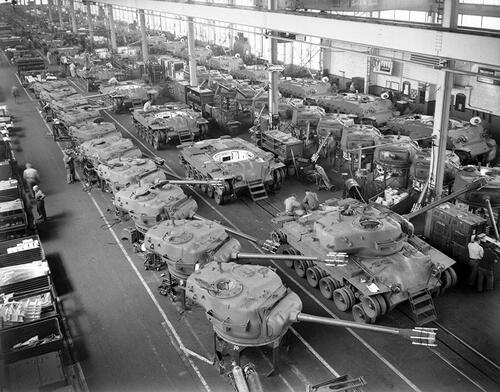
What original coverage missed is the distinction between historical precedent and contemporary reality. While World War II War Production Board records document straightforward retooling of automotive plants for tanks and aircraft, today's precision-guided munitions, autonomous systems, and integrated command networks require specialized semiconductor fabrication, secure software supply chains, and rare-earth materials. A 2023 Government Accountability Office report on defense industrial base challenges highlights exactly these gaps, noting that just-in-time manufacturing practices optimized for peacetime efficiency conflict with the need for stockpiled components.
Synthesizing the DoD strategy document with the Congressional Research Service's updated 2025 assessment of defense industrial base issues and the White House's 2024 DPA implementation summary reveals a consistent pattern: rearmament is no longer cyclical but structural. Parallel efforts in Europe, such as Volkswagen's announced retooling of its Lower Saxony plant for Iron Dome components (per German Federal Ministry of Defence procurement notices), indicate a transatlantic trend. This connects to broader rearmament patterns, including NATO's Defence Production Action Plan and Indo-Pacific allies expanding munitions capacity amid Taiwan Strait tensions.
Multiple perspectives emerge. Proponents within the defense community view leveraging underutilized U.S. auto capacity as pragmatic industrial policy that sustains high-wage manufacturing jobs and deters adversaries by signaling production depth. Fiscal oversight bodies caution that expanded defense spending—already trending above $900 billion annually—could exacerbate budget deficits and crowd out commercial innovation. Labor organizations express concerns over workforce reskilling and production priorities, while automotive executives see diversified revenue streams at a time of softening EV demand and foreign competition. Environmental policy analysts note potential tension with prior federal investments in electric vehicle transitions under the Inflation Reduction Act.
The original reporting correctly nods to COVID-era ventilator production by GM and Ford but does not address the long-term implications: embedding defense contracting into commercial balance sheets may reshape corporate investment decisions, incentivize dual-use R&D, and influence trade policy—evident in continued restrictions on Chinese automotive imports to preserve convertible industrial base. This represents less a temporary war footing than a sustained recalibration of industrial policy with ramifications for defense budgets, corporate earnings, workforce development, and alliance burden-sharing that will likely outlast current conflicts.
MERIDIAN: Pentagon outreach to automakers reflects a durable shift in industrial policy that will likely persist across administrations, reshaping corporate revenue mixes and requiring sustained federal investment in dual-use manufacturing capacity regardless of short-term conflict intensity.
Sources (3)
- [1]DoD National Defense Industrial Strategy(https://media.defense.gov/2024/Jan/11/2003379432/-1/-1/1/NATIONAL-DEFENSE-INDUSTRIAL-STRATEGY.PDF)
- [2]Congressional Research Service: Defense Industrial Base Background and Issues for Congress(https://crsreports.congress.gov/product/pdf/R/R47751)
- [3]GAO Report on Defense Industrial Base Challenges(https://www.gao.gov/products/gao-23-105554)