Ukraine's Drone Crucible Reshapes US Air Defense: Merops Deployment Signals Procurement Revolution Against Iranian Asymmetric Threats
The US Army's rapid adoption of the Ukraine-tested Merops interceptor to economically counter Iranian Shahed drones exemplifies how ongoing conflicts are forcing accelerated procurement reform, tactical innovation, and a shift toward attritable autonomous systems, with implications extending beyond Europe to the Red Sea and potential Pacific threats.
The U.S. Army's accelerated fielding of the Merops low-cost interceptor drone, as reported by Defense News, marks far more than an incremental upgrade to counter Iranian Shahed loitering munitions. It represents a doctrinal and industrial inflection point forged in the attritional laboratory of Ukraine's defense against Russian invasion. While the original coverage correctly notes the system's $15,000 unit cost, 13,000-unit rapid procurement, and favorable economics versus $30,000-$50,000 Shaheds, it understates the deeper systemic failures it exposes in pre-2022 Western defense planning and the profound tactical adaptations now being institutionalized.
Merops—developed by Perennial Autonomy with autonomous RF, thermal, and radar homing plus jamming resistance—builds directly on Ukrainian innovations first battle-tested in summer 2024. Ukrainian forces, facing nightly Shahed swarms, demonstrated that traditional SAM systems like Patriot and NASAMS were economically unsustainable when expending million-dollar missiles against massed low-cost threats. A comprehensive 2024 RUSI report on Ukrainian drone operations documented how Russian forces achieved 1:8 cost-exchange ratios in their favor until Kyiv pivoted to cheap FPV and interceptor drones, forcing Moscow into expensive electronic warfare upgrades. The U.S. Army has now internalized this data.
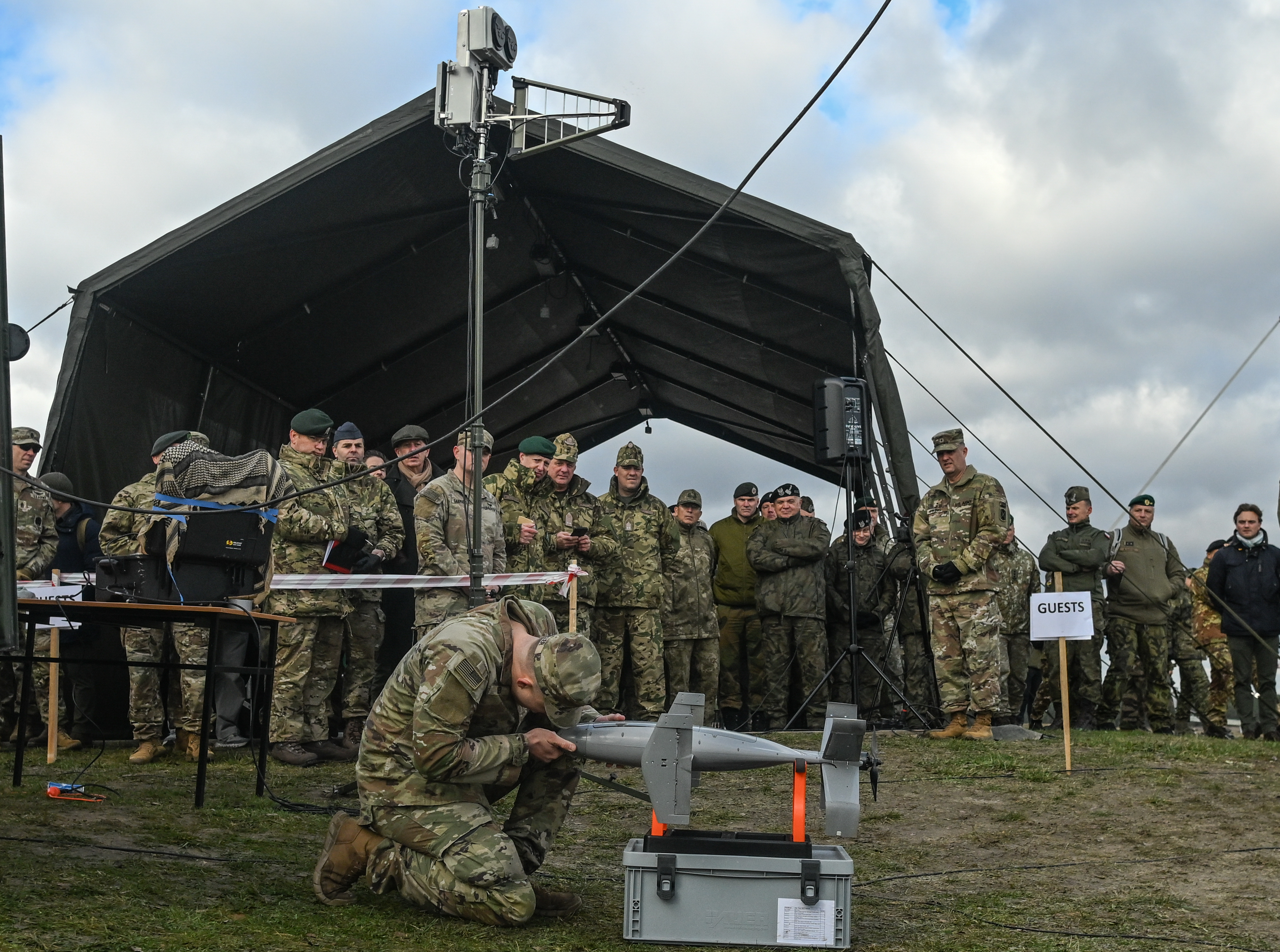
What the Defense News piece misses is the connection to simultaneous Iranian proxy campaigns in the Red Sea. CSIS analysis of Houthi attacks from 2023-2025 revealed the U.S. Navy firing $2 million SM-2s and $1 million ESSMs against $20,000 quadcopters and $50,000 Shahed derivatives—an untenable asymmetry that eroded both munitions stocks and political will. The Merops deployment, demonstrated from pickup trucks in Poland alongside Romanian and Polish forces, directly addresses this vulnerability on NATO's eastern flank while offering a template for Indo-Pacific contingencies.
This adaptation reveals three larger patterns. First, real-world conflict has shattered the Pentagon's traditional requirements-driven acquisition model. Army Secretary Driscoll's admission of cutting years-long processes to eight days echoes Ukraine's 'iterate or die' philosophy, mirroring how commercial components and iterative software updates have outpaced legacy primes. Second, it highlights the shift toward attritable, autonomous systems. At speeds up to 280 km/h and ranges of 20 km with a 2kg warhead, Merops leverages AI terminal guidance that reduces cognitive load on operators—addressing a gap identified in a 2025 RAND Corporation study on human-machine teaming under electromagnetic contestation that earlier Pentagon programs like Coyote failed to fully resolve.
Third, this development exposes Iran's evolving threat calculus. Tehran has distributed Shahed production across proxies in Iraq, Yemen, and Syria, creating a distributed manufacturing model resistant to single-point disruption. By adopting Ukraine-tested counters, the U.S. is implicitly acknowledging that future conflicts will feature massed, low-observability UAVs as standard rather than exceptional. However, vulnerabilities persist: should Iran integrate AI swarming or enhanced autonomy into next-generation platforms, Merops may require rapid software counter-updates, a capability the U.S. is only now prioritizing.
The broader geopolitical implication is clear: great power competition is being redefined by who learns and fields faster. China's documented drone swarm experiments in the South China Sea suggest Beijing is watching these exchanges closely. The Merops program, alongside related efforts like the Air Force's autonomous collaborative combat aircraft, indicates Washington is finally aligning procurement velocity with battlefield reality rather than bureaucratic comfort. As Brig. Gen. Curtis King noted, the system is 'very lethal'—but its true significance lies in proving that observation of peer conflict can compress decades of doctrinal lag into months. This is how modern defense priorities are forged: not in PowerPoint briefings, but in the smoking wreckage of Ukrainian and Middle Eastern battlefields.
SENTINEL: Ukraine's real-time laboratory has compressed US counter-drone acquisition from years to days, proving that battlefield economics now dictate procurement more than Pentagon bureaucracy; expect this model to accelerate adoption of attritable systems across all services facing Iranian and Chinese mass UAV tactics.
Sources (3)
- [1]US Army turns to Ukraine-tested drones to counter Iranian UAV threat(https://www.defensenews.com/unmanned/2026/04/20/us-army-turns-to-ukraine-tested-drones-to-counter-iranian-uav-threat/)
- [2]The Drone War in Ukraine: Lessons for Future Conflict(https://rusi.org/explore-our-research/publications/special-report/drone-war-ukraine)
- [3]Countering Iranian Drones: Red Sea Lessons and Ukraine Parallels(https://www.csis.org/analysis/houthi-attacks-red-sea-lessons-counter-drone-operations)