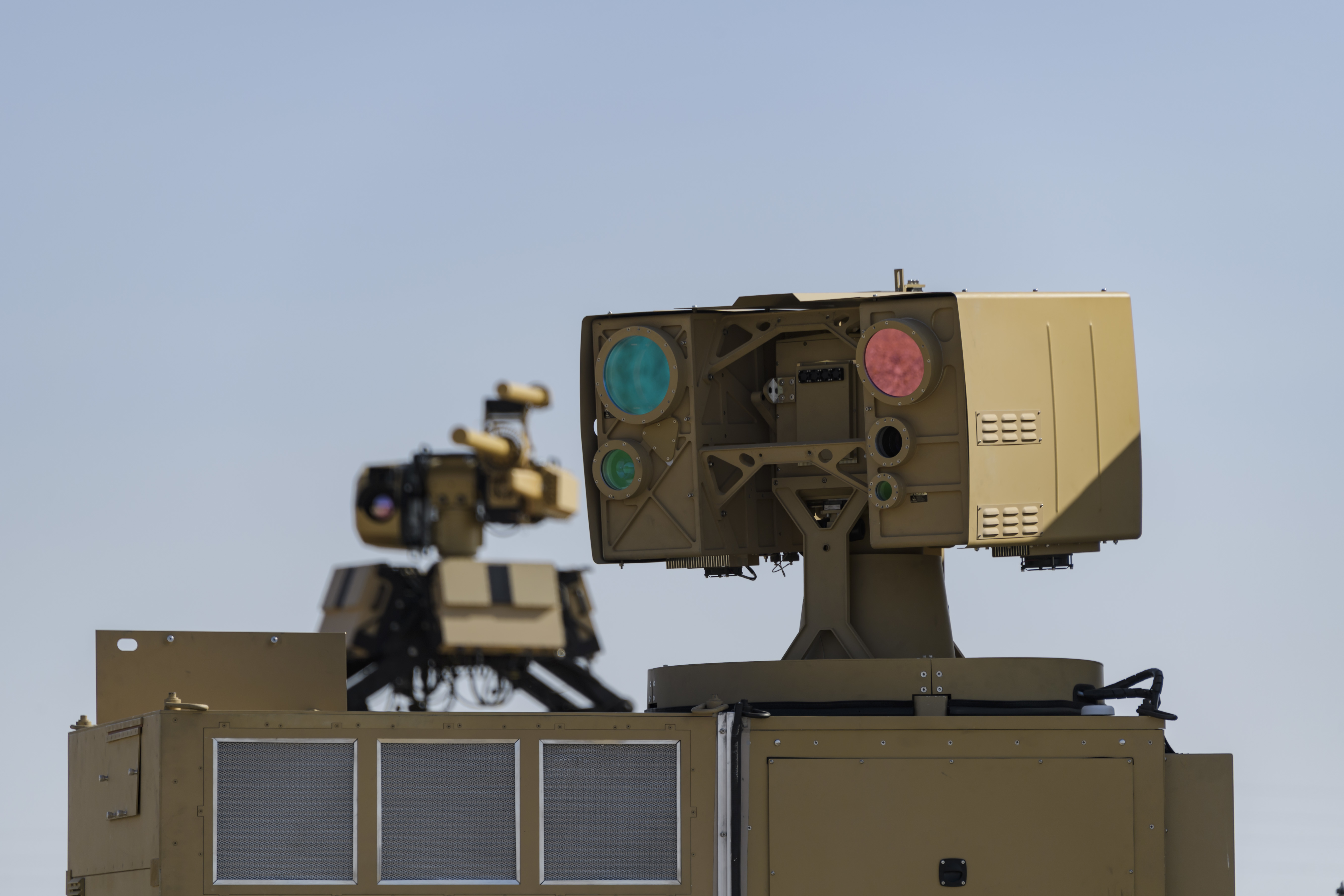
Laser Dome Over the Homeland: Directed-Energy Breakthrough Exposes Pentagon's Urgent Reorientation Toward Domestic Drone Defense
The U.S. military's FAA-cleared high-energy laser tests along the southern border represent the initial rollout of a 'laser dome' concept for homeland air defense. This reflects directed-energy maturation, economic necessity against drone swarms (informed by Ukraine), and a strategic pivot from overseas to domestic protection—elements largely missed in initial reporting.
The FAA-DoD 'landmark safety agreement' announced this month, which clears high-energy laser deployment for counter-drone missions along the U.S.-Mexico border, is far more consequential than the regulatory milestone framed in original Defense News reporting. While the piece correctly recounts the February AMP-HEL incidents near Fort Bliss and Fort Hancock—including the embarrassing engagement of a friendly CBP drone—it fails to connect these events to a larger strategic architecture now coalescing around the concept of a continental 'laser dome.' This is not an isolated safety test; it is the first legal and technical brick in a persistent, overlapping directed-energy shield intended for routine domestic use.
The original coverage understates the economic and doctrinal drivers. In Ukraine, as exhaustively documented by CSIS's multiyear battlefield assessments (2022-2025), both sides have burned through tens of thousands of expensive missiles and ammunition against commercial quadcopters costing a few hundred dollars. The math is unsustainable. A 20 kW solid-state laser like the LOCUST variant engages at the cost of diesel fuel and cooling water. The RAND Corporation's 2024 update on directed-energy maturation notes that systems have now crossed the threshold where power, beam quality, and thermal management allow sustained fire against swarming Class I and II UAS—precisely the proliferating threat seen on the southern border, where cartels increasingly deploy UAVs for scouting, smuggling, and electronic warfare.
What existing coverage missed is the interagency friction and precedent-setting nature of this shift. The abrupt airspace closures over El Paso revealed seams between CBP, Army, FAA, and JIATF-401. The second incident, in which U.S. forces destroyed one of their own drones, underscores persistent identification and deconfliction challenges that will only intensify when lasers transition from temporary border trials to permanent installations protecting critical infrastructure. Moreover, the automatic 'voting' safety interlocks praised by AV executives are impressive engineering, yet they do not resolve broader policy questions: rules of engagement for military lasers inside CONUS, potential impacts on civil aviation during degraded weather when beam divergence increases, and the slow erosion of the traditional bright line separating overseas contingency operations from homeland defense.
This development fits a discernible pattern. It mirrors Israel's rapid fielding of the Iron Beam laser interceptor to augment kinetic Iron Dome batteries against cheap rockets and drones. It parallels accelerating U.S. Navy HELIOS and Air Force SHiELD efforts, now being repurposed for land-based homeland security. Chinese and Iranian investment in both drone proliferation and counter-laser coatings suggests an emerging arms race in which the United States has quietly chosen to prioritize homeland resilience over pure expeditionary power projection—a subtle but unmistakable post-Afghanistan realignment.
Atmospheric limitations (dust, humidity common to the Rio Grande Valley), power infrastructure demands, and integration with NORAD's larger air-defense picture remain unresolved. Nevertheless, the White Sands fuselage testing that 'disproved myths' about catastrophic aircraft damage at range provides the bureaucratic cover needed to expand deployment. The laser dome is therefore both technological innovation and doctrinal admission: the homeland is no longer a sanctuary, cheap autonomous systems have democratized aerial attack, and only systems traveling at the speed of light can economically restore deterrence. Future coverage must track whether this border proof-of-concept evolves into networked domes over ports, power substations, and eventually urban centers—because the February incidents were not anomalies; they were the opening salvo of a new domestic defense reality.
SENTINEL: The laser dome's domestic debut reveals the Pentagon now views low-cost drones as a persistent homeland vulnerability rather than a distant battlefield problem, accelerating deployment of speed-of-light defenses that will likely expand from borders to critical infrastructure nationwide within 36 months.
Sources (3)
- [1]US military eyes high-energy ‘laser dome’ for domestic air defense(https://www.defensenews.com/industry/techwatch/2026/04/13/us-military-eyes-high-energy-laser-dome-for-domestic-air-defense/)
- [2]The Drone War in Ukraine: Lessons for the Future of Homeland Defense(https://www.csis.org/analysis/drone-war-ukraine-lessons-homeland-defense)
- [3]Directed-Energy Weapons: Technologies, Applications, and Implications(https://www.rand.org/pubs/research_reports/RRA1141-1.html)