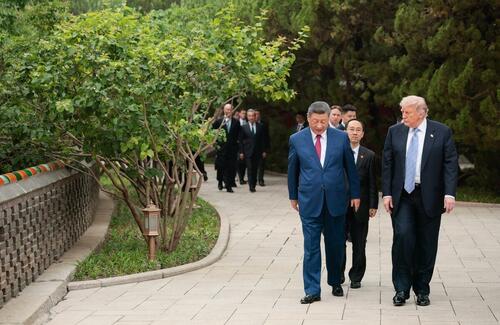
Trump-Xi Summit: AI at the Core of U.S.-China Tech Rivalry
The upcoming Trump-Xi meeting underscores AI's role in U.S.-China strategic competition, backed by converging performance metrics, massive investment gaps, and China's manufacturing edge.
As President Donald Trump prepares to host Chinese leader Xi Jinping at the White House on September 24, 2026, the bilateral agenda encompasses trade, tariffs, rare earths, Taiwan, and the Iran conflict. Yet AI emerges as a pivotal undercurrent, reflecting a broader shift in geopolitical competition toward technological supremacy. Credible reporting confirms the summit follows Trump's May 2026 visit to Beijing and a prior October 2025 meeting in South Korea, with expectations of tariff truce extensions and commercial deals. Reuters explicitly notes global concerns over artificial intelligence as a discussion point alongside traditional flashpoints. The Financial Times highlights AI governance as a summit topic, though likely limited to dialogue rather than binding restraints, given U.S. emphasis on dominance and China's push for self-reliance. Stanford's 2026 AI Index Report substantiates narrowing capability gaps: U.S. and Chinese frontier models have traded leads since early 2025, with the top U.S. model holding just a 2.7% edge over its Chinese counterpart as of March 2026 on key benchmarks. U.S. private AI investment reached $285.9 billion in 2025—over 23 times China's $12.4 billion—yet China leads in AI publications, citations, patents, and industrial robot deployments. The International Federation of Robotics reports China installed 295,000 industrial robots in 2024, representing 54% of global installations and enabling tight integration of AI with manufacturing at unprecedented scale. This robotics advantage fosters a data-AI-robotics feedback loop, amplified by China's open-source model ecosystem, including Alibaba's Qwen derivatives. Xi's objectives likely include easing U.S. chip restrictions and advancing Beijing's Global AI Governance Initiative, which prioritizes cooperation without halting aggressive development. The summit thus signals technology as the new arena for influence, where manufacturing scale and model adaptability may offset investment disparities.
Analyst: AI integration with physical infrastructure will increasingly determine strategic leverage, favoring nations that combine model performance with scalable deployment.
Sources (5)
- [1]Factbox-What will Trump and Xi discuss in Washington next week?(https://www.reuters.com/world/what-will-trump-xi-discuss-washington-next-week-2026-09-17/)
- [2]The main Trump-Xi summit achievement will be it happening at all(https://www.ft.com/content/86078ee7-0c8a-4d2b-8ce7-4fc47d965985)
- [3]Stanford AI Index 2026: US-China model gap down to 2.7%(https://aiweekly.co/alerts/stanford-ai-index-2026-us-china-model-gap-down-to-27)
- [4]International Federation of Robotics World Robotics 2025(https://ifr.org/worldrobotics/report-2025)
- [5]CSIS Press Briefing: Previewing the Trump-Xi Summit(https://www.csis.org/analysis/csis-press-briefing-previewing-trump-xi-summit)