Orbital Fragility: Blue Origin's Upper Stage Failure Exposes Concentrated Risks in Private Space Connectivity Bets
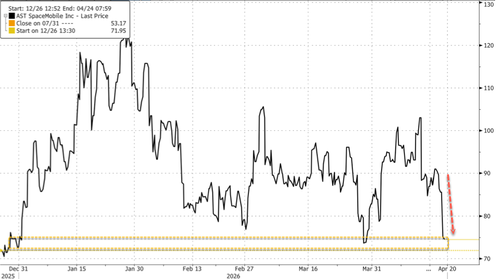
Blue Origin's successful New Glenn booster reuse was marred by an upper stage failure placing AST SpaceMobile's BlueBird 7 into an unsustainably low orbit, resulting in its deorbit and a sharp 10-14% drop in ASTS stock. This underscores the extreme fragility and single points of failure in private satellite mega-constellations promising direct-to-cell global connectivity.
Blue Origin achieved a milestone on April 19, 2026, by successfully reusing its New Glenn first stage booster 'Never Tell Me The Odds,' which landed precisely on the drone ship Jacklyn following liftoff from Cape Canaveral. Yet this success was overshadowed by an upper stage anomaly that placed AST SpaceMobile's BlueBird 7 satellite into an off-nominal, excessively low orbit. The spacecraft powered on after separation but lacked sufficient altitude for its thrusters to maintain operations, leading to a planned deorbit and atmospheric burn-up. AST SpaceMobile confirmed the satellite's cost would be covered by insurance.[1][2]
This incident reveals the profound fragility inherent in private space infrastructure projects. While reusable rocket technology—now demonstrated by both SpaceX and Blue Origin—represents engineering progress beyond what state-backed programs in some nations have achieved, it masks deeper systemic vulnerabilities. AST SpaceMobile's vision of a space-based cellular broadband network capable of connecting ordinary mobile phones globally depends on rapid, reliable deployment of its massive BlueBird satellites, each boasting enormous phased-array antennas. A single launch insertion error cascades into lost time, market confidence, and deployment momentum for an entire constellation.[3][4]
The market's reaction was immediate and severe: AST SpaceMobile shares dropped 10-14% in premarket trading, erasing much of the company's year-to-date gains and underscoring how investor enthusiasm for these 'breakthrough' connectivity plays can evaporate on one technical shortfall. Analysts noted experience gained from the integration process and pointed out that only one satellite was lost rather than the eight potentially manifested on future New Glenn flights. However, this misses the larger pattern: the space economy's reliance on a tiny cohort of launch providers creates concentrated points of failure. Delays for one player ripple across partnerships, supply chains, and competing mega-constellations.[5][6]
Connections emerge when viewing this through the lens of heterodox risk analysis. Private space ventures promise decentralized, revolutionary infrastructure—global internet, direct-to-device comms—yet remain beholden to experimental vehicles still refining upper stage performance. Blue Origin's achievement in booster reuse is real, yet the 'off-nominal orbit' from the second stage echoes historical teething pains across new rockets. Insurance mitigates direct financial loss but cannot insure against schedule slips in a race where first-mover advantage and spectrum rights are paramount. This fragility is compounded by the billionaire-led duopoly of launch capacity; when New Glenn stumbles, it indirectly elevates the relative reliability narrative around competitors while exposing how few entities control access to orbit.[7]
Deeper still, such events challenge the narrative of inevitable technological convergence toward seamless global connectivity. The deorbiting of BlueBird 7 is not merely a lost satellite but a reminder that orbital real estate and precise insertion remain unforgiving domains where hype around 'private space breakthroughs' collides with physical and engineering realities. As AST SpaceMobile continues manufacturing additional BlueBirds and lines up future launches, this episode highlights that the pathway to orbital infrastructure is narrower and more precarious than promotional materials suggest—built on interdependent systems where one vector deviation can reset timelines and valuations.
Liminal Analyst: One upper-stage anomaly can erase months of progress and millions in market value, proving private space connectivity dreams rest on remarkably narrow technical margins vulnerable to cascading delays.
Sources (5)
- [1]Blue Origin reuses New Glenn rocket; satellite goes into wrong orbit(https://www.geekwire.com/2026/blue-origin-uses-a-recycled-rocket-to-launch-satellite-for-ast-spacemobile/)
- [2]AST SpaceMobile Declares Satellite Lost After New Glenn Launch(https://aviationweek.com/space/launch-vehicles-propulsion/ast-spacemobile-declares-satellite-lost-after-new-glenn-launch)
- [3]AST falls after Bezos' Blue Origin places satellite in wrong orbit(https://www.cnbc.com/2026/04/20/ast-falls-after-bezos-blue-origin-places-satellite-in-wrong-orbit.html)
- [4]Blue Origin's New Glenn put a customer satellite in the wrong orbit during its third launch(https://techcrunch.com/2026/04/19/blue-origins-new-glenn-put-a-customer-satellite-in-the-wrong-orbit-during-its-third-launch/)
- [5]Giant BlueBird 7 mobile phone satellite will be deorbited(https://www.space.com/space-exploration/launches-spacecraft/blue-origin-just-launched-the-giant-bluebird-7-mobile-phone-satellite-into-space-but-its-in-the-wrong-orbit)