France's Orion 26 Reveals Europe's Accelerating Pivot to Survivable, Peer-Level Command
Orion 26 demonstrates France's new mobile corps command post designed for high-intensity peer conflict, signaling broader European military resurgence. The exercise integrates multinational divisions under French leadership, incorporates hard lessons from Ukraine on C2 survivability, and aligns with NATO burden-sharing goals. Analysis reveals accelerating preparedness that mainstream coverage understates, while highlighting persistent gaps in stockpiles, interoperability, and political commitment.
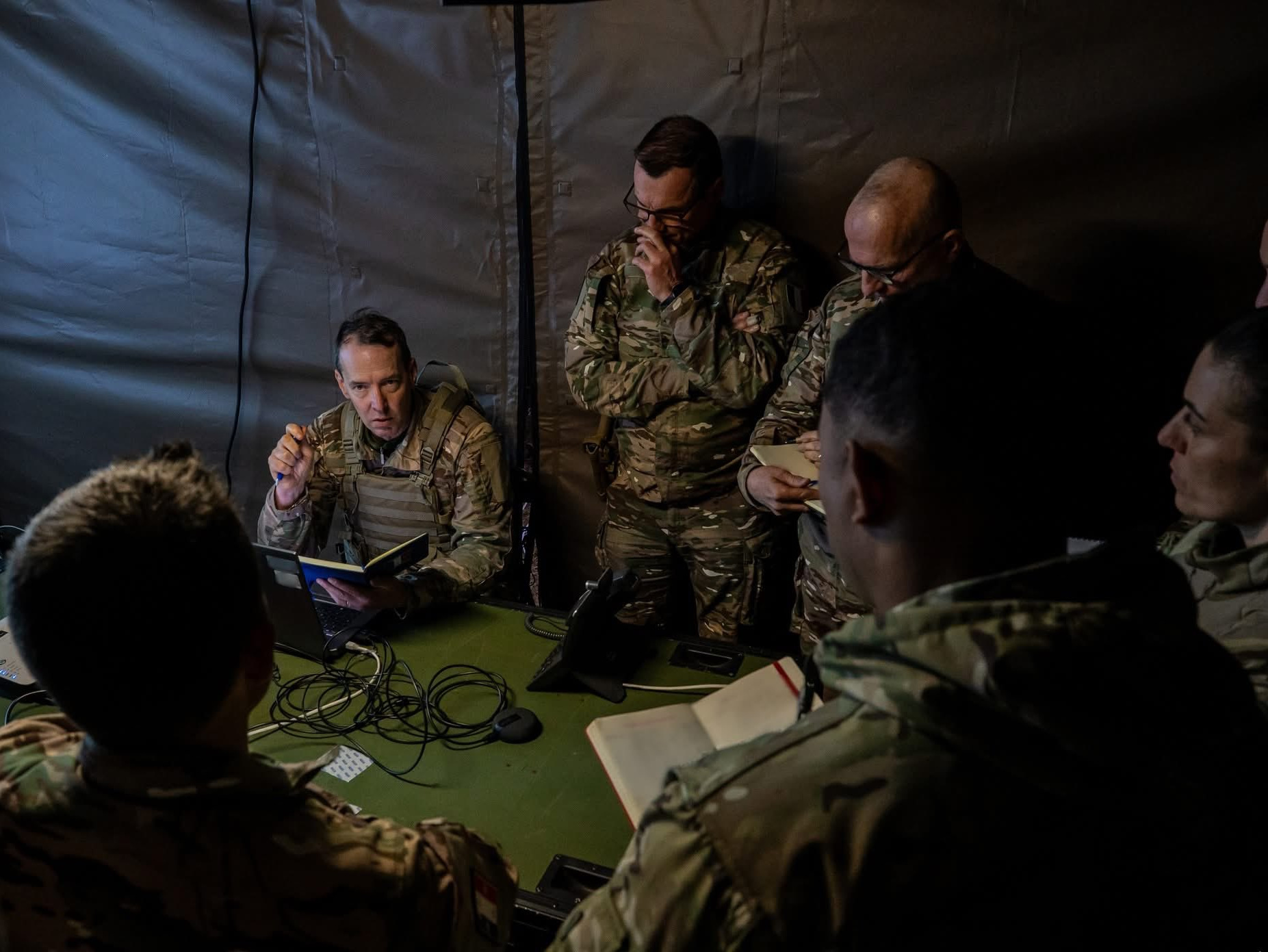
France’s Orion 26 exercise, conducted in April 2026 near Poitiers, tested the 1st Army Corps’ new mobile command post (CP1) in a high-intensity, multi-division scenario involving 120,000 troops from France, Poland, Britain, Italy, and Spain. While the Defense News coverage accurately described the austere forward post under camouflage netting and Gen. Benoît Desmeulles’ emphasis on shrinking the OODA loop, it underplayed the deeper strategic shift this represents: Europe’s accelerating preparation for sustained peer conflict against a near-peer adversary, most likely Russia, without automatic dependence on U.S. command nodes.
The original reporting correctly notes the departure from static NATO rear-area headquarters toward armored, relocatable C2 under the SCORPION modernization program. Yet it missed the broader pattern. Since Russia’s full-scale invasion of Ukraine in 2022, Western armies have absorbed the same lesson: distance no longer equals safety. Ukrainian Maj. Gen. Volodymyr Horbatiuk’s recent Modern War Institute discussion highlighted how Russian Lancet drones, Iskanders, and electronic warfare have rendered traditional fixed corps posts obsolete. France has internalized this without simply copying Ukrainian tactics. Desmeulles referenced Gulf War maneuver warfare and even WWII corps command mobility, signaling an attempt to fuse historical precedent with 21st-century survivability requirements.
This exercise must be read alongside two other developments. First, NATO’s 2024 Regional Defense Plans, which assign specific corps-level responsibilities to framework nations. France positioning itself as a continental European corps provider directly supports Washington’s long-standing demand for burden-sharing while advancing Macron’s “strategic autonomy” agenda. Second, the IISS’s 2025 “European Military Balance” report documented a 19% real-terms increase in European land-force modernization budgets since 2022, with France, Poland, and Germany leading investments in armored C2, dispersed logistics, and electronic warfare resilience. Orion 26 validates these investments in practice.
What mainstream coverage largely omitted is the political signaling. By designing CP1 around six VAB armored vehicles (soon to transition to Griffon), France is demonstrating it can lead a 120,000-strong formation while remaining mobile within 80–100 km of the forward edge—inside the lethal “WEZ” (Weapons Engagement Zone) that Russian and Chinese doctrine seek to create. The reduction from 500 to 50 personnel at the forward node is not merely efficiency; it reduces the signature and decision-making friction that doomed Russian battalion tactical groups in 2022.
Connections to wider European preparedness are clear. Germany’s Zeitenwende has produced the new “Panzerdivision 2025” concept emphasizing exactly this mix of dispersion and forward command. The UK’s 2021 Integrated Review Refresh and subsequent Army restructuring toward lighter, more deployable forces find logical partnership with French corps leadership. Poland’s massive artillery and armored expansion provides the mass. Together these pieces suggest an emergent, if still fragmented, European conventional deterrent layer that can function even if U.S. attention is diverted toward the Indo-Pacific.
Challenges remain unaddressed by both the exercise narrative and much reporting. Interoperability between French, Polish, and British digital C2 systems is improving but not seamless. Ammunition and fuel consumption rates in a real high-intensity fight still exceed current stockpiles across Europe, as noted in the 2024 EU Joint Support Coordination Cell assessments. Most critically, the political decision to actually employ such a corps under fire—without U.S. Article 5 invocation—remains untested.
Orion 26 should therefore be seen not as a single exercise but as part of a quiet remilitarization of European strategic culture. After three decades optimized for counterinsurgency and stabilization, major NATO powers are rediscovering the demanding requirements of corps-level maneuver against sophisticated adversaries. France’s willingness to invest in survivable forward command, to act as framework nation, and to integrate partners inside a realistic scenario reveals genuine momentum. The mobile tent under multispectral netting in a western French meadow is, paradoxically, one of the clearest indicators yet that Europe is preparing for the possibility that the next major conflict may have to be fought primarily by Europeans themselves.
SENTINEL: France's validated mobile corps command in Orion 26 will likely become the template for two additional European framework corps by 2030, strengthening conventional deterrence on NATO's eastern flank even as U.S. forces face growing Indo-Pacific demands.
Sources (3)
- [1]France puts mobile corps command to the test in major war scenario(https://www.defensenews.com/global/europe/2026/04/15/france-puts-mobile-corps-command-to-the-test-in-major-war-scenario/)
- [2]European Military Balance 2025(https://www.iiss.org/publications/the-military-balance/2025/)
- [3]Survivability of Command Posts: Lessons from Ukraine(https://mwi.westpoint.edu/survivability-of-command-posts-lessons-from-ukraine/)