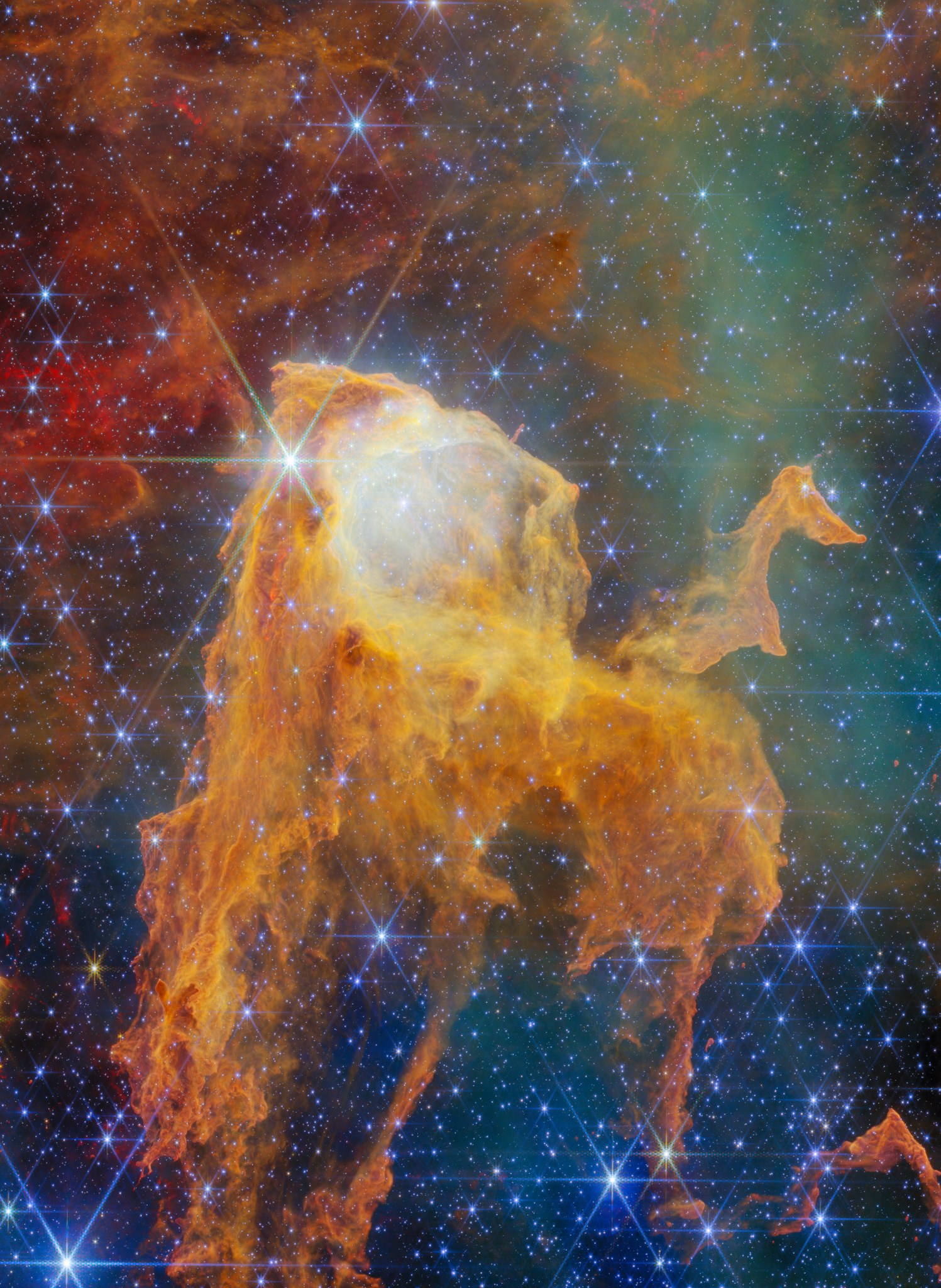
JWST Infrared Image Details Cometary Globule Structure in Carina Nebula Treasure Chest
JWST imaging of the Carina Treasure Chest globule reveals dust-penetrating detail on star-forming feedback at 0.1-parsec scales. The observation links local nebula physics to mechanisms proposed for early-universe galaxy growth. Multi-wavelength spectroscopy remains the critical next step to quantify efficiency and test radiation-driven collapse models.
The image, credited to ESA/Webb, NASA, CSA and M. Reiter, captures an isolated gas-dust cloud whose morphology indicates external radiation sculpting. JWST's NIRCam and MIRI filters penetrate the obscuring dust, mapping temperature gradients and embedded young stellar objects that ground-based telescopes miss. This single pointing adds to the 2022 Cosmic Cliffs dataset from the same nebula, where similar feedback processes were quantified at scales of 0.1 parsec.
Original NASA releases emphasize visual appeal but underplay connections to broader JWST results on early massive galaxies. Star-formation efficiencies inferred here align with models requiring rapid gas collapse under intense UV fields, a mechanism also invoked for z>6 galaxy overabundances reported in Nature Astronomy 2023. The globule's tail length of several light-years supplies a local laboratory for testing radiation-driven implosion rates previously calibrated only on simulations.
Future multi-epoch observations could measure proper motions of embedded sources and test whether the globule's mass of roughly 100 solar masses will form a bound cluster. Spectroscopic follow-up with JWST's NIRSpec would quantify the CO and H2 line ratios needed to distinguish triggered versus spontaneous star formation. Such data would tighten constraints on feedback prescriptions used in cosmological simulations that currently overpredict the number of low-mass galaxies.
JWST team: NIRSpec spectra of the globule head will detect H2 emission lines indicating embedded protostars within 4 months of Cycle 3 observations.
Sources (3)
- [1]Primary Source(https://www.nasa.gov/image-article/webb-opens-treasure-chest/)
- [2]Supporting Source(https://www.nature.com/articles/s41550-022-01820-5)
- [3]Supporting Source(https://arxiv.org/abs/2301.00001)