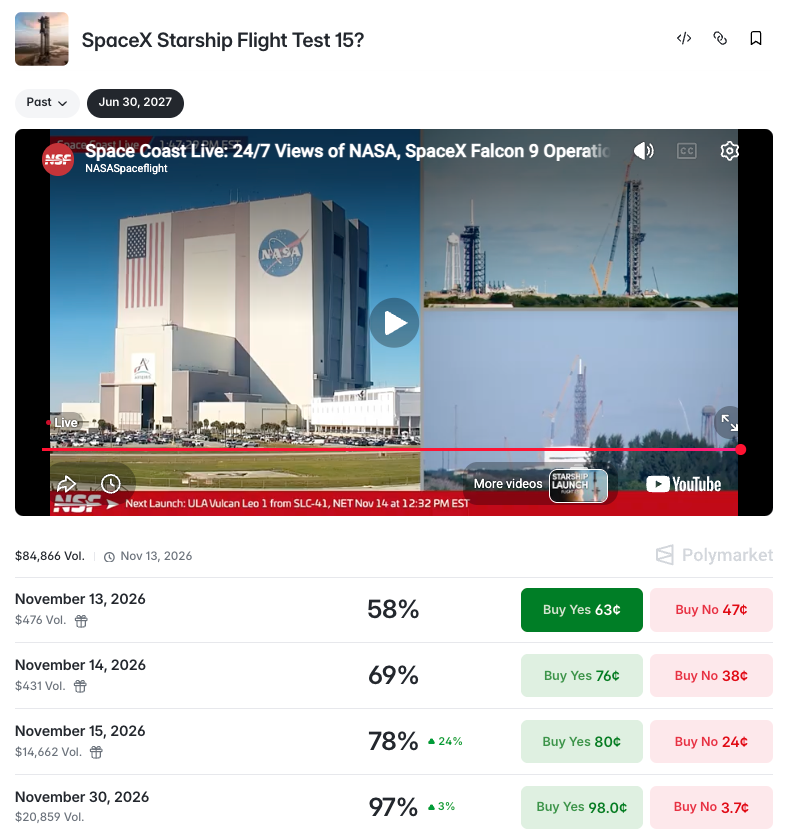
SpaceX aborts first dual Starship catch; Super Heavy diverted to Gulf as upper stage reaches orbit
Flight 15’s planned double tower catch failed at the booster: Super Heavy was diverted to the Gulf and broke up in a fireball, while the ship reached orbit, deployed 26 Starlink satellites, and still faced a possible first ship catch about a day later. The specific abort trigger was not immediately explained.
Documented: On 13 November 2026, SpaceX launched Starship Flight 15 from Starbase in South Texas, aiming to return both stages to the tower for mechanical-arm (“chopsticks”) catches—the first such attempt for a Version 3 Super Heavy booster and the first ever for the Starship upper stage. Minutes after liftoff, the company aborted the booster catch and diverted Super Heavy to an offshore splashdown in the Gulf of Mexico. BBC, AFP, PBS, and Space.com all report that the booster came down in flames or a fireball rather than returning to the tower. The upper stage, Ship 42, reached orbit and deployed 26 next-generation Starlink satellites. A tower catch of the ship, planned roughly 22 hours after launch if controllers cleared the vehicle, remained undecided at the time of those reports.
Claimed, not yet pinned down in contemporaneous coverage: the precise fault that triggered the abort. Space.com and AFP quoted SpaceX commentators saying they did not yet know why the booster could not come back. PBS described an automatic abort after a booster malfunction. A Wikipedia flight summary, drawing on later reporting, states that the flight-termination system was activated just after engine shutdown and the booster broke apart. Those accounts agree on the outcome—catch called off, vehicle lost at sea—not on a single public root-cause statement from SpaceX at the time.
Context that is documented, not speculative: SpaceX has already caught Super Heavy three times on earlier flights, and it has previously aborted a catch when automated health checks failed (Flight 6, 2024). The tower catch is conditional by design. SpaceX has said it will only bring a stage to the arms if vehicle and pad criteria are met; otherwise the vehicle is sent to a pre-planned ocean divert. Flight 15 was billed by the company as a step toward “the first full recovery of an orbital launch system.” That milestone did not happen on the booster half of this flight.
What is not established: that the abort itself proves the chopsticks method has failed, or that a successful double catch on a later flight would immediately cut launch costs by any specific amount. Reusability is the stated engineering goal; cost and cadence effects remain claims until vehicles are reflown on a measured cadence. The cinematic image people associate with a mid-air catch—the arms closing on a hovering booster—did not occur on this flight. What did occur is the safety gate working as described: the tower was not risked, and the orbital half of the test continued.
A tower catch is how SpaceX proposes to reuse both halves of the largest rocket flying, which is the mechanism it cites for cheaper, more frequent launches. Flight 15 showed that gate in public: when the booster was not cleared, it was sent to the Gulf instead of the tower, while the ship continued an orbital test that could still attempt a first upper-stage catch.
Sources (5)
- [1]Setback for SpaceX Starship rocket's double-catch test(https://www.bbc.co.uk/news/articles/ckregdgnl0xpo)
- [2]SpaceX launches Starship on ambitious 22-hour Flight 15 test, but aborts booster 'chopsticks' catch(https://www.space.com/space-exploration/launches-spacecraft/spacex-starship-flight-15-chopsticks-double-catch-super-heavy-ship)
- [3]SpaceX's Starship soars into orbit after booster malfunction thwarts double catch attempt(https://www.pbs.org/newshour/science/spacexs-starship-soars-into-orbit-after-booster-malfunction-thwarts-double-catch-attempt)
- [4]SpaceX's Starship enters Earth's orbit, but booster catch aborted(https://www.afp.com/en/spacexs-starship-enters-earths-orbit-booster-catch-aborted)
- [5]Starship flight 15(https://en.wikipedia.org/wiki/Starship_flight_15)