The AI Data Center Explosion: 4,900 Facilities Poised to Reshape Rural Power Grids, Real Estate, and Community Fabric
Corroborated data reveals over 4,900 AI-driven data centers operational or planned in the US, with a major shift to rural areas creating clustered infrastructure that strains power grids, consumes vast water resources, generates constant noise and emissions, and sparks growing community opposition now influencing local politics and 2026 elections. This under-examined buildout risks higher energy costs, transformed real estate, and quality-of-life declines for millions living nearby.
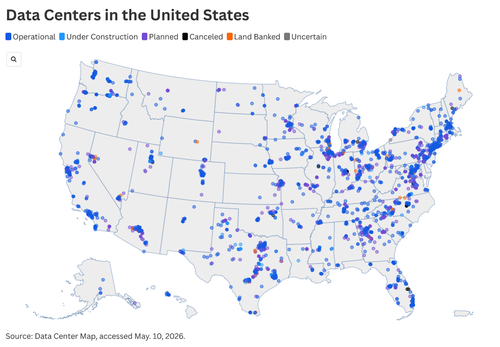
While Silicon Valley garners headlines for AI breakthroughs, a parallel physical transformation is underway across America. Recent analyses confirm the United States operates over 3,000 data centers with more than 1,500 additional facilities in various stages of planning or construction, bringing the total near 4,900. These massive installations, essential for training and running AI models, are shifting from urban cores to rural and suburban communities, with 67% of planned centers targeted for rural areas compared to just 13% of existing ones. Clusters are the norm: nine in ten data centers sit within five miles of another, meaning 38% of Americans currently live within five miles of an operating facility, rising to 42% including planned sites.
This infrastructure boom carries profound under-discussed consequences for local power grids, real estate patterns, and community stability. Data centers are voracious consumers of electricity and water—some facilities can draw power equivalent to tens of thousands of homes and consume millions of gallons of water daily for cooling. Utilities face unprecedented strain, with reports indicating nearly half of planned 2026 projects facing delays or cancellations due to shortages of transformers, grid infrastructure, and electrical equipment. This competition for capacity risks driving up residential energy costs and slowing broader electrification efforts.
Real estate impacts extend beyond zoning disputes. Rural land once used for agriculture is being repurposed into industrial-scale server farms, often in clusters that create de facto "data center alleys." In places like Virginia's Prince William County, residents describe living near constant industrial noise resembling a "motorcycle running 24/7," alongside backup diesel generators that produce air pollution and potential health risks. Water contamination fears and high-voltage infrastructure add to quality-of-life concerns, with some communities labeling their experience as "living in hell."
Grassroots opposition has coalesced into a national movement, with activist groups in over 40 states organizing against projects. In Southern Ohio, groups like Southern Ohio Responsible Development secured a six-month moratorium on a hyperscale project, citing resource strain on small towns. Cancellations reached at least 25 projects in 2025 alone—nearly four times the prior year—with an estimated $152 billion in investments blocked or delayed. This momentum is building toward the 2026 elections, as local officials face voter backlash over tax incentives, grid prioritization for tech giants, and diminished quality of life.
Pew Research Center analyses reveal public sentiment tilts negative: far more Americans view data centers as harmful to the environment, household energy bills, and nearby livability than beneficial. Yet developers promise efficiency improvements and economic contributions via jobs and tax revenue. The deeper connection missed in typical coverage is structural: AI's exponential computational demands are materializing as an invisible industrial revolution. This isn't abstract cloud computing—it's the colonization of physical landscapes, energy flows, and rural character by hyperscale infrastructure. Without coordinated policy on siting standards, water recycling mandates, or dedicated clean power procurement, communities will continue bearing disproportionate costs while Big Tech reaps the gains. The AI race is remaking America's geography one data center at a time.
LIMINAL: The AI data center surge will overload local power infrastructure and industrialize rural America, forging unexpected political coalitions of residents, ratepayers, and environmentalists against unchecked hyperscale development.
Sources (5)
- [1]Most new data centers in the U.S. are coming to rural areas(https://www.pewresearch.org/short-reads/2026/04/13/most-new-data-centers-in-the-us-are-coming-to-rural-areas/)
- [2]Data Center Neighbors Grapple With Noise, Air Pollution(https://www.usnews.com/news/national-news/articles/2026-04-28/living-in-hell-data-center-neighbors-grapple-with-noise-air-pollution)
- [3]Why more residents are saying 'No' to AI data centers in their backyards(https://www.npr.org/2025/07/17/nx-s1-5469933/virginia-data-centers-residents-saying-no)
- [4]Data center cancellations pile up as Virginians voice opposition(https://virginiaindependentnews.com/infrastructure/data-center-cancellations-pile-up-as-virginians-voice-opposition/)
- [5]Half of planned US data center builds have been delayed or canceled(https://www.tomshardware.com/tech-industry/artificial-intelligence/half-of-planned-us-data-center-builds-have-been-delayed-or-canceled-growth-limited-by-shortages-of-power-infrastructure-and-parts-from-china-the-ai-build-out-flips-the-breakers)