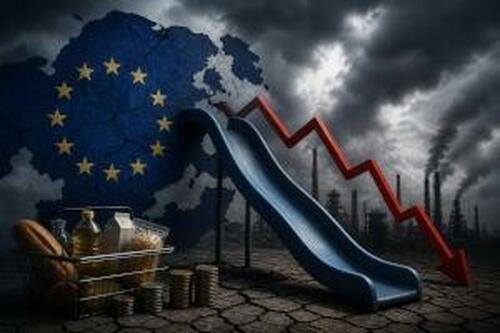
Europe's Stagflation Trap: Policy Rigidity, Energy Shocks, and the Brewing Crisis of Inequality
Synthesized analysis confirms Europe's April 2026 slide toward stagflation via weak PMI, plunging confidence, and rising prices amid the Iran war energy shock. Going beyond mainstream reporting, it connects post-COVID policy missteps, ideological energy constraints, and central bank approaches to heightened risks of inequality and social unrest.
As of April 2026, Europe finds itself at the precipice of stagflation, with the S&P Global flash composite PMI plunging to 48.6—below the critical 50 threshold signaling contraction in both manufacturing and services—while input costs surge at the fastest pace since late 2022 and selling prices hit 37-month highs consistent with consumer inflation nearing 4%. Consumer confidence has collapsed to -20.6 in the euro area per European Commission flash estimates, the weakest since 2022. These figures, corroborated across multiple outlets, echo the vulnerabilities exposed during the 2022 energy crisis but are compounded by the ongoing impacts of the Iran conflict disrupting global LNG markets and driving energy prices higher. While ECB President Christine Lagarde has rejected the 'stagflation' label, insisting the situation differs from the 1970s, Bloomberg reports that the euro-area economy slowed unexpectedly at the start of 2026 amid soaring oil and gas costs. Politico and Reuters highlight how the private sector contracted in April for the first time in months, with services—previously the growth engine—experiencing the sharpest decline since pandemic lockdowns. This is not merely a temporary geopolitical shock. It reveals deeper structural failures: decades of high taxes, excessive regulation, rigid labor markets, low productivity growth, and an ideological industrial policy that has limited domestic energy development, including nuclear restarts and diversified long-term contracts. The IMF's April 2026 analysis projects euro area growth at a meager 1.1% for the year, warning that persistent supply shocks from the Middle East could push the region toward technical recession with inflation approaching 5% in severe scenarios. Post-COVID fiscal expansions and repeated interventionist responses—subsidies, windfall taxes, and rationing rhetoric—have failed to build resilience. Instead, they have entrenched dependency and complacency. Mainstream forecasts often emphasize optimistic rebounds or dismiss stagflation fears, yet this downplays the heterodox connections: how prolonged loose-then-tight central bank policies, combined with green transition mandates that constrain energy supply, accelerate deindustrialization. Manufacturing output relies precariously on stock-building rather than demand, while supplier delivery times lengthen akin to 2022 disruptions. These dynamics exacerbate inequality. Higher costs pass through to consumers via elevated prices, disproportionately burdening lower-income households already strained by post-pandemic inflation and wage stagnation. Rising energy poverty, potential demand controls, and further taxation risk fueling social unrest, patterns observable in prior European crises but frequently minimized in official narratives. By prioritizing ideological constraints over pragmatic supply-side reforms, policymakers have transformed every external shock into an internal emergency. Without addressing productivity, over-regulation, and energy security, Europe risks a self-reinforcing cycle of stagnation, inflation, and widening societal fractures that could extend well beyond 2026.
LIMINAL: Central bank policies ignoring structural rigidities and energy dependence will likely widen inequality, eroding the middle class and triggering social unrest in key EU economies before the end of 2026.
Sources (5)
- [1]EU Economy Slows, Inflation Up -- Just Don’t Call It Stagflation(https://www.bloomberg.com/news/newsletters/2026-04-30/eu-economy-slows-inflation-up-just-don-t-call-it-stagflation)
- [2]Stagflation warning lights flash for the eurozone as private sector contracts in April(https://www.politico.eu/article/stagflation-warning-lights-flash-the-eu-eurozone-private-sector-contracts-april/)
- [3]Euro zone economy close to stalling as war takes its toll(https://www.reuters.com/world/europe/euro-zone-growth-nearly-stalls-middle-east-war-fuels-inflation-surge-pmi-shows-2026-03-24/)
- [4]Reforming Europe Under Pressure(https://www.imf.org/en/blogs/articles/2026/04/17/reforming-europe-under-pressure)
- [5]S&P Global Flash Eurozone PMI(https://www.pmi.spglobal.com/Public/Home/PressRelease/89d5df92554f42589275c1d9ddb5fde3)