Gulf States Accelerate Hormuz Bypass Infrastructure Amid 2026 Disruptions, Signaling Structural Energy Security Shift
Credible mainstream sources confirm UAE's zero-Hormuz push via pipelines and ports, alongside Saudi and regional diversification efforts, amid 2026 disruptions—pointing to a lasting reconfiguration of Gulf energy exports.
Recent reporting confirms that the United Arab Emirates is advancing plans to achieve 'zero Hormuz dependency' through expanded pipelines, ports, and transport links on its eastern coast, independent of the Strait's status. UAE Minister of Foreign Trade Thani Al Zeyoudi stated in a Bloomberg interview: 'We’re moving toward having zero Hormuz dependency and that’s regardless of whether it’s open or not.'[1][2]
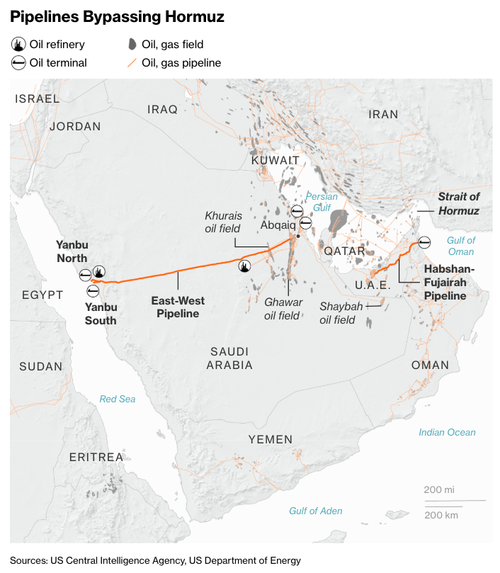
This aligns with a broader regional response to the 2026 Strait of Hormuz crisis, during which Iran restricted shipping flows following US-Iran conflict. Abu Dhabi has fast-tracked a second crude pipeline to Fujairah, with construction already ~50% complete and targeting doubled export capacity (building on the existing Habshan-Fujairah line of ~1.8 million bpd) by 2027.[3][4] Additional reviews for petrochemicals, LNG, and new harbors on the Gulf of Oman are underway.
Saudi Arabia's East-West pipeline (Petroline) ramped up to its full 7 million bpd capacity during the disruption, routing oil from Persian Gulf fields to Red Sea terminals at Yanbu.[5][6] Kuwait has held talks with Saudi Arabia and the UAE on potential cross-border pipelines to further diversify options.[7] Iraq is accelerating shipments via the Kurdistan-Turkey network.
These developments, corroborated across Bloomberg, Reuters, CNBC, Al Jazeera, The National, and Financial Times, indicate a physical rewiring of export routes that could diminish the strategic leverage of the Hormuz chokepoint over time. While LNG and non-oil commodities remain harder to reroute, the infrastructure push reflects a long-term adaptation to repeated chokepoint vulnerabilities.
[Energy Analyst]: Long-term bypass capacity growth will structurally reduce Hormuz's role as a single-point lever, accelerating diversified Gulf export networks even after any reopening.
Sources (7)
- [1]UAE Moves to Cut Dependency on Strait of Hormuz to ‘Zero’(https://www.bloomberg.com/news/articles/2026-06-17/uae-moves-to-cut-dependency-on-strait-of-hormuz-to-zero)
- [2]UAE aims to cut dependency on Strait of Hormuz to 'zero' with major ports expansion plan(https://www.thenationalnews.com/business/energy/2026/06/17/uae-aims-to-cut-dependency-on-strait-of-hormuz-to-zero-with-major-ports-expansion-plan/)
- [3]UAE says new pipeline that will bypass Strait of Hormuz is nearly half complete(https://www.cnbc.com/2026/05/20/uae-pipeline-strait-hormuz-iran-war-oil.html)
- [4]UAE to accelerate oil pipeline project to bypass Strait of Hormuz(https://www.reuters.com/business/energy/uae-accelerate-oil-pipeline-project-help-bypass-hormuz-2026-05-15/)
- [5]UAE to accelerate oil pipeline project to bypass Strait of Hormuz(https://www.aljazeera.com/news/2026/5/15/uae-to-accelerate-oil-pipeline-project-to-bypass-hormuz)
- [6]Persian Gulf states explore pipeline projects to bypass Strait of Hormuz(https://www.iranintl.com/en/202606034322)
- [7]Amid regional conflict, the Strait of Hormuz remains critical...(https://www.eia.gov/todayinenergy/detail.php?id=65504)