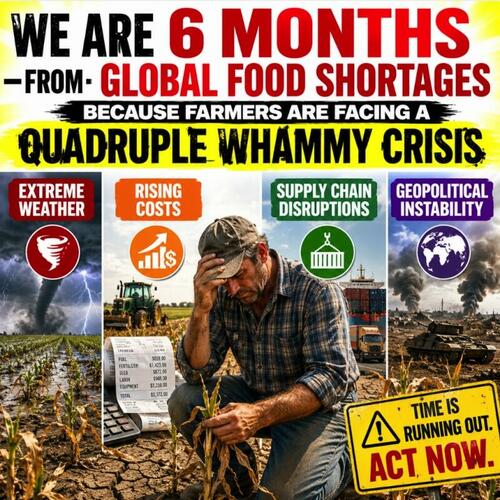
Quadruple Whammy on Global Farms: Fertilizer Crisis, Super El Niño, Surging Costs, and Labor Shortages Signal Systemic Food Risk
UN FAO and UNDP warnings, combined with Super El Niño forecasts, validate risks of global food shortages from late 2026 due to Hormuz disruptions slashing fertilizer access, extreme weather hitting yields, record input costs, and regulatory/labor pressures on farmers—creating interconnected systemic threats to stability.
As of mid-2026, the world faces an underreported convergence of pressures on agriculture that could trigger widespread food shortages and price spikes starting in late 2026 into 2027. The United Nations Food and Agriculture Organization (FAO) has repeatedly warned that disruptions to the Strait of Hormuz—through which roughly one-third of globally traded fertilizer and significant energy supplies pass—have created acute shortages. Following escalation of conflict in the Middle East from late February 2026, shipping collapsed, fertilizer prices exploded, and farmers worldwide scaled back applications during critical planting windows. FAO Director-General QU Dongyu and Chief Economist Máximo Torero have stated that these effects will manifest in lower yields for the latter half of 2026 and into 2027, with food price inflation likely to accelerate unless urgent corrective actions are taken on imports, subsidies, and crop planning. UNDP Administrator Alexander De Croo echoed this in May 2026 interviews, predicting food shortages hitting many regions from September or October 2026 onward due to the fertilizer production plunge tied to high oil prices.
This is compounded by a developing 'Super El Niño,' which climate experts warn could produce more extreme droughts and weather volatility than the devastating 1877-1878 event. Projections indicate severe impacts on staple crops across South and Southeast Asia, Australia, Southern Africa, and parts of the Americas, with weakened monsoons in India, drought-stressed rice and wheat production in Thailand and Vietnam, and reduced maize yields in key African zones. Historical patterns and current modeling show El Niño events already reduce yields across 22-24% of global harvested areas; when layered atop fertilizer constraints, the effect multiplies. U.S. farmers, particularly in drought-hit West Texas and California, report cracked fields, stunted crops, and diesel prices exceeding $7 per gallon in some areas, squeezing margins further.
The 'quadruple whammy' extends beyond the original reporting on costs and weather. Labor shortages have intensified as migrant workers face mobility disruptions from regional instability and tighter border policies, while surveys show over 75% of U.S. producers citing weakened competitiveness from regulatory burdens including environmental rules on emissions, water use, and fertilizer runoff. These regulations, while aimed at long-term sustainability, clash with immediate survival needs amid input scarcity, leading many farmers to under-apply nutrients or abandon marginal land. Connections often missed include feedback loops: failing harvests accelerate rural economic collapse, driving more labor migration away from farms; consolidated corporate agriculture gains dominance as smaller operations fail; and global just-in-time supply chains—already brittle—face simultaneous shocks to energy, nutrients, and climate-stabilized production zones.
The societal fallout could be massive and undercovered. FAO's 2026 Global Report on Food Crises highlights how fertilizer shortages, energy price spikes, and climate stress threaten to push hundreds of millions more into acute hunger, potentially reversing development gains and sparking 'food auction wars' where wealthy nations outbid poorer ones. This systemic risk extends to political instability, as seen in past price shocks correlating with unrest. Without rapid diplomatic reopening of key sea lanes, targeted fertilizer aid, or adaptive shifts toward regenerative practices less reliant on imported synthetics, the coming harvest cycle may mark a turning point toward deglobalized food systems. Real corroboration from UN agencies, economic analyses, and climate reports confirms this is not fringe alarmism but a documented, unfolding crisis demanding attention beyond headlines.
LIMINAL: The quadruple squeeze on farmers is exposing the fragility of hyper-globalized food systems; expect accelerating consolidation, social unrest in import-dependent regions, and a forced pivot to resilient local agriculture by 2028 as prices spike and shortages materialize.
Sources (6)
- [1]Strait of Hormuz crisis: Fertilizer scarcity will affect next harvests and food supplies, FAO warns(https://www.fao.org/newsroom/detail/strait-of-hormuz-crisis--fertilizer-scarcity-will-affect-next-harvests-and-food-supplies--fao-warns/en)
- [2]UNDP head warns of food shortages amid surging fertilizer prices(https://www.japantimes.co.jp/business/2026/05/19/economy/undp-head-interview-food-shortage/)
- [3]Global food crisis 2026: what's driving the next price shock(https://www.foodfacts.org/articles/global-food-crisis-2026)
- [4]How a super El Niño could trigger global famine(https://theconversation.com/how-a-super-el-nino-could-trigger-global-famine-281486)
- [5]'Clock is ticking': Hormuz disruption raises fears of global food crisis(https://news.un.org/en/story/2026/04/1167289)
- [6]2026 Global Report on Food Crises(https://openknowledge.fao.org/handle/20.500.14283/cd9424en)