Maxed-Out Bypass Pipelines Expose Iran Conflict's Immediate Strain on Global Energy Lifelines
Saudi East-West pipeline hits record 7MMb/d and UAE Fujairah nears capacity as Hormuz stays blocked amid Iran war, revealing maxed bypass infrastructure and immediate economic risks from chokepoint saturation.
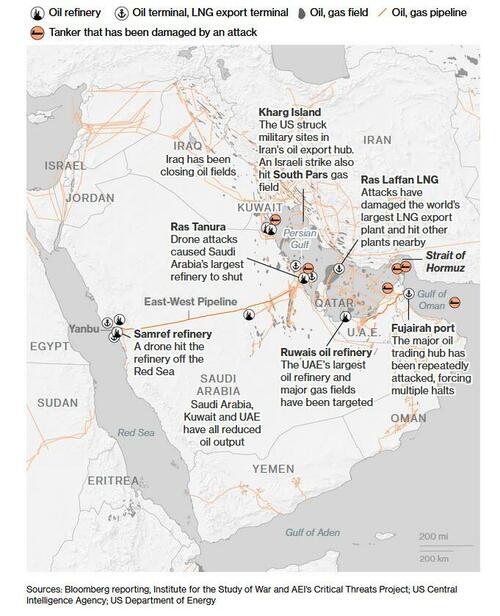
As the Strait of Hormuz remains effectively closed amid the ongoing US-Israeli conflict with Iran, Saudi Arabia's East-West pipeline has reached its full technical capacity of 7 million barrels per day, while UAE terminals at Fujairah are pushing maximum loadings despite repeated Iranian drone strikes. This rapid activation of long-planned contingency routes—originally conceived during the 1980s Iran-Iraq War—demonstrates both the foresight of Gulf producers and the severe limitations of alternatives to the world's most critical energy chokepoint.
Flows through the 1,200-kilometer Petroline to Yanbu have surged dramatically from pre-conflict averages around 1.5-2 million bpd, enabling crude exports from the Red Sea port to hit approximately 5 million bpd alongside 700,000-900,000 bpd of refined products. Of the total pipeline throughput, roughly 2 million bpd supports domestic refineries. However, this leaves a significant gap: Hormuz previously carried about 15-20 million bpd of crude and products, meaning bypasses only partially offset the disruption. A growing fleet of tankers now idles off Yanbu, creating floating storage that highlights logistical bottlenecks.
The situation in the UAE mirrors these pressures. The Habshan-Fujairah pipeline has ramped up to near its 1.5-1.8 million bpd capacity, with loadings reaching 1.9 million bpd in late March periods—up over 50% from annual averages—despite multiple Iranian attacks damaging storage tanks, manifolds, and petrochemical facilities. Operations resumed after initial halts from strikes in mid-March, but vulnerabilities persist given Fujairah's proximity to Iran. These assaults reveal Tehran's strategy not just to block Hormuz but to degrade the very infrastructure designed to circumvent it.
Deeper analysis shows this is more than a temporary rerouting: the conflict has maxed out alternative chokepoints with immediate economic fallout. Red Sea routes now face new risks from Houthi involvement, potentially turning Bab el-Mandeb into a secondary crisis zone. Global oil prices have climbed above $100 per barrel, with limited spare capacity in bypass systems signaling that any escalation could trigger acute shortages. This exposes long-underestimated dependencies—decades of planning by Aramco and ADNOC have bought time, but not unlimited resilience. Connections to broader supply chains include inflated shipping costs, delayed deliveries, and pressure on Asian importers, who rely heavily on Gulf crude. The saturation of these routes may accelerate long-term shifts toward diversified energy sources and renewed investment in pipeline and storage infrastructure across the region.
While providing a lifeline, these maximum flows underscore how the Iran conflict is already reshaping global energy security in real time, with consequences rippling into inflation, economic policy, and geopolitical realignments far beyond the Persian Gulf.
LIMINAL: Maxed bypass routes mean the Iran conflict has already eliminated slack in global oil logistics, risking cascading shortages and sustained high prices if Red Sea threats materialize or attacks intensify.
Sources (5)
- [1]Saudi Pipeline Hits Capacity as Hormuz Remains Shut(https://www.bloomberg.com/news/live-blog/2026-03-28/iran-latest)
- [2]Yanbu Exports at Record Pace as Saudi Bypasses Hormuz(https://www.wsj.com/business/energy-oil/yanbu-exports-at-record-pace-as-saudi-bypasses-hormuz-3b358ba1)
- [3]Saudi, UAE, Iraq: Can three pipelines help oil escape Strait of Hormuz(https://www.aljazeera.com/economy/2026/3/27/saudi-uae-iraq-can-three-pipelines-help-oil-escape-strait-of-hormuz)
- [4]Gulf oil producers scramble to bypass Hormuz as Iran locks down the strait(https://www.reuters.com/graphics/IRAN-CRISIS/MAPS/znpnmelervl/2026-03-17/gulf-oil-producers-scramble-to-bypass-hormuz-as-iran-locks-down-the-strait/)
- [5]UAE's Fujairah resumes oil loadings after attack, sources say(https://www.reuters.com/business/energy/oil-loading-operations-uaes-fujairah-have-restarted-industry-source-says-2026-03-15/)