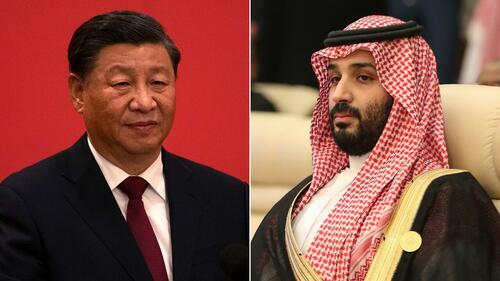
Xi's Hormuz Call with Saudi Prince Signals China's Emergence as Middle East Power Broker
Xi Jinping's direct call for reopening the Strait of Hormuz during talks with Saudi Crown Prince MBS marks Beijing's most assertive Middle East diplomatic move to date, amid a 2026 crisis triggered by strikes on Iran. While US-focused narratives dominate, this reveals China's emerging role as energy security guarantor and peace broker, building on prior Saudi-Iran mediation and exposing accelerating multipolarity in global chokepoint governance.
In a notable phone conversation on April 20, 2026, Chinese President Xi Jinping urged Saudi Arabia's Crown Prince Mohammed bin Salman to support the normalization of shipping through the Strait of Hormuz, marking the first time the Chinese leader has made such a specific public call regarding the vital chokepoint. According to official readouts, Xi stated that "normal navigation through the Strait of Hormuz should be maintained, this is in the shared interests of regional countries and the international community." He further advocated for an "immediate, comprehensive ceasefire" in the ongoing Iran-related conflict and emphasized resolving disputes through "political and diplomatic means" while pledging to deepen strategic mutual trust and practical cooperation with Riyadh.[1][2]
This intervention comes after roughly 50 days of severe disruption to the Strait following US-Israeli strikes on Iran that began on February 28, 2026, which triggered Iranian blockades and a broader regional crisis. The waterway, responsible for roughly 20% of global seaborne oil trade, has seen tanker traffic largely grind to a halt at times, with incidents of vessels making U-turns and renewed Iranian threats against nearby passages like Bab al-Mandeb. Chinese crude imports from Saudi Arabia fell 10% in March amid the chaos, underscoring Beijing's direct stake.[3]
Mainstream coverage has largely framed the Hormuz crisis through a US-centric lens—focusing on Trump administration negotiations in Pakistan (led by JD Vance), Iranian diplomatic hesitations, and American seizures of vessels. Yet Xi's direct outreach to a key US partner like Saudi Arabia reveals a more assertive Chinese role as regional mediator. This builds on Beijing's earlier 2023 facilitation of Saudi-Iran rapprochement and reflects a broader multipolar strategy: positioning China as the advocate for stability and non-military solutions while securing its energy lifelines. Trump himself previously called on China to help reopen the strait, noting Beijing's heavy reliance on Gulf oil, only for Xi to now frame the issue in terms of "international community" interests rather than yielding to US pressure.[4]
Deeper connections emerge when viewed against China's growing Middle East footprint. As Western outlets emphasize tactical military developments, they underreport how energy insecurity is accelerating a pivot: Singapore sourcing LNG alternatives, India expanding Russian insurance for tankers, and China itself ramping up US ethane imports as petrochemical feedstocks shift. The International Energy Agency's recent data on surging global power demand from EVs and data centers only heightens the stakes. By inserting itself between Iran, Saudi Arabia, and the US-brokered talks, Beijing is signaling it will not remain a passive importer but an active shaper of Persian Gulf outcomes—potentially through future naval escorts, expanded BRICS coordination, or economic incentives. This represents a critical geopolitical pivot: the US retains military primacy, but China is leveraging economic interdependence and diplomatic language to erode Washington's exclusive broker status in one of the world's most volatile regions.
While the crisis remains fluid—with Iran signaling willingness for further Islamabad talks amid cautious optimism—the episode highlights how traditional alliances are being stress-tested. Saudi Arabia, balancing US security guarantees with deepening economic ties to Beijing, finds itself courted by Xi at a moment of global realignment.
LIMINAL: China's Hormuz diplomacy accelerates a multipolar shift, positioning Beijing as indispensable Middle East stabilizer and eroding exclusive US influence over global energy chokepoints within the decade.
Sources (5)
- [1]Xi says normal passage through Strait of Hormuz should be maintained(https://english.news.cn/20260420/98a4e1d005274b31bd39761778b72eb8/c.html)
- [2]Xi Jinping says Strait of Hormuz should be open in call with Saudi crown prince(https://www.scmp.com/news/china/diplomacy/article/3350747/xi-jinping-says-strait-hormuz-should-be-open-call-saudi-crown-prince)
- [3]2026 Strait of Hormuz crisis(https://en.wikipedia.org/wiki/2026_Strait_of_Hormuz_crisis)
- [4]Iran says strait of Hormuz 'completely open' but sounds warning on US blockade(https://www.theguardian.com/world/2026/apr/17/strait-of-hormuz-now-open-to-commercial-vessels)
- [5]Trump claims China's Xi is 'very happy' about Strait of Hormuz reopening(https://www.timesofisrael.com/liveblog_entry/trump-claims-chinas-xi-is-very-happy-about-strait-of-hormuz-reopening/)