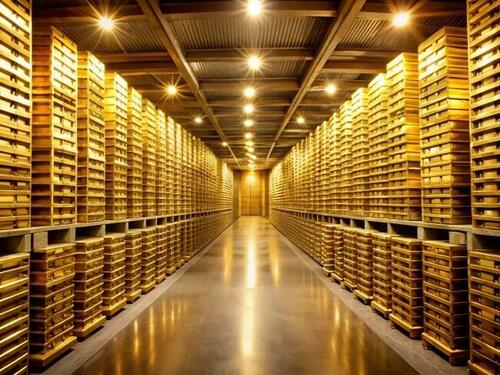
Fort Knox Gold Impurity Revelations: A Crack in U.S. Financial Credibility?
Revelations of impure gold at Fort Knox, with only 17% meeting international purity standards, expose vulnerabilities in U.S. financial reserves. This could erode global trust in the dollar, accelerate de-dollarization, and prompt a reevaluation of precious metals standards, amid historical opacity and geopolitical shifts.
Recent reports about the impurity of gold reserves at Fort Knox, as highlighted by Jp Cortez via The Mises Institute, reveal a startling reality: a significant portion of the U.S. gold stockpile—approximately 83% of the bars held at Fort Knox—fails to meet modern international purity standards set by the London Bullion Market Association (LBMA), which requires a minimum fineness of 995.0 parts per thousand for 'good delivery' status. With only 17% of Fort Knox gold meeting or exceeding this threshold, the illiquidity of these reserves raises questions about the U.S.'s ability to leverage its reported 8,133.5 metric tons of gold in international transactions during a crisis. This is not merely a technical issue but a geopolitical vulnerability that could undermine trust in the U.S. dollar as the world’s reserve currency, especially as global financial systems increasingly scrutinize the integrity of national reserves.
The original coverage misses several critical dimensions, including the broader historical context of U.S. gold management and the geopolitical ripple effects of such revelations. Historically, the U.S. has faced skepticism about its gold reserves since the 1971 Nixon Shock, when the dollar was decoupled from the gold standard, ending the Bretton Woods system. This event already eroded international confidence in U.S. financial commitments, and the current impurity issue compounds lingering doubts about transparency. Moreover, the lack of credible audits since the 1970s—a point raised in the 2011 House Committee on Financial Services Hearing—fuels speculation about the actual state of reserves. The 1974 'audit' was little more than a public relations exercise, with no serial number verification or purity testing, as noted by Sound Money Defense League Director Matthew Cortez. This opacity contrasts sharply with actions by other nations, such as France’s recent move to repatriate and upgrade 129 tonnes of gold to higher purity standards, signaling a global trend toward stricter reserve management.
What the original story also overlooks is the potential impact on international monetary policy and alliances. As countries like China and Russia increase their gold holdings—China’s reserves grew by 225 tonnes in 2022 alone, according to the World Gold Council—they position themselves as alternatives to U.S.-centric financial systems. The impurity of U.S. gold could accelerate de-dollarization efforts, especially if nations perceive American reserves as unreliable for settlements. This ties into a broader pattern of declining trust in U.S. financial hegemony, evident in initiatives like the BRICS alliance’s exploration of a gold-backed currency, as reported in 2023 discussions at the Johannesburg Summit. If Fort Knox’s gold is deemed unfit for international trade, the U.S. may face pressure to either refine its reserves or risk losing leverage in global markets.
Additionally, the statutory valuation of U.S. gold at $42.22 per ounce—unchanged since 1973—creates a disconnect with market realities, where gold trades above $2,000 per ounce as of late 2023. This outdated pricing mechanism, while not directly tied to purity, amplifies perceptions of mismanagement. A modernized valuation could signal intent to align with global standards, yet no such policy shift has emerged, further eroding confidence. The original coverage fails to connect this to the larger question of whether the U.S. is prepared for a potential return to gold-backed financial mechanisms, a debate gaining traction amid inflation fears and currency volatility.
In synthesizing these insights with primary and related sources, it becomes clear that the Fort Knox impurity issue is not an isolated problem but a symptom of systemic neglect in U.S. reserve management. The 2011 House Committee Hearing documents reveal the extent of impurity, while the World Gold Council’s 2023 reports on global reserve trends underscore how other nations are prioritizing quality and transparency. The U.S. risks falling behind if it does not address both the physical state of its gold and the trust deficit it has accrued over decades. This situation could prompt a reevaluation of global precious metals standards, potentially led by non-Western powers, reshaping the financial landscape in ways the original story does not anticipate.
MERIDIAN: The impurity of Fort Knox gold may push nations toward alternative reserve systems, potentially hastening a shift to gold-backed currencies among BRICS countries within the next 5-10 years.
Sources (3)
- [1]House Committee on Financial Services Hearing, 2011 - Gold Reserve Transparency(https://www.govinfo.gov/content/pkg/CHRG-112hhrg67189/html/CHRG-112hhrg67189.htm)
- [2]World Gold Council - Gold Reserves and Demand Trends 2023(https://www.gold.org/goldhub/research/gold-demand-trends-2023)
- [3]Original Source: Ft. Knox Full Of Impure Gold Unfit For International Transactions(https://www.zerohedge.com/precious-metals/ft-knox-full-impure-gold-unfit-international-transactions)