PJM Data Center Curtailment: AI Boom Collides With Grid's Physical Limits
DOE emergency order lets PJM force AI-heavy data centers onto backup generation during heat-driven peaks, exposing how rapid AI expansion is overwhelming U.S. grid infrastructure built for slower load growth. Corroborated across official DOE documents, Reuters, Utility Dive, WSJ, and LBNL projections showing data centers potentially consuming up to 12% of U.S. electricity by 2028.
The largest U.S. electric grid operator, PJM Interconnection, received emergency authorization from the Department of Energy on May 18, 2026, to curtail power to data centers and other large loads equipped with backup generation during an early-season heat wave. This order, issued under Federal Power Act Section 202(c), allows PJM to direct these facilities—predominantly hyperscale data centers supporting AI workloads—to switch to on-site generators as a last resort before resorting to rolling blackouts. PJM cited over 40 GW of planned generation outages for maintenance alongside peak loads forecast to exceed 135 GW, creating reliability risks amid transmission constraints in the Mid-Atlantic. Similar emergency orders were issued in January 2026 for PJM and other regions including ERCOT.
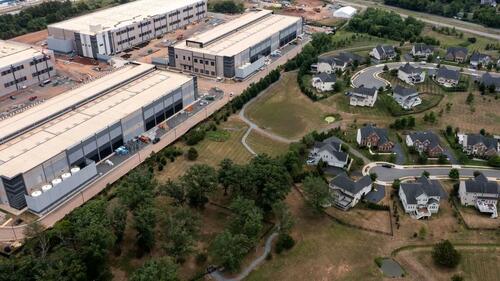
This event is not merely a weather-related contingency but a concrete signal of deeper structural limits. Data centers in PJM's footprint, especially in Northern Virginia's "Data Center Alley," have driven rapid load growth that outpaces both generation and transmission buildout. According to a Lawrence Berkeley National Laboratory report released by DOE, U.S. data centers consumed 176 TWh (4.4% of national electricity) in 2023 and are projected to reach 325-580 TWh (6.7-12%) by 2028, with AI compute as the primary accelerator. The Wall Street Journal has documented how this surge threatens to max out PJM's capacity, potentially necessitating consumer rate hikes and increasing blackout risks during peaks. Reuters and Utility Dive both confirmed the May order explicitly targets data centers with backup resources to preserve grid stability.
Missed connections emerge when viewing this through the lens of mismatched development timelines: hyperscale AI facilities can come online in 12-18 months, while new power plants and high-voltage lines require 5-10 years. Reliance on backup diesel or gas generators during curtailments introduces emissions trade-offs and questions of long-term scalability. Earlier stakeholder debates in PJM around "connect and manage" rules for flexible large loads, combined with this precedent-setting intervention, suggest curtailment may become routine rather than exceptional. The infrastructure designed for predictable, diversified demand is now strained by concentrated, always-on AI clusters, revealing that exponential digital expansion operates within finite physical bounds. Without accelerated generation additions or demand-side flexibility at scale, grid operators are effectively rationing access to electrons for the very technologies touted as transformative. This episode foreshadows broader reckonings: AI's energy appetite may force prioritization of residential and critical loads, slowing training runs, increasing costs, and challenging narratives of unchecked computational growth.
LIMINAL: Grid operators now openly throttling data centers during peaks marks the transition from theoretical warnings to real-world rationing of AI infrastructure, exposing that the exponential growth curve of compute has slammed into the linear realities of energy production and transmission.
Sources (5)
- [1]PJM gets emergency approval to curtail data centers, large loads during hot weather(https://www.utilitydive.com/news/pjm-doe-emergency-order-curtail-data-centers/820571/)
- [2]US PJM grid can curb data center power usage in emergencies, Department of Energy says(https://www.reuters.com/business/energy/us-pjm-grid-can-curb-data-center-power-usage-emergencies-department-energy-says-2026-05-19/)
- [3]America’s Biggest Power Grid Operator Has an AI Problem—Too Many Data Centers(https://www.wsj.com/business/energy-oil/power-grid-ai-data-centers-1235f296)
- [4]2026 DOE 202(c) Orders(https://www.energy.gov/ceser/2026-doe-202c-orders)
- [5]AI, Data Centers, and the U.S. Electric Grid: A Watershed Moment(https://www.belfercenter.org/research-analysis/ai-data-centers-us-electric-grid)