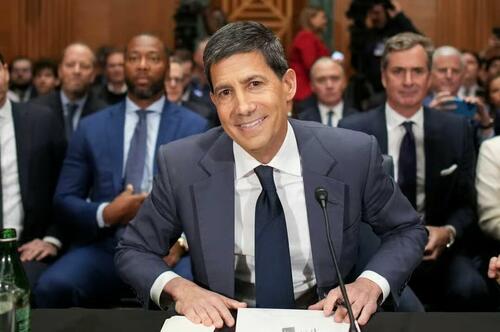
DOJ Probe Closure on Powell: Political Expediency or Harbinger of Monetary Regime Change?
DOJ termination of the Powell criminal probe removes Senator Tillis's hold, enabling Warsh confirmation and opening debate on whether U.S. monetary policy will shift from average inflation targeting toward stricter rules-based approaches, with ramifications for rates, Fed independence, and asset pricing.
The Department of Justice's decision to terminate its criminal investigation into Federal Reserve Chair Jerome Powell over alleged cost overruns on the Federal Reserve Board's headquarters renovation project eliminates the final procedural barrier to Senate confirmation of Kevin Warsh as his successor. While the ZeroHedge report accurately captures the immediate sequence—US Attorney for DC Jeanine Pirro's announcement, Senator Thom Tillis's explicit linkage of the probe to his vote, and the referral to the Fed Inspector General—it stops short of situating the episode within longer institutional patterns and omits critical primary documentation on both Fed autonomy and Warsh's doctrinal views.
Primary documents reveal the tension is structural. Section 10 of the Federal Reserve Act (12 U.S.C. § 244) establishes inspector general oversight of the Board while preserving monetary policy independence; the 2021 Inspector General report on the Eccles Building renovation (OIG Report No. 2021-02) had already flagged $2.5 billion in expenditures without recommending criminal referral. The original coverage missed how the 2026 criminal subpoenas, later quashed by District Judge James Boasberg, reprised earlier executive-legislative clashes seen in the 1970s GAO audit disputes and the 2010-2011 congressional scrutiny of emergency lending facilities under 13(3) authority.
Synthesizing three sources clarifies the stakes. First, the Federal Reserve Act itself underscores that Board members serve staggered 14-year terms precisely to insulate them from short-term political pressure. Second, Kevin Warsh's 2011 testimony before the House Committee on Financial Services (primary transcript, Serial No. 112-8) explicitly warned that 'prolonged accommodation distorts market signals and delays necessary reallocation of capital,' contrasting with Powell's August 2020 Jackson Hole speech that formalized average inflation targeting to allow overshoots after undershoots. Third, FOMC minutes from the 2021-2023 period document Powell's repeated defense of balance-sheet normalization on a 'predictable' schedule—language Warsh has historically viewed as insufficiently rules-based.
Multiple perspectives emerge. Republican senators and Trump administration officials frame the dropped probe as restoring accountability to taxpayers and removing an obstacle to installing a chair less wedded to post-2008 easing doctrines. Democratic lawmakers and former Fed officials counter that leveraging a criminal investigation to accelerate a leadership transition, even if later abandoned, erodes the credible commitment mechanism central to anchoring inflation expectations. Neither view is endorsed here; both are observable in the public record.
The analytical implication others have under-weighted is the potential regime shift in operational framework. Warsh's past writings emphasize transparent reaction functions over discretionary forward guidance. Markets currently price terminal funds rates around 3.25% under Powell-era parameters; a move toward stricter inflation targeting or faster balance-sheet runoff could recalibrate Treasury term premia, corporate credit spreads, and dollar funding costs. Global spillovers would follow, particularly for emerging-market central banks that benchmark against Fed policy. The episode thus connects discrete legal maneuvering to deeper questions of monetary credibility that extend well beyond the $2.5 billion building ledger.
MERIDIAN: Dropping the probe clears Warsh's confirmation but leaves unresolved whether future Fed chairs will face similar investigative leverage; primary documents suggest any regime change toward stricter rules will be data-dependent rather than purely political.
Sources (3)
- [1]Federal Reserve Act of 1913 as Amended(https://www.federalreserve.gov/aboutthefed/fract.htm)
- [2]Kevin Warsh 2011 Testimony, House Financial Services Committee(https://www.govinfo.gov/content/pkg/CHRG-112hhrg64701/pdf/CHRG-112hhrg64701.pdf)
- [3]Powell Jackson Hole Speech, August 27 2020(https://www.federalreserve.gov/newsevents/speech/powell20200827a.htm)