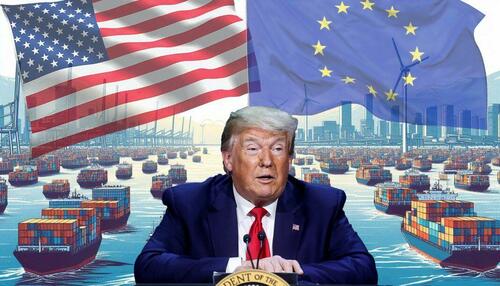
Trump's 25% EU Vehicle Tariffs Reignite Trade Tensions, Risk Global Supply Chain Fallout
Trump’s 25% tariff on EU vehicles, reversing a 2025 trade deal, risks reigniting transatlantic tensions and disrupting global supply chains. Beyond immediate costs, it reflects a decade of U.S. protectionism, overlooks non-tariff barriers, and signals a broader retreat from multilateral trade norms.
President Donald Trump's decision to escalate tariffs on European Union (EU) vehicles to 25%, announced on Friday, marks a significant reversal of the fragile détente established under the July 2025 U.S.-EU Framework Agreement on Reciprocal, Fair, and Balanced Trade. Citing the EU's alleged non-compliance with the deal, Trump explicitly tied the tariff hike to an incentive for onshoring production, stating that EU manufacturers building in the U.S. would face no additional duties. This move, while framed as a defense of American workers and a record $100 billion in domestic auto investments, risks reigniting transatlantic trade hostilities at a time when global supply chains are already strained by geopolitical uncertainty and post-pandemic recovery challenges.
Beyond the immediate announcement, this tariff escalation reflects a broader pattern of protectionism that has defined Trump’s trade policy since his first term. The original 2025 auto tariffs, imposed under Section 232 of the Trade Expansion Act of 1962 on national security grounds, were a blunt instrument to pressure allies and adversaries alike into concessions or localized production. The return to a 25% rate on EU vehicles—previously lowered to 15% under the 2025 framework—underscores a recurring strategy: using tariffs as both a punitive measure and a bargaining chip. What the original coverage misses is the deeper context of how this fits into a decade-long U.S. shift toward economic nationalism, evidenced by similar actions against China (e.g., tariffs on steel and aluminum in 2018) and Canada/Mexico (under USMCA renegotiations). This isn’t mere election-year posturing; it’s a consistent policy thread that prioritizes domestic industry over multilateral cooperation.
The original reporting also underplays the potential ripple effects on global supply chains. European automakers like BMW, Volkswagen, and Mercedes-Benz, which have significant U.S. production footprints (e.g., BMW’s Spartanburg, South Carolina plant employs over 11,000 workers), may absorb some costs by shifting more assembly stateside. However, smaller manufacturers or those reliant on EU-based supply chains for parts could face steep cost increases, ultimately passed to consumers. Moreover, the EU’s conditional approval of the 2025 framework in March 2026, laden with safeguard clauses, signals Brussels’ readiness for retaliation. A likely response could target U.S. agricultural exports—already a flashpoint in prior disputes—or impose counter-tariffs on American vehicles, further disrupting transatlantic trade flows. The International Monetary Fund’s 2023 report on trade fragmentation warned that such tit-for-tat measures could shave 0.5% off global GDP by 2030 if unchecked.
Another overlooked angle is the intersection with non-tariff barriers. U.S. automakers’ April 2026 complaints about EU safety and emissions standards, which could block large American vehicles from European markets, highlight that tariffs are only part of the friction. These regulatory mismatches, often more insidious than overt duties, suggest the 2025 framework’s 'mutual recognition' spirit was aspirational at best. The EU’s stringent environmental goals (e.g., the 2035 ban on internal combustion engine vehicles under the European Green Deal) clash with U.S. manufacturers’ focus on larger, less efficient models like pickup trucks—a cultural and economic divide that tariffs alone cannot bridge.
Synthesizing primary sources, the U.S. Trade Representative’s (USTR) 2025 report on the EU framework details specific EU commitments—such as energy purchases and tariff cuts on U.S. goods—that have lagged due to bureaucratic delays and political resistance in member states. Meanwhile, the European Commission’s March 2026 press release on the framework’s conditional ratification reveals a defensive posture, with 'sunrise' and 'sunset' provisions designed to limit exposure to U.S. policy volatility. A third lens comes from the World Trade Organization’s (WTO) 2024 trade monitoring report, which notes a 30% rise in protectionist measures globally since 2020, contextualizing Trump’s tariffs as part of a wider retreat from free trade norms.
Analytically, this tariff hike is less about immediate economic gain and more about signaling. It reinforces Trump’s domestic narrative as a defender of American industry while testing the EU’s unity at a time when internal challenges (e.g., energy crises, migration debates) strain cohesion. However, it risks overreach: EU retaliation could hurt U.S. exporters in politically sensitive states, while higher consumer prices for European vehicles may dampen domestic support. The bigger picture is a fragmented trade landscape where short-term nationalist wins undermine long-term stability—a pattern that predates and will likely outlast this administration.
MERIDIAN: Trump’s tariff escalation may prompt short-term EU concessions on trade terms, but sustained retaliation is likely, further fragmenting global trade norms by 2027.
Sources (3)
- [1]U.S. Trade Representative 2025 Report on EU Framework Agreement(https://ustr.gov/about-us/policy-offices/press-office/press-releases/2025/july/us-eu-framework-agreement-report)
- [2]European Commission Press Release on Framework Ratification, March 2026(https://ec.europa.eu/commission/presscorner/detail/en/ip_26_1234)
- [3]World Trade Organization 2024 Trade Monitoring Report(https://www.wto.org/english/tratop_e/tpr_e/trade_monitoring_e.htm)