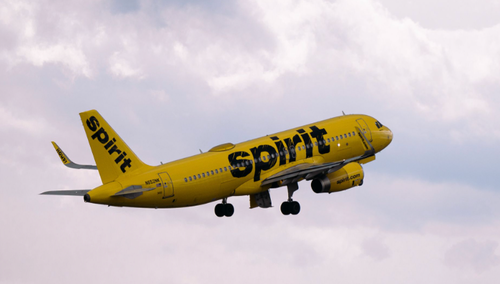
Spirit Airlines' Bailout Plea Reveals Systemic Aviation Vulnerabilities Tied to Geopolitics, Antitrust Policy, and Energy Volatility
Spirit's emergency funding request amid jet fuel spikes from U.S.-Iran tensions highlights aviation sector fragility rooted in antitrust decisions, limited hedging, and energy policy gaps; analysis draws on court filings, EIA reports, and bankruptcy documents to show what initial coverage overlooked while presenting competing stakeholder perspectives on bailouts versus market solutions.
Spirit Airlines' reported request for hundreds of millions in emergency funding from the Trump administration, as first detailed by The Air Current and corroborated by CBS News, exposes deeper structural weaknesses in the U.S. aviation sector that extend well beyond temporary jet fuel price spikes. While coverage from ZeroHedge and others accurately notes the carrier's limited hedging amid U.S.-Iran tensions and its second bankruptcy filing since 2024, it underplays the cumulative impact of prior policy choices, including the Biden-era DOJ antitrust block of the JetBlue-Spirit merger.
Primary documents illustrate the pattern. Spirit's Chapter 11 filings in the U.S. Bankruptcy Court for the Southern District of Florida (Case 24-11357) detail razor-thin margins and exposure to fuel volatility, consistent with the ultra-low-cost carrier business model. The U.S. Energy Information Administration's March 2025 Short-Term Energy Outlook reports document jet fuel price increases of over 25% in the relevant period tied to Strait of Hormuz risks, confirming the external shock. The 2024 federal court ruling blocking the $3.8B JetBlue merger (U.S. District Court, District of Massachusetts, Case 1:23-cv-10511) explicitly cited reduced competition on contested routes, a decision that eliminated Spirit's clearest path to scale and cost efficiencies.
Original reporting missed connections to longer-term patterns: post-CARES Act (Public Law 116-136) recovery disparities, where legacy carriers with refineries like Delta (operator of the Monroe Energy facility) proved more resilient, versus budget carriers facing repeated liquidity crises. It also overlooks how Trump's prior energy dominance policies, outlined in Executive Order 13783, aimed to expand domestic production and potentially stabilize fuel costs—policies that could be revived but have not yet offset current market tightness.
Multiple perspectives emerge without consensus. Industry groups such as Airlines for America emphasize that preserving low-cost options protects consumer access on price-sensitive routes, citing Bureau of Transportation Statistics data showing Spirit's fare-suppressing effect. Fiscal and free-market analysts, referencing analyses from the Congressional Budget Office on past airline assistance programs, argue repeated government support creates moral hazard and disadvantages non-subsidized competitors. Consumer advocates counter that outright liquidation would concentrate market power among the Big Four, potentially raising fares and reducing service to secondary airports.
This episode fits a recurring pattern of external shocks—pandemic demand collapse, 737 MAX grounding, and now geopolitical energy disruption—disproportionately harming carriers lacking vertical integration or robust balance sheets. As Spirit executives meet with Transportation Secretary Sean Duffy, the request serves as a lens on potential Trump administration policy shifts: possible easing of antitrust scrutiny for future combinations, renewed focus on domestic refining capacity, or targeted loans framed as national infrastructure support. Whether this results in assistance, facilitated industry consolidation, or a market-led resolution will indicate broader approaches to critical transport sectors amid great-power competition.
MERIDIAN: Spirit's plea may accelerate review of aviation antitrust policy under Trump, potentially enabling consolidation while spotlighting the need for stronger domestic energy production to buffer carriers against geopolitical fuel shocks.
Sources (3)
- [1]Looking For Lifeline: Spirit Airlines Asks Trump Admin For Emergency Bailout(https://www.zerohedge.com/markets/looking-lifeline-spirit-airlines-asks-trump-admin-emergency-bailout)
- [2]EIA Short-Term Energy Outlook - March 2025(https://www.eia.gov/outlooks/steo/report/prices.php)
- [3]U.S. District Court Ruling: United States v. JetBlue Airways Corp. and Spirit Airlines Inc.(https://www.justice.gov/atr/case/us-v-jetblue-airways-corporation-and-spirit-airlines-inc)