Strait of Hormuz Transits Signal Fragile Energy Market Dynamics Amid Middle East Tensions
The transit of two tankers through the Strait of Hormuz signals tentative energy flow restoration but masks deeper geopolitical risks. Overlooked vulnerabilities, historical disruptions, and non-state actor threats highlight persistent fragility in global oil supply chains.
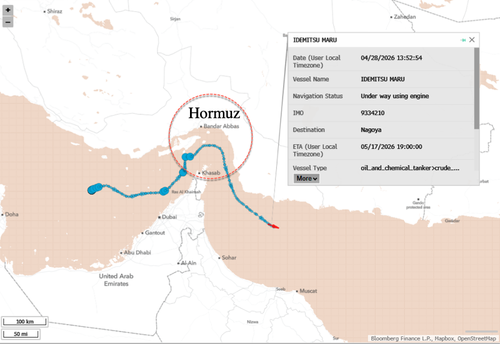
The recent transit of the Idemitsu Maru, a crude supertanker, and the Mubaraz LNG tanker through the Strait of Hormuz marks a tentative step toward restoring energy flows in a region critical to global oil supply chains. As reported by Bloomberg and highlighted in the original ZeroHedge coverage, these are the first such transits since the outbreak of conflict in the region two months ago. However, the broader geopolitical context, coupled with historical patterns of disruption in the Strait, suggests that this development is far from a definitive signal of stability. The Idemitsu Maru notably avoided the Larak Channel, a northern passage near Iran's Larak Island, which may indicate lingering concerns over Iranian naval interference or mines, a tactic used during the 1980s Tanker War. This choice of route, while not emphasized in the original coverage, underscores the persistent risks to maritime traffic despite these initial transits.
The Strait of Hormuz, through which roughly 20% of global oil supply passes, remains a geopolitical flashpoint. The original ZeroHedge article frames these transits as a 'positive signal' for Gulf energy flows, potentially tied to a U.S.-Iran peace framework. However, this optimism overlooks deeper structural vulnerabilities. For instance, the article misses the broader pattern of energy market sensitivity to Middle East tensions, as seen in the 2019 drone attacks on Saudi Arabia's Abqaiq and Khurais facilities, which temporarily halved the kingdom's oil output. Similarly, Iran's seizure of tankers in 2023 as retaliation for Western sanctions highlights how quickly the situation in Hormuz can deteriorate, even absent formal conflict. Current vessel-tracking data showing depressed activity in the Strait, as noted by UBS in the original report, further contradicts the narrative of imminent normalization.
Beyond the immediate transits, the global energy market's reliance on Hormuz exposes systemic risks that mainstream coverage often downplays in favor of short-term price movements. A 2022 report by the U.S. Energy Information Administration (EIA) underscores that any prolonged closure of the Strait could spike oil prices by $10-20 per barrel within weeks, disproportionately impacting import-dependent economies like Japan and China—the destinations of the Idemitsu Maru and Mubaraz, respectively. Moreover, alternative routes, such as Saudi Arabia's East-West Pipeline, lack the capacity to fully offset a Hormuz disruption, a limitation not addressed in the original piece. The Polymarket odds cited in ZeroHedge (14% chance of normal traffic by May 15) reflect market skepticism, aligning with historical data on the slow resolution of regional conflicts.
Another underexplored angle is the role of non-state actors and proxy conflicts in sustaining Hormuz's volatility. Houthi attacks on shipping in the nearby Red Sea, ongoing since late 2023, have already diverted significant LNG and oil traffic, adding costs and delays. While the ZeroHedge piece focuses on state-level de-escalation (e.g., U.S.-Iran talks), it neglects how groups like the Houthis, often backed by Iran, operate outside formal diplomatic channels, complicating any resolution. This gap in coverage misses a critical driver of energy market uncertainty.
In synthesizing these perspectives, the transits of Idemitsu Maru and Mubaraz are less a harbinger of stability and more a reminder of the fragile tightrope energy markets walk in the Middle East. While the original article suggests a linear path to reopening Hormuz, historical precedents and current regional dynamics—spanning state and non-state actors—point to a more cyclical pattern of disruption and uneasy recovery. Global policymakers and energy firms must brace for volatility, as the Strait's centrality to oil supply chains ensures that even minor escalations can reverberate worldwide.
MERIDIAN: The Strait of Hormuz transits are a fragile step, not a resolution. Expect intermittent disruptions as proxy conflicts and Iranian posturing continue to challenge energy market stability.
Sources (3)
- [1]First Loaded LNG Tanker Clears Hormuz; First Crude Supertanker Attempts Exit(https://www.zerohedge.com/energy/first-loaded-lng-tanker-clears-hormuz-first-crude-supertanker-attempts-exit)
- [2]World Oil Transit Chokepoints - Strait of Hormuz(https://www.eia.gov/international/analysis/special-topics/World_Oil_Transit_Chokepoints)
- [3]Houthi Attacks on Shipping in the Red Sea(https://www.reuters.com/world/middle-east/yemens-houthis-target-shipping-red-sea-2023-12-12/)