Rice Price Surge Signals Deepening Global Food Security Risks Amid El Niño and Geopolitical Strains
Corroborated 2023 rice futures rally tied to El Niño and conflicts highlights systemic food security threats, with production drops in Asia and price spikes affecting importers; deeper links to climate-geopolitical intersections and policy interventions amplify economic ripple effects.
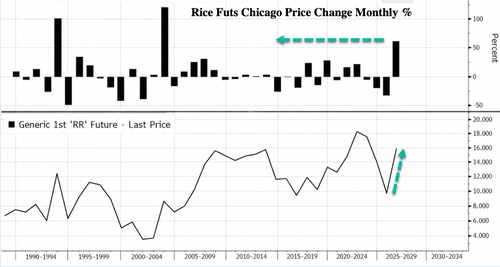
Chicago rice futures surged more than 50% in 2023, marking the largest annual gain since 2003, driven by intensifying El Niño conditions disrupting Asian production and compounded by elevated input costs from the Russia-Ukraine conflict and regional tensions. Benchmark Thai white rice prices climbed to 15-year highs, reaching $650 per ton by December 2023, as importers stockpiled amid drought fears. El Niño, which developed strongly in late 2023, reduced monsoon rainfall in India by around 13% below normal and threatened critical planting periods in Thailand, Indonesia, and the Philippines, with production forecasts showing declines of up to 6-10% in affected regions. These weather shocks overlapped with fertilizer and diesel supply disruptions, amplifying costs for net-importing nations in sub-Saharan Africa and Southeast Asia where rice comprises a dietary staple for billions. Major banks including Barclays and JPMorgan flagged elevated food-supply risks into 2024, while India's export restrictions on non-basmati rice further tightened global availability. Broader analysis reveals connections to the 2023-2024 El Niño event's documented impacts on multiple commodities, including potential yield losses across 22-24% of global harvested areas for key grains, alongside policy responses such as Thailand urging farmers to shift to drought-tolerant crops. These dynamics underscore vulnerabilities in lower-income markets, where higher prices directly fuel inflation and affordability crises, potentially exacerbating food insecurity far beyond the immediate production shortfalls.
Analyst: Persistent El Niño patterns combined with input cost volatility could sustain elevated rice prices into 2027, pressuring food inflation in import-dependent regions and prompting further export controls or crop diversification efforts.
Sources (6)
- [1]Rice Soars to Two-Year High in Asia on El Niño Drought Risks(https://www.bloomberg.com/news/articles/2023-07-11/rice-soars-to-two-year-high-in-asia-on-el-nino-drought-risks)
- [2]Rice Prices Scale Fresh 15-Year High as Supply Risks Linger(https://www.bloomberg.com/news/articles/2023-12-20/rice-prices-scale-fresh-15-year-high-as-supply-risks-flare-up)
- [3]Risks to global food prices from El Niño(https://www.ecb.europa.eu/press/economic-bulletin/focus/2023/html/ecb.ebbox202306_01~36e78cc75e.el.html)
- [4]Rice Production and Food Security in Southeast Asia under Threat from El Niño(https://www.iseas.edu.sg/articles-commentaries/iseas-perspective/2023-53-rice-production-and-food-security-in-southeast-asia-under-threat-from-el-nino-by-elyssa-ludher-and-paul-teng/)
- [5]2023–2024 El Niño event(https://en.wikipedia.org/wiki/2023%E2%80%932024_El_Ni%C3%B1o_event)
- [6]Rice prices surge to 15-year high amid demand and El Niño concerns(https://thethaiger.com/news/business/rice-prices-surge-to-15-year-high-amid-demand-and-el-nino-concerns)