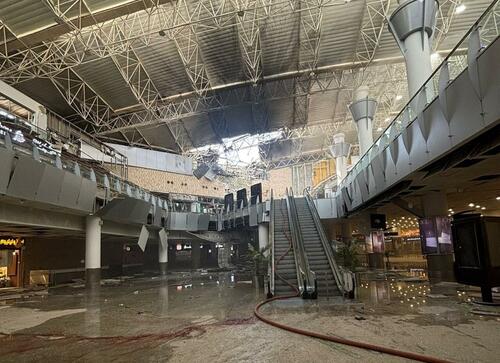
Iranian Strike on Kuwait International Airport Crosses Civilian Threshold in Rapid Middle East Escalation
Iranian drones and missiles struck Kuwait International Airport, killing 1 and injuring 63 in a mass casualty event damaging the main terminal. This fits into fast-escalating U.S.-Iran exchanges involving Hormuz interdictions and Qeshm Island strikes, highlighting spillover to Gulf civilian targets that mainstream analysis often minimizes until economic impacts emerge.
In a significant escalation that mainstream outlets have been slow to frame as a potential turning point, Iranian missiles and drones directly struck Kuwait International Airport's Terminal 1 on June 3, 2026, killing one Indian national and injuring 63 others, many seriously. Kuwaiti authorities described it as 'criminal Iranian aggression,' confirming that 13 missiles and 17 drones were engaged, with the passenger terminal sustaining severe damage that also affected nearby diplomatic missions. Hospitals performed multiple emergency surgeries in what officials called a mass casualty event. This was not an isolated incident but part of a rapid tit-for-tat following U.S. actions in the Strait of Hormuz, where American forces used a Hellfire missile to disable an Iranian-linked tanker, followed by strikes on Qeshm Island. Iran responded with barrages aimed at U.S. facilities in Bahrain and Kuwait, though many were intercepted.
What others miss is how this attack on a major international civilian hub—handling global travelers and commercial traffic—signals Iran's willingness to impose costs on Gulf Cooperation Council states for hosting U.S. bases, effectively internationalizing a conflict previously contained to direct U.S.-Iran exchanges. The GCC has condemned the strikes on civilian objects in Bahrain and Kuwait as 'unprecedented.' While initial coverage treats this as limited reprisal, the connections run deeper: disruption at Kuwait's airport, a key logistics node, combined with threats to the Strait of Hormuz (through which 20% of global oil flows), risks cascading effects on energy markets, aviation insurance, and supply chains that typically only draw attention once prices spike. Past incidents were downplayed until economic signals forced focus; this direct airport hit, killing civilians in a non-combatant nation, likely accelerates that dynamic. Iran’s IRGC framed it as a 'lesson' for the U.S. amid stalled ceasefire talks, with President Trump noting ongoing conversations even as his administration denies broader sanctions relief. Kuwait has expelled Iranian diplomats in response. This event underscores a dangerous erosion of deterrence, where proxy dynamics give way to direct state-on-state strikes on infrastructure, potentially drawing Saudi Arabia, the UAE, and others into active roles before markets fully react.
LIMINAL: Direct Iranian hit on a major Gulf civilian airport with confirmed casualties will force oil and aviation markets to rapidly reprice regional risk, pulling mainstream attention to the widening conflict and increasing odds of broader GCC involvement or emergency diplomacy within days.
Sources (5)
- [1]Iran strikes Kuwait’s main airport and kills 1 as ceasefire is tested again(https://apnews.com/article/iran-us-israel-lebanon-war-kuwait-ceasefire-3-june-2026-de2d1814c0f38252bf0383be859c870b)
- [2]One killed and dozens injured in Iranian drone strikes on Kuwait airport(https://www.bbc.com/news/articles/c5yx135yg53o)
- [3]Iranian drone attack kills one in Kuwait after US strikes(https://www.aljazeera.com/news/2026/6/3/iranian-drone-hits-kuwaits-main-airport-after-us-strikes-qeshm-island)
- [4]Iran War Live Updates: Kuwait Says One Killed and Dozens Injured in Iranian Attack on Airport(https://www.nytimes.com/live/2026/06/03/world/iran-war-trump-israel-lebanon)
- [5]Kuwait says one killed in Iranian missile, drone attack(https://www.arabnews.com/node/2645832/middle-east)