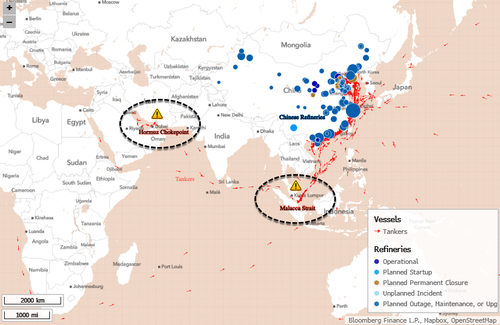
Trump's Hormuz Threat and China's Malacca Dilemma: Energy Chokepoints as Levers in US-China Strategic Competition
Trump's Hormuz blockade threat highlights China's oil import chokepoints but overlooks post-2022 Russian pipeline diversification, Beijing's naval and reserve mitigation efforts, and reciprocal global oil price risks that complicate unilateral leverage.
The ZeroHedge analysis correctly maps Beijing's exposure across the Strait of Hormuz, Malacca, Singapore, Lombok-Makassar, Sunda, and Bab el-Mandeb, citing Bloomberg AIS tanker data and Zoltan Pozsar's observation that the Trump administration is assembling a 'portfolio of assets' centered on energy nodes to generate leverage before any Trump-Xi meeting. Yet this framing understates structural shifts in China's import profile and overstates the simplicity of blockade leverage.
Primary data from the U.S. Energy Information Administration's China Country Analysis Brief (last updated October 2024) shows China imported roughly 11.2 million barrels per day of crude in 2023, with about 42% still originating from the Persian Gulf. However, Russian volumes have climbed to 23% since the 2022 Ukraine conflict, much of it delivered via the ESPO pipeline and rail routes that physically bypass both Hormuz and Malacca. This diversification, omitted in the original piece, materially dilutes the 'Malacca Dilemma' Hu Jintao first flagged in 2003.
The piece also gives insufficient weight to China's deliberate mitigation efforts documented in official PRC white papers. The 2019 China's National Defense in the New Era white paper and the 2023 update explicitly identify securing sea lines of communication as a core PLA Navy mission, driving investment in carrier battlegroups, overseas logistics points, and strategic petroleum reserves now covering an estimated 90-100 days of imports according to IEA assessments.
Historical patterns further contextualize the threat. Tanker incidents near Hormuz in 2019, declassified U.S. Central Command reports, and Iranian responses demonstrated how even limited disruptions produce asymmetric oil price spikes that harm U.S. allies and global markets alike. The 1990-91 Gulf crisis and 1973 embargo, per contemporaneous OPEC and IEA archives, illustrate how chokepoint leverage rarely remains unidirectional.
Multiple perspectives emerge from primary documents. U.S. Department of Defense annual reports to Congress on Chinese military power (2023 and 2024 editions) portray China's naval modernization as designed to contest U.S. freedom of navigation and protect energy imports. Chinese Ministry of Foreign Affairs statements and Xi Jinping speeches at the 2022 and 2023 Central Economic Work Conferences characterize such U.S. moves as hegemonic containment that justifies accelerated energy transition and Belt and Road overland corridors through Myanmar and Pakistan. Independent analysts note that sustained Hormuz disruption could remove nearly 20% of global daily supply, per IEA emergency response scenarios, triggering price shocks exceeding $150 per barrel and complicating inflation fights on both sides of the Pacific.
The original coverage therefore misses the reciprocal vulnerabilities: U.S. pressure on maritime energy flows simultaneously elevates global oil-market risk, incentivizes faster Sino-Russian energy integration, and accelerates Beijing's renewable and stockpiling programs. In the larger pattern of US-China rivalry, control of maritime chokepoints remains real but is increasingly checked by overland alternatives, strategic reserves, and the mutual economic costs that neither primary power can fully externalize.
MERIDIAN: Trump's Hormuz signaling aims to exploit China's sea-lane dependence but is tempered by Beijing's Russian pipeline gains and SPR build-up; sustained pressure risks oil shocks exceeding $150/barrel that would hit U.S. allies and domestic inflation equally.
Sources (3)
- [1]Here's Why Trump's Hormuz Blockade Should Stoke 'Strait Chaos' For China(https://www.zerohedge.com/commodities/heres-why-trumps-hormuz-blockade-should-stoke-strait-chaos-china)
- [2]China Country Analysis Brief(https://www.eia.gov/international/analysis/country/CHN)
- [3]2024 Annual Report to Congress: Military and Security Developments Involving the People's Republic of China(https://media.defense.gov/2024/Dec/18/2003600000/-1/-1/1/2024-MILITARY-AND-SECURITY-DEVELOPMENTS-INVOLVING-THE-PEOPLES-REPUBLIC-OF-CHINA.PDF)