Russia's Temporary Diesel Export Ban Tightens Global Fuel Supplies Amid Refinery Attacks
Russia's July 8 diesel export ban, confirmed by Novak and reported across Reuters, Bloomberg, and Xinhua, responds to refinery damage from Ukrainian strikes. It risks amplifying global diesel price pressures and supply constraints beyond domestic needs.
On July 8, 2026, Russia imposed a ban on diesel fuel exports until July 31 to bolster domestic supplies strained by Ukrainian drone strikes on its oil refineries. Deputy Prime Minister Alexander Novak announced the measure during a government meeting with President Vladimir Putin, stating it would increase domestic availability while Russia begins importing petroleum products in July. The policy applies to producers and extends existing restrictions on gasoline and jet fuel exports.[1][2]
The move follows intensified Ukrainian attacks that have pushed Russia's crude processing rates to multi-year lows, forcing some regions into fuel rationing and driving up pump prices. Russia's diesel exports had already fallen sharply, averaging around 490,000 barrels per day in early June—roughly half the 2025 levels—according to Vortexa data via Bloomberg. Last year, Russia supplied about 11% of global diesel.[3]
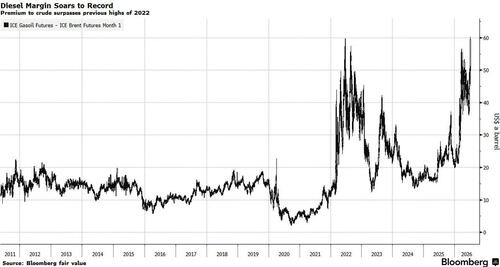
Mainstream coverage emphasizes the domestic crisis and geopolitical backdrop, yet the ban's timing amplifies existing market pressures from Middle East disruptions. Diesel margins had already hit record highs, decoupling from crude prices. With Russia redirecting volumes inward and potentially importing, global middle distillate markets—particularly in Europe—face tighter supply heading into seasonal demand. US refined product exports, including diesel, recently surged to records, hinting at compensatory flows, but analysts note the removal of Russian barrels could sustain elevated prices and feed into broader inflation dynamics often framed abstractly in reporting.[4]
Earlier discussions in June had weighed the ban amid mounting shortages, with Novak initially signaling it was under consideration alongside tax adjustments and production ramps. The decision marks a shift toward stricter controls to stabilize the market.
[Market Analyst]: The ban will likely sustain elevated global diesel margins into late summer, with direct pass-through to transport costs and inflation metrics in import-dependent regions, amplifying effects from concurrent supply shocks.
Sources (5)
- [1]Russia bans diesel exports to ensure domestic supply after targeted Ukrainian drone strikes(https://www.reuters.com/business/energy/russia-bans-diesel-exports-increase-domestic-supply-says-deputy-pm-2026-07-08/)
- [2]Russia bans diesel fuel exports(https://english.news.cn/20260709/897915781bda4dd297394cff52e1ec1c/c.html)
- [3]Russia weighs diesel export ban to steady fuel market, deputy PM says(https://www.reuters.com/business/energy/russia-weighs-diesel-export-ban-steady-fuel-market-deputy-pm-says-2026-06-23/)
- [4]Russia Considers Diesel-Export Ban on Ukraine Refinery Attacks(https://www.bloomberg.com/news/articles/2026-06-23/russia-considers-diesel-export-ban-on-ukraine-refinery-attacks)
- [5]Russian Government Weighs Total Ban on Diesel Exports(https://www.themoscowtimes.com/2026/06/24/russian-government-weighs-total-ban-on-diesel-exports-a93086)