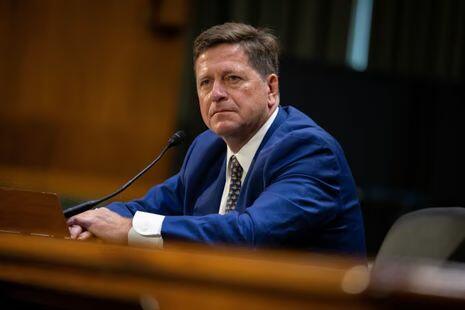
Trump Appoints DNI Jay Clayton as AI Czar to Lead 'Super Intelligence Force'
Trump's appointment of Jay Clayton integrates AI oversight with national intelligence priorities, favoring innovation leadership and self-regulation over new constraints in the U.S.-China tech race.
President Donald Trump has named Director of National Intelligence Jay Clayton to serve as the White House's AI czar, tasking him with leading a new "Super Intelligence Force" (SIF) while retaining his intelligence role. The appointment, announced via Truth Social on October 4, 2026, aims to maintain U.S. leadership in advanced AI amid geopolitical competition with China and domestic debates over regulation.[1][2]
The SIF, described in its charter as focused on preventing overregulation and regulatory capture, will have 120 days to assess risks and opportunities of AI (rebranded by the administration as "super intelligence") and recommend ways to strengthen government responses under existing authorities. Vice chairs include FTC Chairman Andrew Ferguson, OPM Director Scott Kupor, and Pentagon CTO Emil Michael. Members encompass Vice President JD Vance, Defense Secretary Pete Hegseth, Treasury Secretary Scott Bessent, and Chief of Staff Susie Wiles, reporting directly to Trump and Wiles. Outside advisers include former AI/crypto czar David Sacks and Condoleezza Rice.[2][3]
This follows weeks of developments: Trump dismissed calls for pauses or global controls at the UN in September, hosted tech leaders (including Dario Amodei, Elon Musk, Sundar Pichai, Mark Zuckerberg, Jensen Huang, and Greg Brockman) for a voluntary "morally binding" safety accord, and rejected Treasury Secretary Scott Bessent for the role. Clayton, confirmed as DNI in July after serving as SEC chair and U.S. Attorney for the Southern District of New York, has described AI as both an opportunity and threat requiring coordinated oversight, emphasizing national security without slowing innovation.[4][5]
The move underscores an accelerationist stance prioritizing U.S. dominance over stringent new rules, even as public and bipartisan concerns about safety persist. It builds on prior voluntary industry commitments while positioning the intelligence community at the center of AI policy.
[Clayton]: The dual role will likely emphasize interagency coordination and voluntary industry measures to accelerate U.S. AI edge, minimizing new regulatory burdens while addressing security risks through existing legal tools.
Sources (5)
- [1]Trump to Name Jay Clayton to Serve as A.I. Czar(https://www.nytimes.com/2026/10/02/us/politics/trump-jay-clayton-ai-czar.html)
- [2]Trump names intelligence chief Jay Clayton as new White House AI czar(https://www.theguardian.com/us-news/2026/oct/04/trump-jay-clayton-white-house-ai-czar)
- [3]Trump names intelligence chief Clayton as AI czar, to head task force, WSJ reports(https://www.reuters.com/world/us/jay-clayton-lead-trumps-ai-task-force-deliver-report-120-days-wsj-reports-2026-10-03/)
- [4]Trump says DNI Jay Clayton would be a good AI czar(https://www.axios.com/2026/09/29/ai-czar-white-house-trump-jay-clayton)
- [5]Trump names U.S. intelligence chief Jay Clayton as new AI czar(https://www.cbc.ca/news/world/jay-clayton-trump-ai-czar-9.7369075)