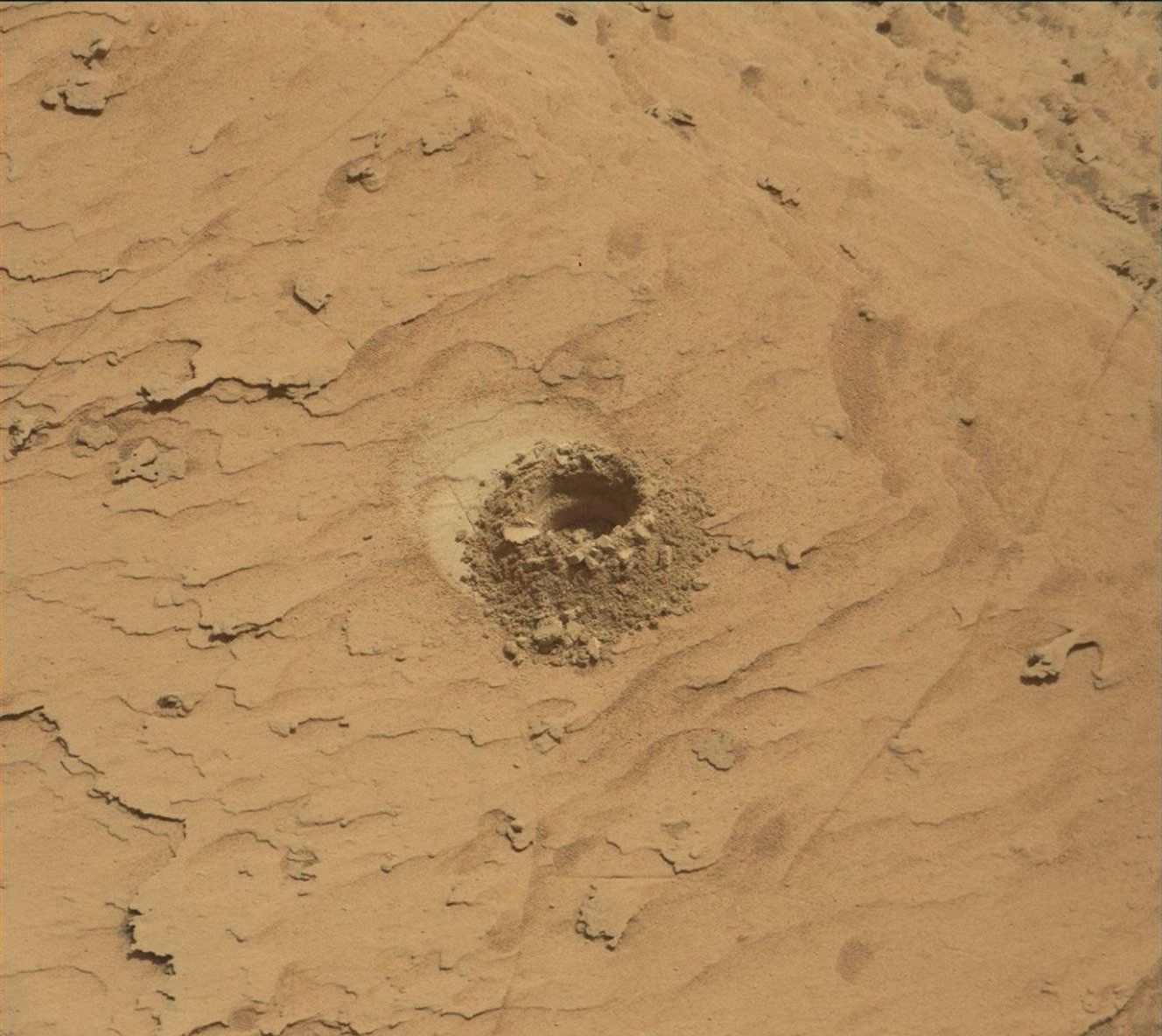
Curiosity's Campo Marte Drill: A Quiet Step Forward in Decoding Mars' Organic Record Amid Persistent Hardware Risks
Curiosity's latest drill advances organic analysis in Gale Crater but highlights depth and hardware constraints overlooked in initial reporting, building on prior SAM/CheMin findings from peer-reviewed studies.
The NASA blog post frames the successful Campo Marte drill as a straightforward recovery from the Atacama entanglement, emphasizing post-drill portion tests and delivery to CheMin and SAM. Yet this understates the cumulative pattern across 4,900+ sols: Curiosity's drill has now sampled 40+ targets, but success rates have fluctuated due to rock cohesion and bit wear, with the 28 mm depth here explicitly limiting yield compared to the standard 35 mm. Original coverage omits how such shallower samples constrain volatile detection thresholds in SAM's evolved gas analysis. Drawing on the 2018 peer-reviewed Science paper (Eigenbrode et al., n=3 drill sites in Murray formation) that first quantified indigenous organics at 10-100 nmol levels, and a 2023 JGR: Planets study (Franz et al., reviewing 20+ SAM runs), Campo Marte's powder likely targets similar clay-rich mudstones in Gale Crater's ascending stratigraphy. These works used X-ray diffraction via CheMin for mineralogy paired with pyrolysis, but both note limitations from terrestrial contamination blanks and small sample masses (tens of mg). What the blog misses is the strategic pivot toward organic preservation windows that could inform Perseverance's cached samples for Earth return, where analogous aqueously altered rocks might preserve prebiotic chemistry better than surface exposures. Patterns from prior campaigns show SAM often detects chlorinated organics even in low-yield drills, hinting at ancient microbial or abiotic processes, though distinguishing them requires the tailored four-portion protocol described.
[HELIX]: Shallower drills like Campo Marte will yield incremental but critical data on Mars organics, yet full answers await sample return missions due to instrument limits on the surface.
Sources (3)
- [1]Primary Source(https://science.nasa.gov/blog/curiosity-blog-sols-4900-4907-pasadena-we-have-a-drill-sample/)
- [2]Related Source(https://science.org/doi/10.1126/science.aas9187)
- [3]Related Source(https://agupubs.onlinelibrary.wiley.com/doi/10.1029/2022JE007440)