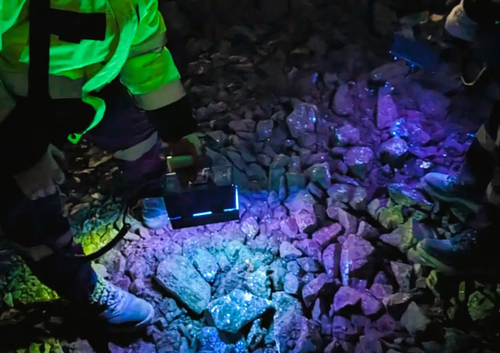
Tungsten Supply Crisis Deepens as China Tightens Export Controls and U.S. Bans Scrap Shipments
China's 2025 export controls and the U.S. 2026 tungsten scrap export ban have tightened global supply of this defense- and industry-critical metal, with Almonty's Sangdong Mine positioned as a major non-Chinese source amid surging prices and demand.
The global tungsten market faces acute supply constraints driven by China's dominance and recent policy shifts. China accounts for roughly 79-85% of world mine production (around 67,000 tonnes out of 85,000 tonnes in 2025) and controls most APT refining capacity. Starting February 2025, Beijing imposed export licensing requirements on tungsten intermediates like APT, oxides, and carbides, later restricting authorized exporters to just 15 firms for 2026-2027. This caused exports to plummet—APT shipments fell nearly 70% in 2025, with further declines into 2026—creating a firewall between Chinese domestic supply and Western markets.[1][2]
Western prices for APT CIF Rotterdam/Baltimore have stabilized near $3,000/mtu amid the tightness, while downstream users report persistent shortages. Defense, semiconductor (including WF6 for chip manufacturing), automotive, tooling, and energy sectors are all exposed, with demand projected to rise significantly due to AI infrastructure and military needs.[3][4]
In response, the Trump administration implemented a one-year ban on U.S. exports of tungsten scrap and battery black mass effective August 27, 2026, under the Defense Production Act, aiming to retain materials domestically and reduce reliance on China.[5][6]
Almonty Industries stands out as a key Western player. Its Sangdong Mine in South Korea completed Phase 1 commissioning in March 2026, targeting 2,300 tonnes per year of concentrate initially, with Phase 2 expansion in 2027 expected to double output to ~4,600 tpa—potentially supplying about 40% of non-Chinese demand. The company also operates the Panasqueira mine in Portugal.[7][8]
Broader efforts include new projects in Kazakhstan and elsewhere, though near-term gaps persist. The structural deficit underscores vulnerabilities in critical minerals supply chains amid U.S.-China decoupling.
Market Analyst: Western tungsten prices are likely to remain elevated through 2027 as new non-Chinese capacity ramps slowly, amplifying incentives for recycling, substitution, and allied supply deals.
Sources (6)
- [1]Tungsten price shock signals deeper supply crisis(https://theoregongroup.com/commodities/tungsten/tungsten-price-shock-signals-deeper-supply-crisis/)
- [2]Tungsten hardens against Chinese pressure(https://www.metaltechnews.com/story/2026/08/24/critical-minerals-alliances-2026/tungsten-hardens-against-chinese-pressure/2889.html)
- [3]Tungsten breaks records as China export curbs, military demand boost investment(https://www.reuters.com/world/asia-pacific/tungsten-breaks-records-china-export-curbs-military-demand-boost-investment-2026-04-29/)
- [4]Trump admin blocks tungsten, battery waste exports to boost US minerals supply(https://www.reuters.com/world/asia-pacific/trump-admin-blocks-tungsten-battery-waste-exports-boost-us-minerals-supply-2026-08-06/)
- [5]Phase one commissioning concludes at Almonty’s Sangdong Mine(https://www.mining-technology.com/news/phase-1-commissioning-concludes-sangdong-mine/)
- [6]Sangdong tungsten mine in South Korea returns to production after 30 years(https://www.mining.com/sangdong-tungsten-mine-in-south-korea-returns-to-production-after-30-years/)