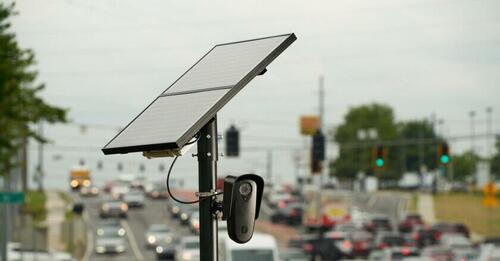
Flock Safety's Expanding Surveillance Web: From License Plates to AI-Driven Pedestrian Tracking Amid Privacy Pushback
Flock Safety's ALPR and Condor camera network has scaled rapidly to tens of thousands of units nationwide, enabling warrantless historical vehicle and pedestrian tracking; corroborated by ACLU, EFF, activist mappings, security exposures, and documented police misuse cases.
Flock Safety, an Atlanta-based company, operates a vast network of over 80,000 to 90,000 AI-powered cameras across nearly 5,000 communities in 49 states, processing billions of vehicle scans monthly. While primarily known for automated license plate readers (ALPRs) that log time-stamped vehicle data searchable for up to 30 days without warrants, the firm has expanded into video surveillance and pedestrian tracking via its Condor pan-tilt-zoom cameras, which use AI to detect and follow human movement.[1][2]
Activists like Will Freeman have mapped more than 88,000 Flock devices through DeFlock.org, revealing their pervasive placement in public spaces. Security researcher Benn Jordan exposed dozens of Condor cameras streaming live footage openly online due to configuration errors (later fixed by the company), allowing unauthorized viewing of pedestrians, playgrounds, and trails—prompting descriptions of the feeds as 'Netflix for stalkers.'[3][4]
Flock maintains its systems capture discrete events rather than continuous tracking, yet company training materials and webinars describe reconstructing suspect movements across locations and states. The ACLU and EFF have documented how the nationwide data-sharing model enables warrantless searches by thousands of agencies, raising Fourth Amendment concerns as the technology evolves beyond plates to natural-language AI searches of video, including descriptions of people and objects.[5][6]
Misuse cases underscore risks: the Institute for Justice has cataloged at least 18 instances of officers using ALPR networks, including Flock, to stalk romantic interests, with multiple arrests reported in Georgia, Kansas, and elsewhere. Critics argue audit logs alone cannot prevent such abuses in a default-log-everything architecture.[7]
While Flock claims its tools solve hundreds of thousands of crimes annually and integrate with national databases like NCIC, the rapid, low-debate rollout of this infrastructure—coupled with security lapses and feature creep—highlights tensions between public safety claims and unaccountable mass surveillance.
[Analyst]: The unchecked scaling of private-public surveillance networks like Flock's signals a shift toward default, warrantless tracking infrastructure that will normalize mass data retention and cross-jurisdictional access, likely spurring more localized bans, mapping tools, and legal challenges as privacy harms accumulate.
Sources (7)
- [1]Flock Safety(https://www.flocksafety.com/)
- [2]Flock's Aggressive Expansions Go Far Beyond Simple License Plate Reading(https://www.aclu.org/news/privacy-technology/flock-roundup)
- [3]Flock Gives Law Enforcement All Over the Country Access to Your Location Data(https://data.aclum.org/2025/10/07/flock-gives-law-enforcement-all-over-the-country-access-to-your-location/)
- [4]Flock Safety(https://en.wikipedia.org/wiki/Flock_Safety)
- [5]Flock Exposed Its AI-Powered Cameras to the Internet(https://www.404media.co/flock-exposed-its-ai-powered-cameras-to-the-internet-we-tracked-ourselves/)
- [6]Police Have Reportedly Used License Plate Readers to Stalk Romantic Interests(https://ij.org/police-have-reportedly-used-license-plate-readers-to-stalk-romantic-interests-at-least-14-times-in-recent-years/)
- [7]DeFlock: Find Nearby ALPRs(https://deflock.org/)