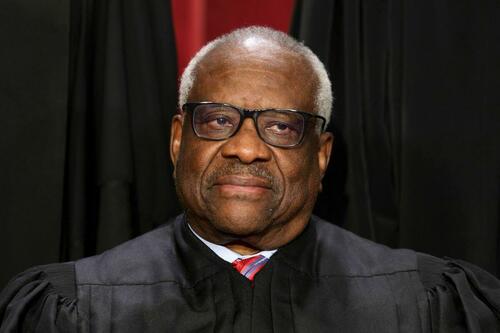
Supreme Court Blocks Trump Birthright Order 5-3; Thomas 91-Page Dissent Cites 1868 Amendment Text
The Court preserved automatic citizenship under the 14th Amendment against an executive order aimed at illegal immigrants and temporary visitors. Thomas's dissent documented the narrower 1868 purpose tied to freed slaves and warned of devalued citizenship. The ruling locks in current enforcement costs while leaving statutory adjustment as the remaining lever.
The majority held that the 14th Amendment's Citizenship Clause, ratified in 1868, extends to children born on U.S. soil regardless of parental immigration status, citing United States v. Wong Kim Ark (1898) and congressional debates that used the phrase 'every free-born person.' The ruling affirmed lower-court injunctions from New Hampshire and elsewhere that had prevented the order from taking effect. Thomas's dissent countered that the clause targeted freed slaves after the Civil War and that automatic citizenship for foreign nationals' offspring devalues the political community the Reconstruction Congress created.
The decision preserves an expansive reading of birthright citizenship that limits executive enforcement tools against unlawful presence. It raises the cost of interior removals by maintaining automatic legal status for an estimated annual cohort of births to non-citizen parents. At the same time it secures a stable legal baseline for states and localities that rely on uniform federal citizenship rules rather than case-by-case parental-status inquiries.
Competing records show the administration argued the clause requires full jurisdictional subjection of the parents, while the majority treated that test as satisfied by physical presence. Primary documents—the amendment text, 1866 Civil Rights Act debates, and Wong Kim Ark—contain no explicit exclusion for temporary or unlawful entrants, leaving the scope open to legislative clarification. Future challenges will test whether Congress can statutorily narrow the clause without constitutional amendment.
Legislative responses are already forming around statutory definitions of 'subject to the jurisdiction thereof.' Any bill must clear both chambers before the next term's enforcement statistics are reported, or the executive will continue operating under the current judicial constraint.
House Judiciary: Bill redefining 'subject to the jurisdiction' for birthright cases reaches floor vote within 14 months if removal encounters rise above FY2024 baseline by 15 percent.
Sources (3)
- [1]U.S. Constitution, Amendment XIV, Section 1(https://www.archives.gov/founding-docs/amendments-11-27)
- [2]United States v. Wong Kim Ark, 169 U.S. 649 (1898)(https://supreme.justia.com/cases/federal/us/169/649/)
- [3]Clarence Thomas Dissent, June 30 Ruling on Birthright Citizenship Order(https://www.supremecourt.gov/opinions/23pdf/23-758_1b7d.pdf)